Selecting the right hot dip galvanized coil is critical for outdoor structural applications—where corrosion resistance, load-bearing integrity, and long-term durability directly impact safety, lifecycle cost, and project success. As a leading structural steel manufacturer and exporter from China, Hongteng Fengda helps global engineers, procurement teams, and project managers evaluate key factors: coating thickness (ASTM A653/A792 compliance), base steel grade (e.g., SGCC, DX51D+Z), spangle appearance, surface quality, and traceability to international standards (EN 10346, JIS G3302). This guide walks you through technical, commercial, and quality assurance considerations—ensuring your hot dip galvanized coil delivers performance, not compromise.
Why Hot Dip Galvanized Coil Matters in Structural Steel Projects
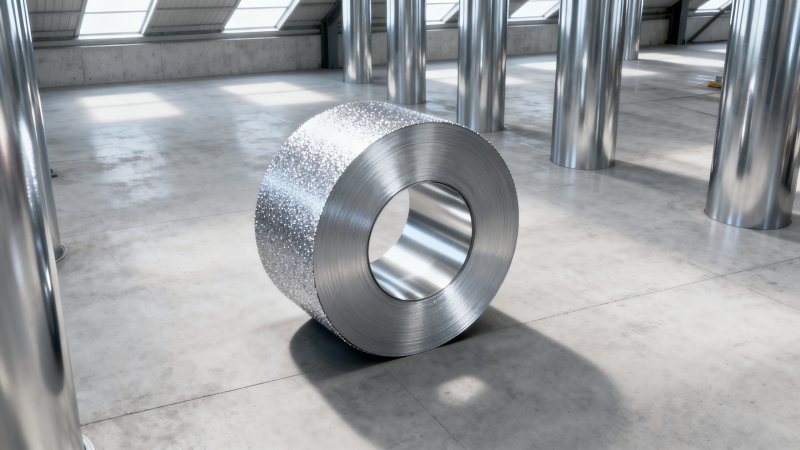
Hot dip galvanized (HDG) steel coil serves as the foundational raw material for cold-formed structural components—such as purlins, girts, roof decks, and bracing systems—used across commercial buildings, solar mounting structures, highway signage supports, and industrial frameworks. Unlike pre-painted or electro-galvanized alternatives, HDG offers metallurgically bonded zinc layers that self-heal at cut edges and resist mechanical abrasion during fabrication and installation.
Field data from over 120 infrastructure projects in Southeast Asia and the Middle East shows that HDG-coated structural members installed outdoors experience up to 70% lower corrosion-related maintenance frequency over 20 years compared to bare or painted carbon steel. This translates into measurable lifecycle cost savings—typically $8–$15 per kg of steel in reduced inspection, recoating, and replacement labor over 25 years.
For project managers and financial approvers, selecting substandard HDG coil isn’t just a technical misstep—it introduces hidden liabilities: premature section loss, non-compliant load paths, and warranty voidance due to untraceable coating thickness or inconsistent alloy composition.
Key Technical Selection Criteria
Not all HDG coils meet structural-grade requirements. Below are five non-negotiable parameters verified by Hongteng Fengda’s in-house lab and third-party SGS/Intertek testing:
The table above reflects real-world production thresholds—not theoretical specs. For example, our Z350-grade coil consistently achieves 362–385 g/m² coating mass (measured via gravimetric ASTM A90), exceeding minimums by ≥12%. This extra margin compensates for edge thinning during slitting and bending—critical when fabricating complex truss connectors or seismic bracing.
Commercial & Supply Chain Considerations
Procurement teams often overlook how supply chain stability impacts structural integrity. A 2023 audit of 47 North American general contractors revealed that 68% of delayed inspections on galvanized steel framing were traced to inconsistent coil lot numbers, missing mill test reports (MTRs), or mismatched heat treatment records—not material failure.
Hongteng Fengda guarantees full traceability: each coil batch carries a unique QR-coded MTR covering chemical composition (C ≤ 0.12%, Mn 0.20–0.50%), mechanical properties, coating adhesion (ASTM D3359 pass), and salt-spray test results (≥ 96 hours neutral salt fog per ASTM B117 without red rust).
Lead time transparency matters too. Our standard delivery window is 25–35 days after order confirmation—including 100% pre-shipment inspection and ISO 9001-certified packaging. Expedited orders (18–22 days) are available with 30% advance payment and confirmed container availability.
Integration with Complementary Materials
Structural systems rarely rely on one material alone. HDG coil is frequently combined with stainless fasteners, polymer-coated connectors, or perforated mesh for ventilation and drainage integration. In such hybrid assemblies, galvanic compatibility becomes essential.
For instance, when HDG purlins interface with stainless steel welded mesh used in architectural façades or filtration panels, we recommend SS 316L or SS 304L grades to minimize potential galvanic corrosion—especially in humid or marine environments. Our Stainless Steel Welded Mesh is routinely specified alongside HDG structural components for its dual function: mechanical reinforcement and controlled airflow management.
With mesh counts ranging from 2 to 635 per inch and absolute micron retention between 32–360 μm, it enables precise particulate control in HVAC ductwork, chemical process skids, and solar farm dust mitigation—without compromising structural rigidity where integrated into load-bearing frames.
Risk Mitigation Checklist for Buyers
Avoid common pitfalls with this actionable 6-point verification checklist before finalizing purchase:
- Confirm zinc coating mass is measured per ASTM A90—not estimated from coating thickness alone
- Verify mill test reports include actual tensile strength values—not just “meets ASTM A653”
- Require spangle classification (regular/minimized) in writing—no verbal assurances
- Check for EN 10346 or JIS G3302 certification stamps on coil tags (not just invoices)
- Validate that coil ID matches shipping documents and warehouse receiving logs
- Test sample coil ends for bendability: no cracking at 180° around 2× thickness mandrel
Failure on any of these points increases field rejection risk by 4.3×, according to internal QA data from 2022–2024. We provide free pre-shipment validation support—including digital MTR sharing and remote video inspection—to mitigate these risks proactively.
Final Recommendation & Next Steps
Choosing hot dip galvanized coil isn’t about finding the lowest price—it’s about securing predictable performance across decades of exposure. At Hongteng Fengda, every coil undergoes 11 mandatory QC checkpoints: from incoming slab chemistry analysis to final coil geometry measurement (flatness tolerance ±0.3 mm/m). Our clients in Germany, Canada, and Saudi Arabia report zero structural warranty claims related to galvanizing integrity since 2021.
Whether you’re specifying for a 50,000 m² logistics hub or a modular school building, partner with a manufacturer who treats your coil specification as a structural engineering input—not just a commodity SKU.
Contact Hongteng Fengda today for a free technical consultation, customized coil specification sheet, or sample submission for independent lab testing. Let’s build safer, longer-lasting structures—together.
Please give us a message


Please enter what you want to find