Choosing the right high-temperature steel is critical when components must withstand extreme heat, oxidation, and long-term mechanical stress. For technical evaluators, the decision goes beyond basic strength to include thermal stability, fabrication performance, and compliance with ASTM, EN, JIS, or GB standards. This guide explains how to assess material grades for harsh heat conditions while balancing reliability, cost, and project-specific performance requirements.
In steel-intensive projects, harsh heat service can mean continuous exposure above 300°C, thermal cycling between ambient and elevated temperatures, or localized hot zones in furnaces, ducts, supports, kilns, exhaust systems, and industrial enclosures. Under these conditions, a poor grade selection may lead to scaling, creep deformation, weld cracking, or short replacement cycles.
For technical evaluation teams, the best choice is rarely the highest alloy grade by default. The right decision usually comes from matching temperature range, loading pattern, atmosphere, fabrication route, and supply consistency. For buyers sourcing from China or global markets, it is also important to verify dimensional tolerance, heat treatment condition, and conformity to project standards before issuing a final purchase order.
What High-Temperature Steel Must Do in Harsh Heat Service
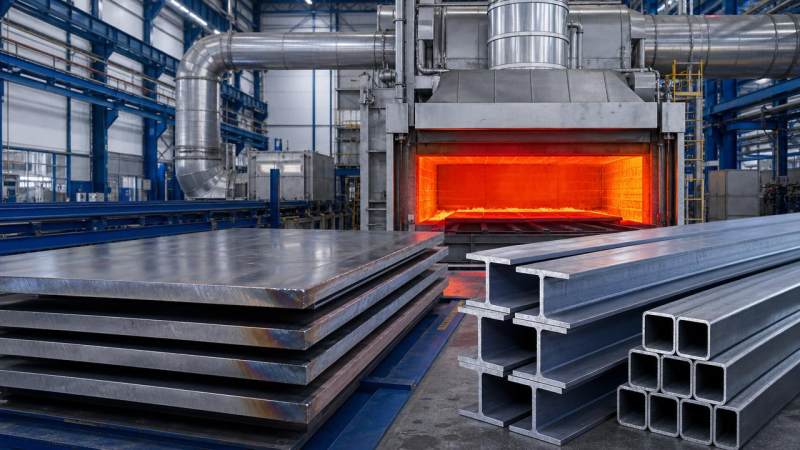
High-temperature steel is selected for more than simple tensile strength. In harsh heat environments, the material must retain usable mechanical properties, resist oxidation, and control metallurgical degradation over service periods that may extend from 5,000 to 100,000 hours, depending on duty cycle and maintenance planning.
Core performance criteria
Technical evaluators typically review 4 core criteria first: maximum service temperature, time under load, process atmosphere, and fabrication method. These 4 factors influence whether carbon steel, low-alloy heat-resistant steel, ferritic stainless steel, or austenitic heat-resistant steel is the better fit.
- Oxidation resistance at 450°C, 600°C, 800°C, or higher
- Creep strength for sustained loading over long operating periods
- Thermal fatigue resistance under repeated heating and cooling
- Weldability and post-fabrication stability
- Compatibility with ASTM, EN, JIS, or GB project specifications
Temperature alone is not enough
A component operating at 550°C for 2 hours per day behaves very differently from one exposed to 550°C continuously for 24 hours. The first case may be governed by thermal cycling and distortion. The second may be governed by creep, oxidation scale growth, and section loss over time.
Likewise, 650°C in dry air is not equivalent to 650°C in sulfur-bearing gas, water vapor, or chloride-containing exhaust. Technical assessment should therefore consider both temperature and atmosphere as a combined exposure condition.
Typical material groups for heat service
The table below helps compare common steel categories used when selecting high-temperature steel for structural and industrial applications. Exact grade choice still depends on design stress, corrosion environment, and code requirements.
The main takeaway is that high-temperature steel selection should begin with the realistic operating window, not with a broad assumption that “heat-resistant” means suitable for all hot service. In many projects, one grade may be adequate at 480°C but underperform badly at 650°C under continuous load.
How Technical Evaluators Should Assess Grade Suitability
A practical evaluation process usually works best when broken into 5 steps: define service conditions, shortlist material families, review standards, confirm fabrication compatibility, and compare life-cycle cost. This approach reduces the risk of choosing a grade based only on initial price per ton.
Step 1: Define the actual service profile
Before reviewing any quotation, confirm at least 6 technical inputs: peak temperature, continuous temperature, heating rate, cooling rate, atmosphere, and load condition. If any of these are missing, grade comparison becomes unreliable and suppliers may quote unsuitable alternatives.
- Peak operating temperature: for example 650°C
- Normal continuous temperature: for example 540°C–580°C
- Exposure mode: continuous, intermittent, or cyclic
- Environment: oxidizing, humid, sulfur-bearing, or chemically mixed
- Section thickness: thin sheet, plate, beam, channel, or fabricated component
- Mechanical demand: static support, thermal expansion load, vibration, or creep load
Step 2: Check standards and equivalency carefully
Many international projects involve ASTM, EN, JIS, and GB references in the same procurement cycle. Equivalent grades are not always identical in chemistry range, mechanical property minimums, or delivery condition. Small differences in chromium, nickel, molybdenum, or carbon can materially affect heat performance.
For example, technical teams should verify whether the quoted material is supplied in hot rolled, normalized, annealed, or solution-treated condition. In high-temperature steel applications, the starting metallurgical condition influences weld response, creep behavior, and long-term dimensional stability.
Step 3: Evaluate fabrication and joining risks
Some heat-resistant grades perform well in service but complicate welding, forming, or post-fabrication handling. Evaluators should therefore compare not just base material performance, but the full manufacturing route from cutting and drilling to welding and installation.
This becomes especially relevant when the steel is part of fabricated structural supports, housings, roof systems near hot exhaust zones, or industrial enclosures. In some auxiliary building applications, a heat-resistant coated profile may be more cost-efficient than using a higher-alloy plate across the whole assembly.
For instance, in secondary building envelopes exposed to elevated radiant heat, Colored Corrugated Roof Sheet can be considered for selected roofing or cladding applications where lightweight installation, corrosion resistance, and heat resistance above 300 degrees are relevant. Typical specifications include PPGL, thickness from 0.2mm to 1.2mm, width from 600mm to 1250mm, and service life beyond 25 years under suitable conditions.
That does not replace primary load-bearing high-temperature steel where creep and structural load dominate. However, for technical evaluators reviewing full-system design, separating load-bearing hot-zone steel from surrounding protective envelope materials can improve total project cost and simplify maintenance planning.
Decision matrix for material selection
The following matrix can be used during supplier comparison or internal review meetings. It helps turn qualitative judgments into a more repeatable decision process for harsh heat applications.
In practice, the most expensive grade on paper is not always the lowest-risk option, and the lowest quoted price is often not the most economical over a 10-year to 25-year service window. A balanced decision matrix helps prevent both over-specification and under-specification.
Common Mistakes When Choosing High-Temperature Steel
Even experienced procurement and engineering teams make recurring mistakes when reviewing harsh heat materials. Most failures can be traced to 3 issues: incomplete operating data, oversimplified grade substitution, or poor coordination between design and fabrication teams.
Mistake 1: Selecting by room-temperature properties only
A grade with strong ambient tensile values may lose a significant portion of useful strength as temperature rises. If the design review focuses only on room-temperature data sheets, the selected high-temperature steel may look acceptable on paper while underperforming in real service.
Mistake 2: Assuming “equivalent” means interchangeable
Cross-standard substitutions require caution. Similar designations under ASTM, EN, JIS, and GB may differ in chemistry windows, testing requirements, and delivery condition. One supplier’s alternative may be suitable for moderate heat, while another may fall short in creep or oxidation resistance above 600°C.
Mistake 3: Ignoring total system design
Heat service components do not operate in isolation. Supports, stiffeners, housings, fasteners, and adjacent roof or wall materials may expand at different rates. Technical evaluators should examine at least 3 system questions: where heat concentrates, where movement occurs, and where corrosion accelerates under temperature.
A more reliable review checklist
Before final approval, it is useful to confirm 6 items: service temperature range, atmosphere, load duration, welding plan, required standards, and expected maintenance interval. If one of these remains unclear, delay final material lock-in until the engineering basis is complete.
Procurement and Supply Considerations for Global Buyers
For technical evaluators working with overseas suppliers, material performance must be matched by supply reliability. This includes stable production capacity, traceable documentation, inspection consistency, and realistic lead times. In many structural and industrial projects, late delivery can be as costly as an incorrect grade choice.
What to request from a steel supplier
A qualified supplier should be able to support both standard steel products and customized fabricated solutions. Hongteng Fengda, as a structural steel manufacturer and exporter from China, supports global buyers with angle steel, channel steel, steel beams, cold formed steel profiles, and customized structural steel components aligned with ASTM, EN, JIS, and GB requirements.
- Mill test certificates and chemistry confirmation
- Dimensional tolerance details for sections or fabricated parts
- Production lead time, often 2–6 weeks depending on complexity
- Inspection scope covering visual, dimensional, and document review
- Packaging and export planning for long-distance shipment
Supplier review points for harsh heat projects
When the project requires high-temperature steel, supplier evaluation should include more than price. Ask whether the supplier understands hot-service applications, can offer grade comparison support, and can coordinate custom processing without compromising material traceability.
For fabricated structural components, consistency matters. Variations in thickness, forming quality, or welding execution can shorten service life even if the base steel grade is correct. This is particularly important for export projects where site correction may add 7–21 days of delay.
Balancing cost and service life
A useful procurement model compares initial material cost, fabrication cost, expected maintenance frequency, and replacement interval. If a higher grade extends replacement from 3 years to 8 years in a severe heat zone, the life-cycle value may justify the premium. If the exposure is only intermittent and below 450°C, a lower-alloy solution may be adequate.
This is why technical evaluators should collaborate early with purchasing, fabrication, and site teams. Good decisions come from matching the steel to actual duty, not from applying a one-grade-fits-all rule across every hot-service area.
Practical Final Guidance for Technical Evaluators
The most effective way to choose high-temperature steel for harsh heat is to evaluate 5 linked factors together: temperature, atmosphere, load, fabrication, and standards compliance. Once these are defined clearly, it becomes easier to compare material families, reject unsuitable substitutions, and control long-term project risk.
For structural, industrial, and manufacturing applications, buyers benefit from suppliers that can provide both standard sections and customized steel solutions with consistent quality control. That combination supports faster technical review, lower sourcing risk, and smoother project execution across international markets.
If you are evaluating high-temperature steel for demanding service conditions, Hongteng Fengda can support your review with structural steel product options, standard-based material coordination, and customized supply planning. Contact us to discuss your application, request technical details, or get a tailored sourcing solution for your next project.
Please give us a message


Please enter what you want to find