Why galvanized steel sheet for construction is under closer evaluation
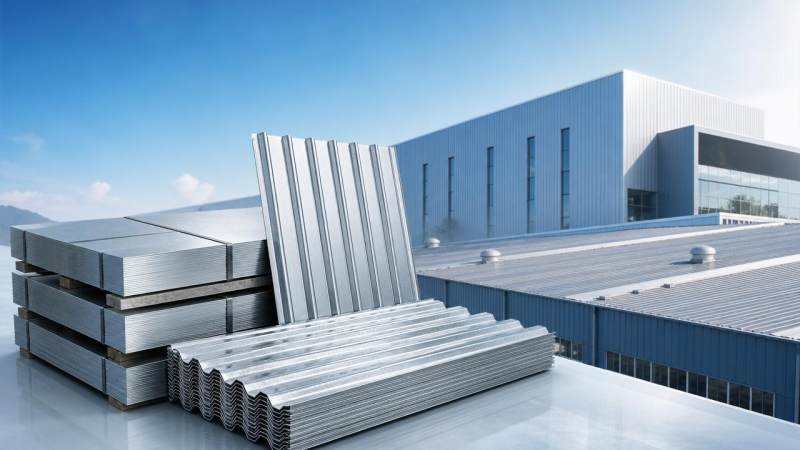
Choosing the right galvanized steel sheet for construction now involves more than price and availability.
Project durability, corrosion exposure, code compliance, and lifecycle cost have become more important across global building markets.
Buyers increasingly compare coating performance, base steel quality, dimensional accuracy, and supplier consistency before placing orders.
This shift matters because the wrong galvanized steel sheet for construction can cause early rust, rework, structural risk, and delayed installation.
A better selection process reduces sourcing uncertainty and supports stable project execution in residential, commercial, and industrial construction.
Construction demand is changing how steel sheet selection is judged
Construction environments are becoming more demanding, especially in coastal, humid, polluted, and high-temperature regions.
As a result, galvanized steel sheet for construction is no longer evaluated only by zinc coating weight.
Attention is moving toward service life prediction, coating adhesion, paint compatibility, and total installed performance.
Another clear trend is the growth of prefabrication and light steel systems.
These applications require stable thickness tolerance, flatness, and formability, not just corrosion resistance.
At the same time, international projects increasingly request ASTM, EN, JIS, or GB compliance records during qualification.
Key signals behind this shift
- Longer design life expectations for roofing, cladding, decking, and framing components
- Stronger focus on maintenance cost instead of only initial procurement cost
- Higher quality control requirements in export-oriented construction supply chains
- Greater use of formed, bent, and roll-profiled steel sheets in modular building systems
- More projects located in aggressive atmospheric corrosion zones
The main drivers shaping galvanized steel sheet for construction decisions
Several technical and commercial factors now drive selection decisions for galvanized steel sheet for construction.
Performance expectations now vary by application and exposure
Not every galvanized steel sheet for construction should be selected using the same checklist.
Interior partitions, dry warehouses, and temporary structures may accept lighter coating levels.
However, roofing, façades, agricultural buildings, and exposed structural components need stronger corrosion margins.
Agricultural projects deserve special attention because ammonia, moisture, and cleaning cycles can shorten service life quickly.
For these cases, coated alloy alternatives can offer better long-term appearance and atmospheric resistance.
One useful option is Color Coated Galvalume Steel Sheet PPGL.
It uses aluminized zinc steel with 55% aluminum, 43.3% zinc, and 1.6% silicon for improved corrosion performance.
This material suits agricultural, residential, commercial, and public building applications where appearance and durability both matter.
Typical thickness ranges from 0.2mm to 1.2mm, with widths from 600mm to 1250mm.
Top coating thickness can reach 11-35μm, while back coating is 5-14μm.
Wavy and trapezoidal profiles support easy installation in roof and wall systems.
PE, SMP, HDP, and PVDF finishes also help align the material with climate and design requirements.
How different applications change the requirement
- Roof panels: prioritize weather resistance, heat reflection, coating adhesion, and appearance retention
- Wall cladding: focus on flatness, paint durability, and scratch resistance during installation
- Decking and formed parts: check strength, bendability, and coating integrity after processing
- Agricultural structures: demand stronger corrosion protection against humidity and chemicals
The most important technical checkpoints before final selection
A sound decision on galvanized steel sheet for construction should be based on measurable technical checkpoints.
1. Coating type and coating mass
Check whether the sheet is standard galvanized, galvalume, or color-coated on an alloy-coated substrate.
Then verify coating mass or coating thickness against the project environment and expected service life.
2. Base steel grade and thickness tolerance
Base metal strength affects load capacity, forming behavior, and fastening performance.
Tight thickness tolerance improves installation consistency and avoids unexpected weight or stiffness variation.
3. Surface quality and coating adhesion
Look for smooth surface condition, uniform spangle where relevant, and low defect frequency.
Adhesion matters when sheets will be bent, profiled, or exposed to thermal cycling.
4. Standards and testing documents
Ask for mill test certificates, coating test records, and dimensional inspection data.
For export projects, compliance with ASTM, EN, JIS, or GB should be clear and traceable.
5. Fabrication and installation compatibility
The right galvanized steel sheet for construction must work with the actual fabrication route.
Confirm compatibility with roll forming, welding, cutting, fastening, and sealant systems before purchase.
Supplier reliability is becoming a decisive performance factor
Material quality alone does not guarantee good project results.
Stable supply, repeatable production, and dependable quality control now have direct project impact.
A qualified structural steel partner should support standard specifications, customized processing, and consistent lead times.
This matters especially when galvanized steel sheet for construction is part of a larger steel package.
Hongteng Fengda, based in China, supplies structural steel products and customized solutions for global projects.
Its capabilities cover angle steel, channel steel, steel beams, cold formed profiles, and custom structural steel components.
With modern manufacturing and strict quality control, products can align with ASTM, EN, JIS, and GB requirements.
That combination helps reduce sourcing risk, support cost control, and improve schedule reliability.
What to verify when comparing suppliers
- Production capacity and delivery stability
- Inspection process for thickness, coating, and dimensions
- Experience with export packaging and international documentation
- Ability to provide OEM or customized profiles when required
- Responsiveness during technical clarification and after-sales support
A practical way to judge the best fit before ordering
Before selecting galvanized steel sheet for construction, align technical data with the actual service environment.
The best choice is usually the one that balances corrosion resistance, process suitability, compliance, and dependable supply.
That is how galvanized steel sheet for construction creates long-term value instead of short-term savings.
Next-step focus for better construction steel decisions
Market expectations are moving toward longer service life, lower maintenance, and stronger specification discipline.
Because of that, galvanized steel sheet for construction should be judged by environment, application, and supplier execution together.
Review coating type, thickness tolerance, standards compliance, and fabrication needs before confirming any order.
If the project also requires shaped roofing or cladding with enhanced corrosion resistance, compare coated alloy options early.
A clear technical checklist and a reliable structural steel source will improve quality, schedule, and total project performance.
Please give us a message


Please enter what you want to find