Choosing the right galvanized pipe for water supply systems now involves stricter performance expectations than before.
Rising durability demands, tighter compliance checks, and lifecycle cost pressure are changing how projects evaluate steel pipe options.
For technical review, coating integrity, pressure rating, corrosion behavior, and dimensional consistency matter more than headline price alone.
Reliable galvanized pipe manufacturers for water supply help reduce sourcing risk, support standard compliance, and improve long-term system stability.
Quality expectations for water supply pipe are clearly rising
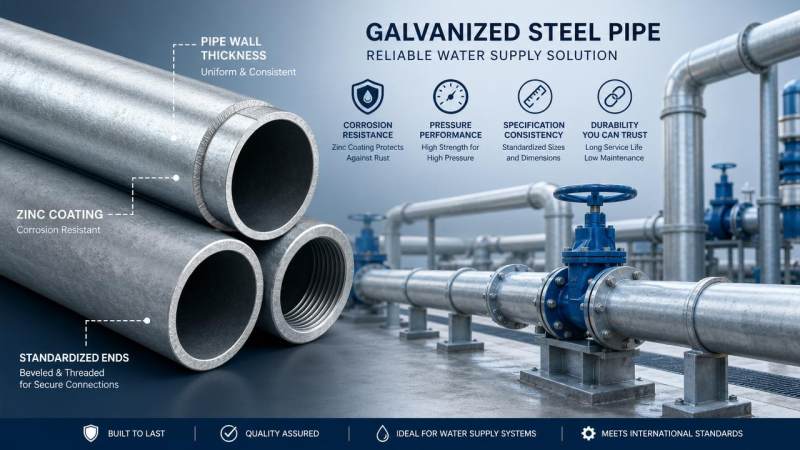
Water infrastructure is being judged more closely on durability, maintenance frequency, and total operating cost.
This has pushed buyers to compare galvanized pipe by verified performance, not only nominal specification.
In many regions, water quality requirements and longer service-life targets have also increased.
As a result, galvanized pipe manufacturers for water supply are expected to document coating thickness, base steel grade, and testing methods.
Projects involving industrial plants, commercial buildings, and utility upgrades are especially sensitive to these details.
Several market signals are changing pipe selection standards
Recent project decisions show a shift from simple specification matching toward risk-controlled material selection.
The following signals explain why galvanized pipe manufacturers for water supply face more technical scrutiny today.
These signals are making product traceability and supplier consistency central to approval decisions.
The main drivers behind better galvanized pipe decisions
The change is not random.
Several technical and commercial factors are shaping demand for better water supply pipe.
- Longer design life expectations in municipal and building systems.
- Greater concern about internal corrosion and flow reliability.
- More frequent third-party inspection and compliance review.
- Need to avoid replacement costs caused by poor galvanizing quality.
- Preference for suppliers with export experience and consistent documentation.
This is why galvanized pipe manufacturers for water supply are increasingly compared by production control, not only sales quotation.
What should be checked first
- Confirm the pipe standard and applicable testing basis.
- Review zinc coating method and average coating thickness.
- Verify pressure suitability for the operating system.
- Check dimensional tolerance, straightness, and end finishing.
- Request mill certificates and inspection records.
Selection priorities now affect multiple project stages
A better galvanized pipe decision influences installation quality, maintenance planning, and budget predictability.
When pipe quality is unstable, hidden problems often appear after commissioning rather than during delivery inspection.
That creates risk in joints, coatings, flow efficiency, and service continuity.
These effects explain why experienced galvanized pipe manufacturers for water supply are preferred in long-cycle projects.
The technical checkpoints that matter most in current projects
1. Coating quality is a primary durability indicator
Galvanizing protects steel from external and internal corrosion under normal service conditions.
Uneven coating, poor adhesion, or insufficient zinc thickness can shorten service life significantly.
Ask whether the supplier provides coating inspection reports and surface appearance criteria.
2. Pressure capacity must match actual operating conditions
Nominal diameter alone does not confirm suitability for water supply duty.
Wall thickness, steel grade, and manufacturing method affect pressure performance and safety margin.
Reliable galvanized pipe manufacturers for water supply should clarify these values before order confirmation.
3. Standard compliance supports cross-market acceptance
Projects exporting equipment or serving international contractors often require ASTM, EN, JIS, or GB conformity.
Clear certificates simplify approval, inspection, and later traceability.
4. Consistent supply can be as important as material performance
A technically suitable pipe still creates risk if delivery is unstable or batch quality changes frequently.
This is where established steel exporters add value through production planning and quality control.
In broader structural packages, related steel items may also need aligned sourcing schedules.
For example, reinforcement materials such as Rebar are often ordered alongside piping or support structures.
Available grades include HRB335, HRB400, and HRB500, with sizes from 6mm to 50mm and standards like ASTM A615-A615M-04a.
Such coordination can improve schedule control in foundations, beams, columns, walls, slabs, bridges, and tunnel-related works.
The strongest suppliers are being judged by more than price
Current evaluation trends show that low initial pricing does not guarantee lower total project cost.
Instead, the best galvanized pipe manufacturers for water supply usually show strength in several areas.
- Stable raw material control and modern production facilities.
- Support for customized specifications and OEM requirements.
- Understanding of international export standards and documentation.
- Consistent lead times across repeated purchase cycles.
- Responsive communication during technical clarification.
A professional structural steel exporter can support these needs across water, construction, and industrial applications.
With products aligned to ASTM, EN, JIS, and GB standards, sourcing becomes more predictable and easier to validate.
A practical comparison framework helps avoid common selection mistakes
The following checklist is useful when comparing galvanized pipe manufacturers for water supply.
This method supports faster technical decisions and lowers the chance of hidden performance gaps.
The next step is to verify both product data and supplier discipline
How to choose galvanized pipe for water supply systems is increasingly a matter of informed risk judgment.
The market is moving toward stronger documentation, better corrosion performance, and more dependable delivery execution.
That makes supplier capability as important as pipe specification itself.
When reviewing galvanized pipe manufacturers for water supply, compare coating data, standard compliance, dimensional control, and supply history together.
A structured evaluation today can prevent maintenance, replacement, and approval problems later.
If a project also involves structural steel sections, beams, channels, angles, or custom fabrication, integrated sourcing review can further improve cost control and schedule confidence.
Please give us a message


Please enter what you want to find