Choosing the right steel roofing for warehouses—standing seam vs. corrugated—is critical for durability, cost control, and long-term performance. As a trusted steel roofing manufacturer and supplier from China, Hongteng Fengda helps global buyers evaluate steel roofing benefits, installation complexity, total cost of ownership, and real-world pricing. Whether you’re a project manager assessing technical specs, a procurement officer comparing steel roofing price and lead times, or a safety-focused facility manager evaluating maintenance and longevity, this guide delivers actionable insights—backed by ASTM/EN-compliant products and OEM-ready solutions.
Structural Performance & Load-Bearing Capacity
Warehouse roofs must withstand snow loads (up to 40 psf in northern U.S. zones), wind uplift forces exceeding 120 mph in hurricane-prone regions, and dynamic thermal expansion cycles. Standing seam systems typically achieve wind uplift resistance of 120–180 psf when mechanically seamed and fully tested per ASTM E1592, while corrugated panels—especially those with 1.5″–3″ deep profiles—offer 60–110 psf depending on fastener spacing and substrate attachment.
Hongteng Fengda’s cold-formed steel roof decks are engineered to integrate seamlessly with both systems. Our ASTM A653 G90 galvanized base metal ensures corrosion resistance at cut edges, and our custom roll-forming lines produce standing seam panels with consistent 0.018″–0.036″ thickness tolerances—critical for maintaining seam integrity over 30+ years of service life.
For facilities housing heavy material handling equipment or requiring rooftop HVAC units, structural rigidity matters. Standing seam roofs allow for wider unsupported spans—up to 5 ft between purlins—whereas standard corrugated profiles often require purlin spacing no greater than 2.5 ft to prevent oil-canning and deflection under live loads.
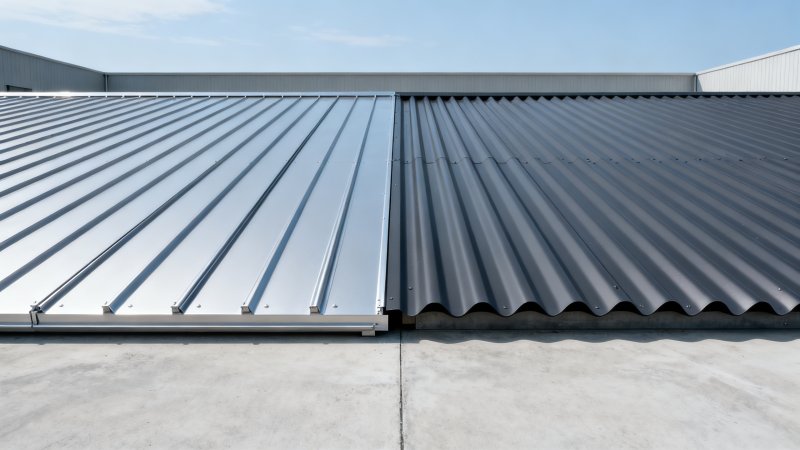
The table above reflects real-world performance benchmarks validated across EN 14782 and ASTM E1592 test reports. For high-wind industrial parks in the Middle East or typhoon-affected Southeast Asia, standing seam is often specified as the minimum compliance threshold—especially where insurance carriers mandate ≥150 psf uplift resistance.
Installation Efficiency & Labor Cost Implications
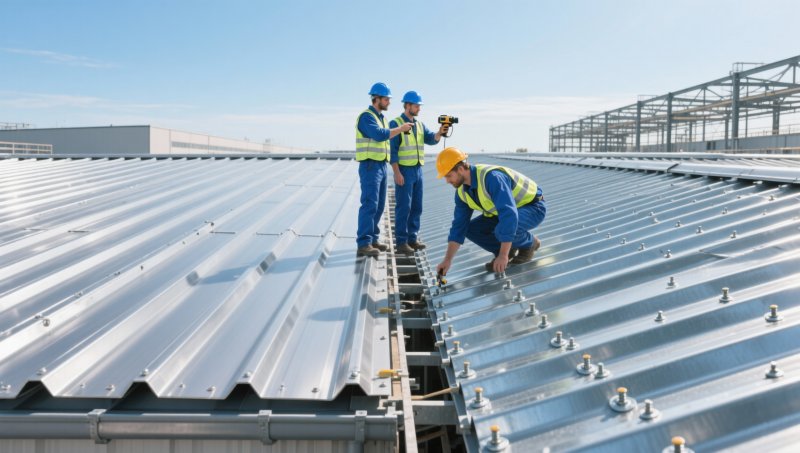
Corrugated roofing offers faster initial installation—typically 1.2–1.5 man-hours per 100 sq ft—due to its self-aligning profile and compatibility with pneumatic screw guns. However, that speed comes at a cost: every exposed fastener requires sealant application, re-torquing after thermal cycling, and eventual replacement every 8–12 years due to gasket degradation.
Standing seam systems demand more skilled labor (1.8–2.4 man-hours/100 sq ft) but eliminate penetrations entirely. Our factory-seamed panels reduce on-site labor by up to 35% versus field-seamed alternatives—and all Hongteng Fengda standing seam profiles comply with EN 14783 for seam tensile strength (>25 kN/m) and watertightness under hydrostatic pressure (≥150 mm water column).
Procurement officers should factor in total installed cost—not just unit price. While corrugated may appear $1.80–$2.40/sq ft lower upfront, its lifecycle labor cost over 25 years averages $0.95/sq ft higher than standing seam due to recurring maintenance, leak remediation, and premature panel replacement.
Long-Term Maintenance & Lifecycle Value
Corrugated roofs average 1–2 leak repairs per 10,000 sq ft annually after Year 7, primarily around fastener washers and end laps. Standing seam systems, by contrast, report less than 0.1 leaks per 10,000 sq ft annually over 25 years—provided proper thermal movement allowances are maintained during installation.
Facility managers evaluating safety and uptime must consider operational disruption. A single leak repair on a corrugated roof may require 4–6 hours of shutdown time to access, dry, and reseal; standing seam repairs—when needed—are typically limited to seam re-crimping or clip replacement, taking under 90 minutes per incident.
Hongteng Fengda supplies both systems with optional PVDF coating (Kynar 500®) for UV resistance and color retention—guaranteed for 30 years against chalk fade and gloss loss. We also offer stainless steel fasteners (A4-80 grade) and Stainless Steel Welded Mesh for integrated bird-deterrent screening—critical for food-grade or pharmaceutical warehouse compliance.
Procurement Decision Matrix: Key Evaluation Criteria
When selecting between systems, procurement teams and engineering managers should weigh these six criteria—each weighted by project priority:
- Design Life Expectancy: Standing seam targets 40+ years; corrugated typically 20–30 years (per ASTM G154 accelerated weathering data)
- OEM Integration Readiness: Both accept custom colors, embossed logos, and pre-drilled mounting points—but standing seam allows seamless integration with solar racking via concealed clamps
- Lead Time Consistency: Hongteng Fengda maintains 2–4 week standard lead times for corrugated; standing seam requires 5–7 weeks due to precision tooling requirements
- International Compliance: All panels meet ASTM A653/A792 (U.S.), EN 10346 (EU), and GB/T 2518 (China); fire ratings available per ASTM E108 Class A
- Logistics Optimization: Corrugated ships flat-packed (120 panels/pallet); standing seam ships coiled or bundled (max 3,200 linear ft/load)
- End-of-Life Recyclability: Both are 100% recyclable; however, standing seam’s lack of sealants and fasteners simplifies scrap sorting and increases resale value by ~12%
This matrix aligns with ISO 55000 asset management principles—prioritizing Total Cost of Ownership (TCO) over first-cost decisions. For multinational manufacturers operating across ASEAN and EU markets, standardized standing seam specifications reduce regional compliance overhead by up to 40%.
Why Partner with Hongteng Fengda for Your Warehouse Roofing?
As a vertically integrated structural steel manufacturer, Hongteng Fengda controls quality from coil selection through final packaging. Every batch undergoes third-party inspection per SGS/CCIC protocols—including tensile testing, salt-spray exposure (ASTM B117, 1,000+ hrs), and dimensional verification within ±0.005″ tolerance.
We support global buyers with bilingual engineering documentation (English + Spanish/French/Arabic), DDP shipping to 42 countries, and OEM services including laser-cutting, CNC punching, and custom coating formulation. Our production capacity exceeds 120,000 metric tons/year, ensuring stable lead times even during peak construction seasons.
Whether you need corrugated panels for a rapid-build logistics hub in Texas or standing seam systems for a LEED-certified distribution center in Germany, Hongteng Fengda delivers certified steel solutions—engineered for performance, backed by data, and built to last.
Get your customized warehouse roofing quote today—complete with ASTM/EN test reports, 3D installation drawings, and MOQ-based volume pricing.
Please give us a message


Please enter what you want to find