Choosing a reliable steel square rod exporter to Europe is crucial for stable sourcing, quality control, and compliant delivery.
European buyers often compare price first, yet certification, traceability, and export execution matter just as much.
A capable steel square rod exporter to Europe should combine manufacturing strength, standard compliance, flexible production, and dependable communication.
This guide explains what to check, what to compare, and how to reduce sourcing risks before placing orders.
What defines a qualified steel square rod exporter to Europe?
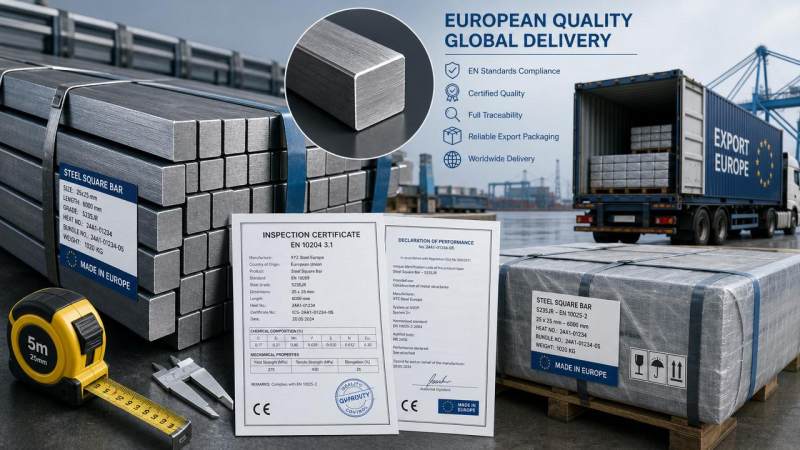
A qualified steel square rod exporter to Europe does more than ship steel products overseas.
It should understand European technical expectations, packing standards, documentation rules, and delivery coordination.
The supplier should offer clear material grades, dimensional tolerances, and test records for every shipment.
For structural and industrial use, consistency across batches is often more important than the lowest quote.
A strong exporter usually provides products aligned with ASTM, EN, JIS, or GB requirements.
It should also support custom lengths, cutting options, surface treatment, and packaging methods for sea transport.
Manufacturing depth matters as well.
Factories with modern equipment and strict inspections are better positioned to maintain stable dimensions and mechanical performance.
How can you verify quality and compliance before ordering?
Start with documents, but do not stop there.
Ask for mill test certificates, chemical composition data, mechanical property reports, and inspection procedures.
For a steel square rod exporter to Europe, traceability should link each bundle to production batches.
That helps resolve claims quickly and supports internal quality review.
Request details on these checkpoints:
- grade and standard equivalence
- size range and tolerance control
- surface condition and straightness
- packing, marking, and corrosion protection
- third-party inspection availability
Sample orders can be useful, especially for new suppliers or customized dimensions.
A trustworthy exporter should welcome reasonable audits and technical clarification.
If replies are vague, delayed, or inconsistent, that is an early warning sign.
Which production and export capabilities matter most?
Production capacity affects both lead time and repeat order reliability.
A steel square rod exporter to Europe should show stable output, not just occasional trading access.
Direct manufacturing control often improves scheduling, quality stability, and customization response.
Export capability is equally important.
The supplier should know booking cycles, container loading efficiency, export paperwork, and destination-specific shipping requirements.
Experience with European markets usually means fewer mistakes in labeling, documentation, and packing protection.
In many steel sourcing programs, buyers also need related materials from one source.
That makes broader product capability valuable.
For example, some projects require plates together with square rods, channels, or beams.
A supplier offering Carbon Steel Plate Manufacturer solutions can support bundled procurement.
Common grades include A36, Q235, and S235JR for building frames, mechanical parts, bridges, tanks, and brackets.
These plates feature low carbon content, good weldability, easy formability, and balanced mechanical properties.
Typical sizes cover widths from 100mm to 3000mm, lengths from 1m to 12m, and thickness from 0.1mm to 400mm.
Such integration can simplify purchasing, reduce coordination costs, and improve shipment planning.
How do price, lead time, and total landed cost compare?
The lowest ex-works price does not always produce the lowest final cost.
When comparing a steel square rod exporter to Europe, calculate total landed cost instead of unit price alone.
Include these factors in your review:
- raw material grade differences
- weight tolerance and actual net quantity
- inspection and certification cost
- packaging strength and rust prevention
- port handling and freight timing
- risk of delay, rejection, or rework
Lead time should include production, inspection, inland transport, customs clearance, and sea transit.
Ask whether the quoted schedule is based on current capacity or only best-case assumptions.
Reliable exporters usually provide realistic windows rather than overpromising.
Stable delivery can protect project schedules better than a small price advantage.
What common risks and mistakes should be avoided?
One common mistake is assuming that all square rods with similar dimensions perform the same.
Material grade, tolerance, straightness, and surface quality can vary significantly.
Another mistake is relying on certificates without checking whether they match the actual shipment.
A dependable steel square rod exporter to Europe should maintain clear marking and batch identification.
Packaging is often underestimated.
Poor bundling or weak moisture protection can cause rust, deformation, or handling damage during sea transport.
Communication gaps can also create unnecessary losses.
If dimensions, tolerances, or standards are not written clearly, disputes become harder to settle.
To reduce risk, confirm every technical and commercial point in writing before production begins.
Quick comparison table for supplier screening
How should you make the final selection?
Use a balanced evaluation method instead of choosing only by quotation.
A practical shortlist often compares technical fit, compliance, communication speed, packaging quality, and lead time stability.
It is wise to begin with a smaller trial order when a new source is under review.
That trial can confirm document accuracy, dimensional consistency, shipment protection, and after-sales responsiveness.
If the supplier performs well, scale can grow with lower sourcing risk.
Hongteng Fengda, as a structural steel manufacturer and exporter from China, supports global projects with stable production, strict quality control, and customized steel solutions.
With experience across Europe and other international markets, the company supplies structural steel products aligned with major global standards.
When evaluating any steel square rod exporter to Europe, focus on long-term supply reliability, not just the first order price.
The right partner helps control cost, reduce claims, and keep projects moving with confidence.
Please give us a message


Please enter what you want to find