What really matters when assessing an S275JR hot rolled carbon steel sheet exporter
If you are evaluating an S275JR hot rolled carbon steel sheet exporter, the difficult part is usually not finding offers. It is separating suppliers that can ship acceptable steel once from suppliers that can support repeat orders without turning quality, paperwork, or delivery into a project risk.
S275JR is commonly specified for structural and general fabrication work under EN standards, so the exporter is not just selling a commodity sheet. They are expected to deliver material with the right grade declaration, dimensional consistency, mill traceability, and export execution. For a buyer comparing landed cost, this distinction matters. A low unit price can disappear quickly if the shipment arrives with incomplete documents, mixed heats, poor flatness, or unclear compliance to EN 10025 requirements.
In practice, a sound assessment comes down to five things: whether the supplier understands the grade, whether they control production and records, whether they can export reliably, whether their quote is transparent, and whether their service team reacts like a factory partner rather than a trading inbox.
Start with grade understanding, not just price
An exporter offering S275JR should be able to discuss the material beyond “hot rolled sheet available.” They should know where the grade is typically used, what standard it aligns with, and what needs extra confirmation before order release. Buyers often assume that if the grade name is printed on the quotation, technical understanding is already in place. That is not always true.
A useful early test is to ask specific questions: Can they provide the relevant test certificate format? How do they manage thickness tolerance? Can they explain whether the requested dimensions are cut from coil or supplied as mill sheet? What is their normal approach to surface condition and edge condition? A capable supplier usually answers these points directly. A weak one tends to repeat generic lines about “high quality products” without addressing the actual steel sheet requirements.
This is especially important when the material will be used in structural fabrication, equipment bases, brackets, welded assemblies, or projects where downstream processing costs are higher than the steel price itself. In those cases, consistency is often worth more than chasing the cheapest FOB number.
Check whether the supply chain is traceable
The next question is simple: who is actually making or controlling the material? Some exporters are mills, some are processors, and some are traders coordinating supply from multiple sources. None of these models is automatically wrong, but your evaluation standard should change depending on the model.
If the exporter has its own manufacturing base or stable processing facilities, it is usually easier to verify inspection routines, cutting accuracy, packaging standards, and lead time control. A company with real structural steel production experience often has a more disciplined view of material traceability because it already works with standard-driven products such as angle steel, channels, beams, cold formed sections, and custom fabricated components. That background tends to show in how documents are handled and how specifications are confirmed before production.
For example, a China-based structural steel manufacturer and exporter serving North America, Europe, the Middle East, and Southeast Asia may be used to dealing with ASTM, EN, JIS, and GB requirements across different projects. That does not automatically guarantee that every S275JR order will fit your needs, but it is usually a positive sign. It suggests the team is familiar with standard matching, export packing, and the discipline required for cross-border steel supply.
Ask for heat traceability method, mill test certificate availability, inspection workflow, and whether third-party inspection can be arranged if required. If the exporter hesitates on these basics, the risk is already visible.
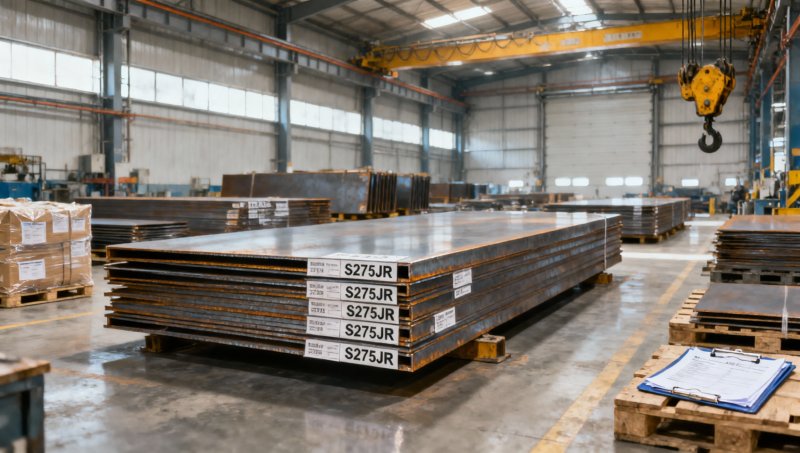
Look past the mill certificate and examine execution details
Many sourcing problems happen after the technical grade has been confirmed. The material may be correct on paper, yet the shipment still causes trouble because execution details were not defined clearly enough.
For hot rolled carbon steel sheet, practical checks usually include:
- thickness and width tolerance basis;
- sheet size range and whether custom cutting is available;
- surface condition acceptable for your fabrication or coating process;
- packing method for moisture, edge damage, and handling;
- marking, label traceability, and document match between bundle and certificate;
- realistic production and shipping lead time, not just quoted lead time.
This is where experienced evaluators spend time, because the cost of a problem is rarely just replacement steel. It can include delayed cutting, rejected welding preparation, repainting, warehouse sorting, customs clarification, or line stoppage at the buyer’s plant.
The same logic applies across metal sourcing categories. A supplier that can clearly define process variables for sheet steel often does the same in other industrial materials. That is one reason diversified exporters are sometimes easier to assess. If they also handle products such as 306 Stainless Steel Welded Mesh for filters, sieve applications, chemical or mining use, they may already be accustomed to discussing measurable specifications rather than vague performance claims. In mesh products, buyers typically verify wire material, diameter ranges from 0.0008″ to 0.12″, mesh counts from 2 to 635 mesh, roll width up to 240″, and corrosion or heat resistance depending on grade like 304, 316, or 430. That habit of specification-based communication is worth noticing even when your immediate purchase is carbon steel sheet.
Assess cost on a landed basis, not a quoted basis
A common procurement mistake is comparing exporters by headline price alone. For S275JR sheet, the better comparison is total delivered value: material price, yield loss from dimensional mismatch, port and inland logistics, documentation quality, packaging loss risk, inspection cost, and the likelihood of delay.
Two exporters can offer similar tonnage at visibly different prices for reasons that are not always obvious from the first quotation. One may be quoting ex-stock mixed sourcing with limited size control. Another may be quoting fresh production with clearer traceability and more reliable export packing. In some projects the cheaper option is perfectly workable. In others, especially when steel goes straight into fabrication schedules, the extra control is worth paying for.
It helps to request a quote breakdown in plain terms:
If the exporter avoids detail and pushes hard on “best price now,” that is information too.
Export capability is not a side issue
With steel, export performance often separates dependable suppliers from merely available ones. An exporter may understand the product and still fail on delivery coordination. You want to know how they manage booking, loading, packing lists, certificates, and response time when something changes.
For buyers working across multiple regions, this becomes more important. A supplier used to serving Europe may be more comfortable with EN-driven documentation. One supplying North America or Southeast Asia regularly may have stronger flexibility around mixed specifications, OEM processing, or staggered delivery schedules. The right fit depends on your project, but experience across different markets usually reduces friction.
This is one area where established structural steel exporters from China can be strong partners when they have modern production facilities, internal quality control, and a routine of shipping standard and customized steel products overseas. The useful question is not “Are they in China?” but “Can they show stable production, consistent quality, and dependable lead time under international order conditions?”
How to read red flags early
A few warning signs come up often in steel sourcing.
One is specification drift. The inquiry starts with S275JR hot rolled carbon steel sheet, but the supplier replies with a broad “carbon steel plate/sheet available” offer and no standard reference. Another is document vagueness: the supplier says certificates can be provided, but cannot state what kind or when. A third is suspiciously elastic lead time, where production, cutting, and vessel timing are all promised immediately without checking order details.
Communication quality matters more than many teams admit. If questions about tolerance, standard, packing, or inspection receive generic answers before the order, service usually does not improve after payment.
A practical way to shortlist exporters
A sensible shortlist process is not complicated. Ask each candidate for the same set of technical and commercial clarifications. Review how complete the reply is, how fast it comes back, and whether the answer shows real understanding of the material. Then request sample documents or a draft certificate format if the order is compliance-sensitive. If the order value justifies it, discuss pre-shipment inspection or third-party verification in advance rather than after a dispute appears.
The goal is not to find a perfect exporter. It is to identify the supplier whose process is clear enough that risk can be managed. For many buyers, that ends up being a company with real structural steel manufacturing background, familiarity with ASTM, EN, JIS, and GB frameworks, and the discipline to support both standard products and customized requirements without losing control of lead time or documentation.
When assessing an S275JR hot rolled carbon steel sheet exporter, the best decision usually comes from looking at the ordinary details closely. Grade understanding, traceability, quote transparency, export execution, and response quality are not glamorous criteria, but they are the ones that decide whether a low-cost order stays low-cost after the steel reaches your yard.
Please give us a message


Please enter what you want to find