How to Vet Stainless Steel Coil Suppliers: 7 Due-Diligence Checks for Quality, Traceability, and ISO Compliance
Choosing the right stainless steel coil suppliers isn’t just about ticking boxes on a quotation sheet—it’s about safeguarding structural integrity, project timelines, and your reputation as a procurement professional. When you’re sourcing for large-scale civil engineering construction—whether it’s reinforcing foundations for high-rises in Dubai, rebar for bridges across Southeast Asia, or cold-formed steel profiles for industrial plants in North America—the raw material’s consistency, traceability, and compliance aren’t abstract ideals. They’re non-negotiables baked into every weld, bend, and load calculation.
At Hongteng Fengda, we’ve spent over a decade working alongside global buyers who’ve faced the quiet cost of poor supplier vetting: coils arriving with mismatched heat numbers, mill test reports (MTRs) that don’t align with physical batch markings, or ISO 9001 certificates issued by unrecognized bodies. These aren’t minor paperwork gaps—they’re systemic risks that compound downstream: rework delays, rejected shipments, third-party inspection failures, and, ultimately, cost overruns that no budget line item anticipated.
So how do you separate the truly capable stainless steel coil suppliers from those who *sound* compliant? Not by scanning websites or counting certifications—but by conducting focused, evidence-based due diligence. Here are seven checks we recommend—not as theoretical best practices, but as field-tested filters used by experienced procurement teams managing multi-million-dollar structural steel projects.
**1. Verify Heat Number Traceability—End to End**
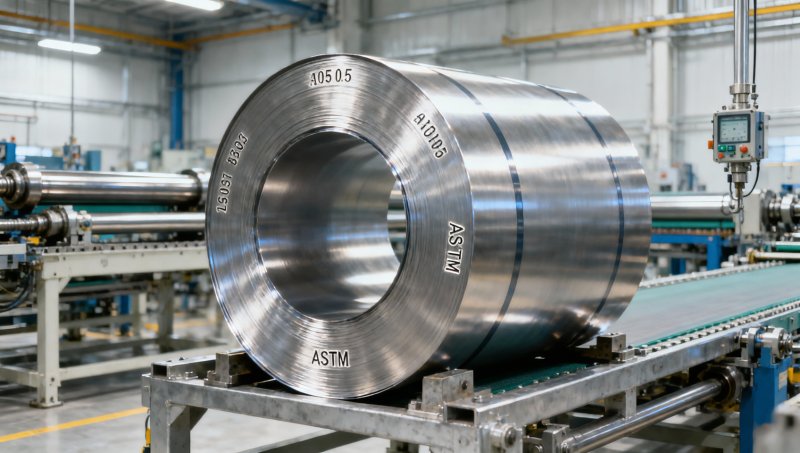
Stainless steel coils are batch-sensitive. A single heat number ties chemistry, mechanical properties, and processing history together. Ask for the full chain: from furnace log entry → hot rolling pass records → cooling profile logs → final coil marking. Then cross-check one random coil’s heat number against its MTR *and* the physical stamp on the coil’s inner wrap. If the heat number on the tag doesn’t match the MTR—or worse, if it’s missing entirely—you’re dealing with fragmented quality control. At Hongteng Fengda, every coil is tagged with laser-etched heat numbers visible even after surface treatment, and our internal ERP links each heat to its corresponding MTR, chemical analysis, and tensile report.
**2. Scrutinize Mill Test Reports—Beyond the Header**
An MTR isn’t just a PDF with a logo. Look past the “Certified” stamp. Does it list actual test values—not just “meets ASTM A240”—for yield strength, tensile strength, elongation, and intergranular corrosion resistance (if applicable)? Are test methods cited (e.g., ASTM E18 for hardness, ASTM A923 for ferrite content)? Is the testing lab accredited to ISO/IEC 17025? And crucially—does the report include the inspector’s signature *and* date *after* final processing? Generic templates or pre-filled reports without dated verification are red flags.
**3. Audit ISO 9001 Evidence—Not Just the Certificate**
A framed ISO 9001 certificate proves little. Request the latest audit summary report—not the certificate alone—from an accredited body like SGS, BV, or TÜV. Check whether the scope explicitly covers “production of stainless steel coils” (not just “metal trading” or “export services”). Confirm the last surveillance audit was conducted within the past 12 months—and ask for corrective action records from any non-conformities raised. If the supplier hesitates or offers only a digital copy without audit trail references, their system may be paper-compliant, not process-driven.
**4. Observe Real-Time Production Oversight**
Can they show you live footage—or at least recent timestamps—from key stages: pickling line monitoring, tension leveling logs, surface inspection cameras, and slitting machine calibration records? Suppliers with robust quality systems don’t just inspect finished coils; they monitor parameters *during* production. For instance, pickling temperature and acid concentration directly impact surface finish and corrosion resistance—especially critical for architectural or food-grade applications. If real-time data access isn’t offered, ask how deviations are captured and escalated mid-run.
**5. Validate Packaging & Marking Consistency**
This seems minor—until your site team unspools a coil and finds inconsistent labeling, faded heat stamps, or moisture-damaged packaging that compromises surface integrity. Inspect sample packaging: Are coils protected with VCI paper or desiccant-lined wraps? Are ID tags laminated and UV-resistant? Does each coil carry dual marking—laser etched *and* printed label—with identical heat number, grade, thickness, width, and standard reference? Inconsistent marking often signals weak internal traceability discipline.
**6. Cross-Reference Third-Party Inspection Protocols**
Many suppliers accept third-party inspections—but few proactively share their agreed-upon inspection checklist. Request the exact protocol used with SGS or Bureau Veritas for stainless steel coils: How many coils per lot are sampled? What’s the acceptance criteria for surface pitting or edge burr height? Are dimensional checks done with calibrated micrometers—not tape measures? Are samples drawn *before* packaging, or post-sealing? Transparency here reveals whether inspection is treated as a gatekeeping step—or a box-ticking formality.
**7. Assess Responsiveness to Non-Conformance Scenarios**
Ask: *“What happens when a coil fails a tensile test during your internal QA?”* Their answer tells you more than any audit report. Do they quarantine the entire heat lot? Trace back to raw material batches? Re-test with independent labs? Or do they isolate only the failed coil and release the rest? A mature supplier treats non-conformance as a system signal—not an isolated event. Their root-cause analysis process, CAPA documentation, and communication timeline (e.g., 24-hour notification threshold) matter deeply when your project schedule hinges on material readiness.
 These seven checks aren’t meant to be completed in sequence—they’re interconnected lenses. A supplier strong in heat traceability but vague on third-party protocols likely outsources inspection without oversight. One with pristine ISO documentation but no real-time production visibility may rely on batch-level sampling rather than continuous monitoring.
And while stainless steel coils are central to this framework, remember: the same rigor applies across your structural steel supply chain. Whether you’re specifying Rebar for highway foundations or cold-formed channels for modular housing, inconsistent input materials cascade into fabrication errors, welding inconsistencies, and long-term performance uncertainty. That’s why at Hongteng Fengda, our internal vetting of upstream stainless coil partners mirrors what we advise our clients to do—because reliability starts where the material does.
Procurement isn’t just about cost per tonne. It’s about confidence per project phase. The right stainless steel coil supplier doesn’t just deliver metal—they deliver predictability. And in global construction, where timelines tighten and specifications grow more demanding, that predictability isn’t a luxury. It’s the foundation.
These seven checks aren’t meant to be completed in sequence—they’re interconnected lenses. A supplier strong in heat traceability but vague on third-party protocols likely outsources inspection without oversight. One with pristine ISO documentation but no real-time production visibility may rely on batch-level sampling rather than continuous monitoring.
And while stainless steel coils are central to this framework, remember: the same rigor applies across your structural steel supply chain. Whether you’re specifying Rebar for highway foundations or cold-formed channels for modular housing, inconsistent input materials cascade into fabrication errors, welding inconsistencies, and long-term performance uncertainty. That’s why at Hongteng Fengda, our internal vetting of upstream stainless coil partners mirrors what we advise our clients to do—because reliability starts where the material does.
Procurement isn’t just about cost per tonne. It’s about confidence per project phase. The right stainless steel coil supplier doesn’t just deliver metal—they deliver predictability. And in global construction, where timelines tighten and specifications grow more demanding, that predictability isn’t a luxury. It’s the foundation.
Previous page: Already the first one
Next page: Already the last one
Please give us a message


Please enter what you want to find