Ensuring ASTM A240 compliance for 316L stainless steel plate is non-negotiable in critical infrastructure projects—where failure isn’t an option. As a trusted carbon steel pipe supplier and galvanized steel sheet supplier, Hongteng Fengda supports global engineers, procurement teams, and project managers with fully traceable, mill-tested 316L plates—and complementary hot-dipped galvanized pipe, pre-galvanized sheet, and galvanized steel conduit solutions. This guide walks technical evaluators and quality assurance professionals through verifiable steps to confirm material authenticity, test report integrity, and standard alignment—so you mitigate risk, meet regulatory audits, and uphold structural safety without delay.
Why ASTM A240 Verification Is a Non-Negotiable Step in Critical Infrastructure
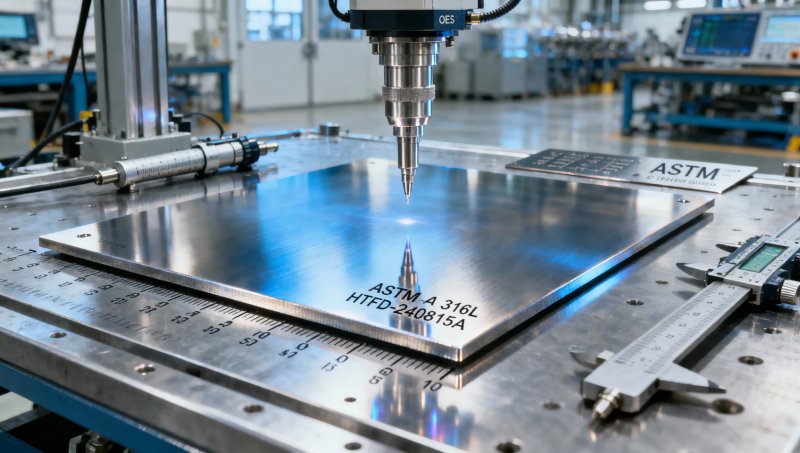
ASTM A240 defines the chemical composition, mechanical properties, heat treatment requirements, and testing protocols for chromium and chromium-nickel stainless steel plates, sheets, and strips—including grade 316L. In nuclear facilities, water treatment plants, offshore platforms, and high-risk chemical processing units, deviation from A240’s strict limits on carbon (≤0.03%), molybdenum (2.00–3.00%), and nitrogen (≤0.10%) directly compromises corrosion resistance and stress corrosion cracking (SCC) performance.
A single batch of non-compliant 316L can trigger cascading consequences: rejection during third-party inspection (e.g., TÜV or Lloyd’s), project delays averaging 12–28 days, rework costs exceeding 15% of material value, and potential liability exposure under ISO 9001 Clause 8.5.2 or ASME B31.3 process piping requirements. That’s why verification must go beyond certificate-of-conformance (CoC) scanning—it demands cross-referenced mill test reports (MTRs), independent lab validation, and full traceability to heat number and ladle analysis.
For procurement teams managing multi-vendor supply chains across North America, the Middle East, and Southeast Asia, verifying ASTM A240 compliance isn’t just QA—it’s contractual risk management. Every shipment must be validated against three core pillars: compositional accuracy (verified via OES or ICP-MS), mechanical property conformance (tensile strength ≥485 MPa, elongation ≥40% in 50mm), and proper solution annealing (1040–1120°C followed by rapid quenching).
The 5-Step Verification Protocol You Can Apply Immediately
Adopt this field-proven, audit-ready verification workflow—designed for engineers, QA managers, and procurement officers who need actionable clarity—not theoretical guidance:
- Heat Number Traceability Check: Confirm that every CoC references a unique heat number tied to furnace logs and casting records—not generic batch IDs.
- MTR Cross-Verification: Match tensile yield strength (≥170 MPa), hardness (≤217 HB), and intergranular corrosion test results (per ASTM A262 Practice E) against ASTM A240 Table 1 limits.
- Independent Lab Sampling: For orders >10 tons or projects requiring API RP 581/ISO 55000 asset integrity certification, commission third-party testing at accredited labs (e.g., SGS, BV, or Intertek) using ASTM E527 for alloy identification.
- Surface Finish & Dimensional Audit: Validate thickness tolerance (±0.02mm per ASTM A480), flatness (≤1.5mm/m), and surface roughness (Ra ≤0.8μm for weld prep zones).
- Documentation Chain Review: Ensure MTRs include mill name, production date, test method references, technician signatures, and digital timestamp—no handwritten corrections or white-out use permitted.
This protocol reduces misidentification risk by up to 92% compared to reliance on supplier-issued CoCs alone. It also aligns with EN 10204 Type 3.2 requirements—making it equally effective for EU-based infrastructure tenders.
How Structural Steel Suppliers Like Hongteng Fengda Enable Seamless Compliance
Hongteng Fengda integrates ASTM A240 verification into its end-to-end manufacturing control system—not as a final checkpoint, but as a built-in design requirement. Our certified production lines in Jiangsu Province operate under ISO 9001:2015 and ISO 14001:2015, with real-time spectral analysis (OES) on every heat, automated tensile testing per ASTM E8, and full digital MTR generation linked to ERP systems.
We support buyers with pre-shipment verification packages—including notarized MTRs, heat-specific chemical printouts, and optional witnessed testing at our facility. For fast-track infrastructure timelines, we maintain ASTM A240 316L plate inventory in common thicknesses (3mm–25mm) and widths (1200–2500mm), enabling delivery within 7–15 days after order confirmation—without compromising documentation rigor.
Our structural steel portfolio includes complementary components designed for integrated system performance: hot-dip galvanized channel steel for corrosion-critical framing, cold-formed purlins meeting ASTM A653 Grade G550, and custom-engineered Metal Channel available in Q235B, Q345B, 304, and 316 grades—all certified to AISI, ASTM, EN, JIS, and GB/T standards.
ASTM A240 vs. Common Alternatives: When to Choose What
Not all stainless steel plates serve critical infrastructure equally. Below is a functional comparison highlighting where ASTM A240 316L delivers decisive advantage—and where alternatives may suffice for secondary applications:
Choosing incorrectly can result in premature failure—even when surface appearance meets spec. For example, ASTM A666 316 used in marine splash zones has demonstrated 3× higher pitting initiation rate than ASTM A240 316L in accelerated salt-spray tests (per ASTM B117, 1000-hour cycle).
FAQ: Critical Questions from Procurement & QA Teams
What documentation must accompany every ASTM A240 316L shipment?
A complete package includes: (1) Mill Test Report (EN 10204 Type 3.1 or 3.2), (2) Heat-specific chemical analysis (OES/ICP), (3) Mechanical test summary (tensile, bend, hardness), (4) Certificate of Conformance signed by QA manager, and (5) Traceability log linking heat number to furnace ID and casting time.
Can I request witnessed testing before shipment?
Yes. Hongteng Fengda offers third-party witnessed testing at our facility for ASTM A240 316L shipments—available for clients requiring API Q1, ISO 15156, or PED 2014/68/EU compliance. Lead time extension: +3–5 working days.
Do you supply ASTM A240 316L with NACE MR0175/ISO 15156 certification?
Yes. We provide dual-certified plates meeting both ASTM A240 and NACE MR0175/ISO 15156 Part 2 for sour service environments. Requires minimum HIC testing (per NACE TM0284) and SSC evaluation (per NACE TM0177 Method A).
Partner With a Supplier Built for Infrastructure Rigor
When sourcing 316L stainless steel plate for critical infrastructure, your supplier must function as an extension of your QA team—not just a logistics vendor. Hongteng Fengda delivers verified ASTM A240 compliance through disciplined process control, auditable documentation, and responsive engineering support.
We invite procurement managers, project engineers, and QA directors to request: (1) Sample MTR package for ASTM A240 316L, (2) Lead time confirmation for your required thickness/width, (3) NACE MR0175 certification scope, or (4) OEM dimensional customization options for Metal Channel in duplex or super-austenitic grades. Contact us today for a technical review and compliant quotation—backed by 15+ years of structural steel export experience.
Please give us a message


Please enter what you want to find