Sizing an electrical conduit pipe for commercial wiring requires calculating the total cross-sectional area of the conductors and applying the maximum fill capacity rules defined by electrical codes, typically the National Electrical Code (NEC) in North America or equivalent international standards. In large-scale commercial projects, undersized conduits lead to wire insulation damage during pulling, overheating due to poor heat dissipation, and failed inspections. Conversely, oversized conduits unnecessarily inflate material costs, require larger mounting hardware, and complicate the installation process. The core decision relies on balancing the physical space needed for the wires with the specific environmental and mechanical demands of the building.
The first step in the sizing process is to identify every conductor that will pass through the conduit. This includes all current-carrying conductors as well as equipment grounding conductors. You must note the wire gauge (AWG or kcmil) and the specific insulation type, such as THHN or THWN-2. Different insulation types and voltage ratings have different outer diameters, which directly impacts the total area the wires will occupy. For instance, a wire with a higher voltage rating typically has thicker insulation, taking up more space inside the pipe.
Once the conductors are identified, calculate the total cross-sectional area. Refer to NEC Chapter 9, Table 5, which provides the approximate area for each conductor size and insulation type. Multiply the area of each individual wire by the total number of wires of that specific size, and then sum these values to get the total conductor area. This mathematical baseline is non-negotiable for code compliance.
Next, apply the conduit fill rules outlined in NEC Chapter 9, Table 1. The maximum allowable fill percentage depends on the number of wires. If the conduit contains only one wire, the maximum fill is 53%. For exactly two wires, the limit drops to 31%. For three or more wires, the maximum fill is 40%. This significant reduction for three or more conductors accounts for the irregular shape of the wires when they are bundled together. Unlike perfect circles, bundled wires create dead space between them, reducing the effective area available for pulling.
With the total conductor area and the applicable fill percentage determined, consult NEC Chapter 9, Table 4 for standard conduit types like Rigid Metal Conduit (RMC) or Electrical Metallic Tubing (EMT). Find the smallest conduit trade size where the allowable area for your specific number of wires equals or exceeds your calculated total conductor area. Always round up to the next available trade size if the exact area is not listed.
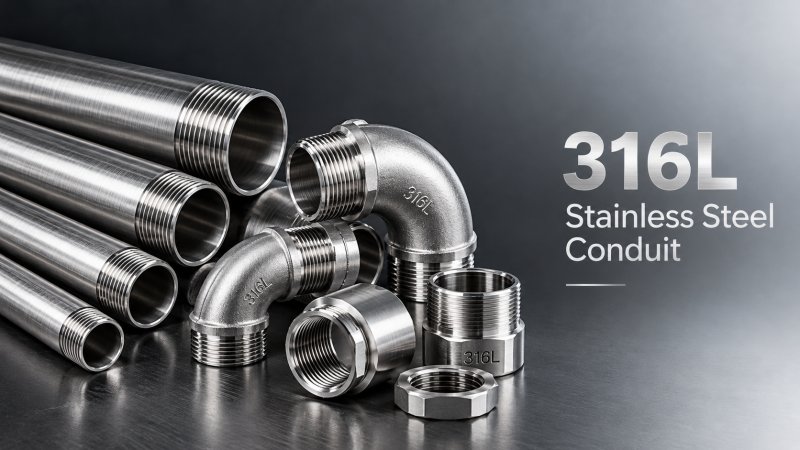
Beyond basic mathematical sizing, the physical environment of the commercial building heavily dictates the conduit material and its structural requirements. Standard RMC or EMT works perfectly for most indoor, dry locations. However, commercial facilities such as food processing plants, chemical storage areas, marine docks, or coastal developments face severe corrosion risks. In these aggressive environments, standard galvanized steel degrades quickly, compromising both the mechanical protection of the wires and the electrical continuity of the grounding path.
Upgrading to stainless steel conduit becomes necessary to maintain long-term structural integrity. When procuring or custom-fabricating specialized conduit components, heavy-duty fittings, or custom enclosures for these highly corrosive zones, the raw material choice is critical. Sourcing premium 316L Stainless Steel Plate allows manufacturers to fabricate custom conduit parts that resist pitting and crevice corrosion from chlorides and industrial chemicals. The addition of nickel and molybdenum in this alloy provides superior corrosion resistance compared to standard 304 grades. Furthermore, the low carbon content prevents sensitization, or grain boundary carbide precipitation, during the welding process. This ensures that the welded joints of custom conduit assemblies remain as robust and corrosion-resistant as the pipe itself, which is especially important for large-gauge welded parts.
Thermal management is another critical factor that influences conduit sizing. Sizing is not just about physical fit; it is about heat dissipation. When more than three current-carrying conductors are placed in a single conduit, their ability to dissipate heat decreases significantly due to the mutual heating effect. Electrical codes require ampacity derating based on the number of conductors and the ambient temperature of the environment. If this derating forces you to upsize the conductors to carry the required load safely, you must recalculate the conduit size from scratch. Always evaluate the final conductor size after applying all derating factors, including ambient temperature corrections, before finalizing the conduit dimensions. Ignoring this step is a common error that leads to overheating and premature insulation failure.
Commercial wiring layouts also introduce physical constraints that affect conduit sizing and routing. Long runs with multiple bends increase the friction during wire pulling. Codes typically limit a single conduit run to 360 degrees of total bend (equivalent to four 90-degree bends) between pull boxes. Exceeding this limit makes wire pulling nearly impossible without applying excessive tension, which can strip insulation or break conductors. When designing the layout, strategically place pull boxes to break up long runs and reduce the total bend angle. This not only facilitates the initial installation but also allows for easier future maintenance and wire replacement.
In areas subject to physical impact, such as parking garages, warehouses, or industrial corridors, the mechanical strength of the conduit must be rigorously evaluated. While EMT is lightweight and easy to install, it may not withstand heavy forklift traffic or accidental impacts from moving equipment. Intermediate metal conduit (IMC) or RMC provides better mechanical protection due to their thicker walls and higher tensile strength. The wall thickness and material grade must be matched against the specific impact risks of the installation area to prevent crushing or puncturing. In high-traffic zones, installing physical guards or routing the conduit above the reach of moving vehicles are additional protective measures that complement the inherent strength of the chosen conduit material.
It is also crucial to understand that the internal diameter of a conduit varies significantly depending on the material and the manufacturing standard. For example, a 2-inch Rigid Metal Conduit (RMC) has a different internal cross-sectional area compared to a 2-inch PVC Schedule 40 or Schedule 80 conduit. PVC conduits generally have thicker walls, especially in Schedule 80, which reduces the available internal space for conductors. When switching from metal to non-metallic conduit during the value engineering phase of a commercial project, the conduit trade size might need to be increased to maintain the same fill capacity. Always use the specific Table 4 for the exact conduit type you are procuring, rather than relying on generic sizing charts.
Planning for future expansion is a hallmark of professional commercial electrical design. While the NEC provides the minimum requirements for conduit fill, real-world commercial operations frequently evolve. Adding new machinery, upgrading lighting systems, or integrating smart building technologies often requires additional circuits. If a conduit is sized exactly to the 40% fill limit for the initial installation, there is no room for future wires without installing a parallel conduit. By intentionally sizing the conduit to accommodate 20% to 30% spare capacity, facility managers can easily pull new conductors years down the line. This proactive approach minimizes operational disruptions and avoids the high costs associated with retrofitting new pathways in finished commercial spaces.
From a procurement and logistics perspective, the handling and storage of conduit materials on a commercial job site also influence material selection. Heavy steel conduits, such as RMC or thick-walled stainless steel variants, require proper lifting equipment and organized staging areas to prevent damage to the threads or protective coatings. If the project site has limited storage space or restricted access for heavy delivery trucks, lighter alternatives like IMC or aluminum conduit might be preferred, provided they meet the mechanical and environmental requirements. Coordinating with the supplier to deliver materials in phased shipments aligned with the installation schedule prevents site congestion and reduces the risk of material damage before installation.
For purchasing professionals managing international construction projects, sourcing conduits that comply with local codes while leveraging global supply chains requires careful specification and verification. Ensure that the supplied materials meet the required regional standards, such as ASTM for the Americas, EN for Europe, JIS for Asian markets, or GB for domestic Chinese standards. Requesting proper documentation and third-party certifications, such as ISO, SGS, or BV, helps verify that the materials meet the specified mechanical and chemical properties. It is also advisable to request mill test certificates for critical batches, especially when procuring large volumes of specialized alloys. This documentation trail ensures traceability and provides confidence that the materials will perform as expected under the specific environmental stresses of the commercial facility.
When specifying materials for high-stress zones, verify the mechanical properties of the steel. For instance, if custom conduit supports, heavy-duty brackets, or specialized enclosures are needed alongside the piping, materials with high tensile strength (≥ 520MPa) and excellent elongation (≥ 55-60%) are highly preferable. These properties ensure the components can absorb structural vibrations, handle heavy loads, and accommodate thermal expansion without cracking or failing. The density and thermal conductivity of the chosen material also play a role in how the conduit system reacts to temperature fluctuations in the commercial environment.
Lead times and customization capabilities are vital considerations in the procurement phase. Standard conduit sizes and materials are readily available, but custom diameters, specialized alloys, or specific surface finishes might require longer manufacturing lead times. Factor in the fabrication time for custom bends, threaded ends, or specialized coatings. Communicating exact project timelines, environmental conditions, and technical requirements to the supplier early in the design phase prevents costly delays during the installation phase.
Before placing the final order, cross-reference the conduit schedule with the latest electrical drawings. Engineering designs often undergo revisions during the commercial planning phase. Ensure that any changes, such as adding spare conductors for future expansion or upgrading wire sizes due to voltage drop calculations, are reflected in the conduit sizing calculations. Incorporating a 10% to 20% spare capacity in the conduit fill is a common and recommended practice in commercial projects. This foresight accommodates future upgrades without requiring the demolition of walls or the installation of entirely new conduit runs, ultimately saving time and money over the building's lifecycle.
Please give us a message


Please enter what you want to find