Choosing the right Steel Sheet Pile supplier for industrial use directly affects project cost, lead time, compliance, and long-term performance. For business evaluators, a qualified supplier should offer proven manufacturing capability, stable quality control, international standard compliance, and dependable export experience. This guide explains the key criteria to compare suppliers efficiently and reduce sourcing risk in industrial steel procurement.
What should business evaluators check first in a Steel Sheet Pile supplier for industrial use?
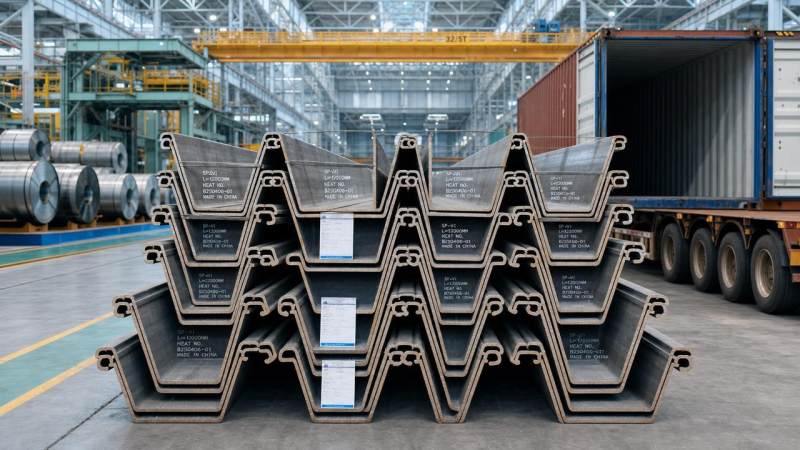
When evaluating a Steel Sheet Pile supplier for industrial use, the first question is not price. It is capability. A supplier may offer an attractive quotation, but if production control, material traceability, and export coordination are weak, the total sourcing risk rises quickly.
Industrial buyers usually work under pressure from project schedules, technical approval procedures, and budget targets. That is why supplier evaluation should focus on measurable factors such as steel grade consistency, rolling or forming capacity, inspection procedures, packing methods, and experience with international shipping documents.
- Manufacturing scope: Can the supplier handle standard sheet piles, related structural sections, and project-specific steel fabrication requirements?
- Quality stability: Are raw material control, dimensional inspection, and batch identification managed consistently?
- Compliance readiness: Can the supplier work with ASTM, EN, JIS, or GB standards according to target market requirements?
- Export reliability: Does the supplier understand packaging, container loading, lead time planning, and document accuracy for overseas buyers?
For many procurement teams, especially those comparing Asian manufacturers, the real value comes from suppliers that reduce coordination complexity. Hongteng Fengda, as a structural steel manufacturer and exporter from China, supports global buyers with structural sections, customized steel solutions, and production aligned with international standards. This is particularly useful when sheet pile procurement is part of a larger industrial steel package.
How to compare suppliers beyond unit price
A proper comparison of a Steel Sheet Pile supplier for industrial use should separate visible cost from hidden cost. Unit price matters, but delays, rejection risk, inconsistent dimensions, and incomplete test records often create a higher total landed cost than a slightly higher initial offer.
The table below helps business evaluators compare suppliers using practical steel procurement criteria rather than only quotation value.
This comparison framework makes supplier screening more objective. It also helps procurement teams explain decisions internally to engineering, finance, and project management departments.
Common hidden costs in industrial steel procurement
A low quote can become expensive when the supplier cannot maintain dimensional consistency, cannot provide standard-compliant documentation, or cannot ship on time. Rework, idle labor, demurrage, and late project penalties often exceed small savings on material price.
For buyers managing cross-border steel sourcing, the better supplier is often the one with stronger communication, clearer technical confirmation, and more predictable execution.
Which technical and compliance points matter most?
A Steel Sheet Pile supplier for industrial use must be evaluated through technical discipline. Industrial applications often involve retaining structures, foundation support, temporary works, waterfront projects, and civil infrastructure where steel performance and consistency are critical.
Business evaluators should confirm whether the supplier can support the required material grades, dimensions, corrosion protection requirements, and test documentation. If sheet piles are part of a wider procurement package, the supplier should also coordinate with other structural steel items to simplify sourcing.
- Applicable standards requested by the project or local authority
- Mechanical property expectations for strength and toughness
- Tolerance control for interlocking profiles and length accuracy
- Surface condition, coating, or anti-corrosion preparation where needed
- Inspection scope before shipment, including third-party checks if required
Hongteng Fengda works across structural steel categories including angle steel, channel steel, steel beams, cold formed steel profiles, and customized components. For industrial buyers, this broader manufacturing scope is useful because procurement often combines multiple steel products under one project schedule and one export coordination plan.
Natural product insertion for related industrial sourcing
In some industrial projects, sheet piles are not sourced alone. Buyers may also need pipe materials for process lines, supporting structures, or adjacent engineering work. In such cases, combining suppliers with wider steel supply capability can improve schedule control and reduce communication gaps.
For example, a106 gr b Seamless Pipe may be relevant for projects that require high strength and good low-temperature toughness in addition to structural steel items. The available range includes outer diameter from 10 to 3048mm, length from 1 to 12m, thickness from 0.5 to 75mm or customized options, with tolerance references such as outer diameter +/- 0.5mm, thickness +/- 0.05mm, and length +/- 5mm.
Supporting tests can include squash test, extended test, water pressure test, crystal rot test, and heat-related verification. Buyers working on international projects may also pay attention to references to ASTM, DIN, JIS, EN, BS, GOST, and GB standards during technical review. This type of product integration is especially practical when a supplier can support both structural sections and related industrial steel materials.
How to assess lead time, supply stability, and export execution
For business evaluators, delivery reliability is often as important as price and quality. A Steel Sheet Pile supplier for industrial use should not only state a lead time but also explain how that lead time is controlled. Reliable scheduling usually reflects stronger production planning, raw material coordination, and shipment management.
The following table can be used during supplier review meetings to test whether lead time commitments are realistic.
A good answer includes sequence, ownership, and documentation. A weak answer stays general. That difference often reveals whether the supplier can truly support industrial project execution.
Why export experience matters for Chinese steel sourcing
Export experience is not only about shipping goods overseas. It includes understanding destination standards, packing methods for long transit, customs documentation, and communication speed when changes occur. Suppliers serving North America, Europe, the Middle East, and Southeast Asia typically build better discipline around these details.
Hongteng Fengda supports international buyers with stable production capacity, consistent quality control, and dependable lead times. For procurement teams, this reduces the administrative burden of coordinating multiple issues across factories, forwarders, and project stakeholders.
What procurement process reduces risk most effectively?
A structured procurement process helps evaluators compare each Steel Sheet Pile supplier for industrial use under the same rules. This prevents decisions based only on sales response speed or first-quote pricing.
- Define technical scope clearly, including standard, dimensions, quantity, coating, packing, and inspection requirements.
- Request supporting documents early, such as sample MTC format, inspection checklist, and export packing details.
- Compare total offer value, including delivery term, payment structure, production schedule, and after-sales response.
- Verify communication quality during quotation. Slow or unclear technical feedback often predicts execution problems later.
- Use a trial order or sample review for new suppliers when project timing allows.
This process is especially important when sourcing from overseas manufacturers. The earlier technical and commercial details are clarified, the lower the risk of later dispute over specification, quantity, or shipping readiness.
Common mistakes when choosing a Steel Sheet Pile supplier for industrial use
Many sourcing problems come from evaluation shortcuts. Buyers may assume all suppliers can provide the same product once the section size looks similar. In practice, differences in steel origin, process control, tolerance handling, and documentation discipline can be significant.
- Choosing based only on lowest price without checking hidden execution risks
- Accepting unclear lead time commitments without milestone confirmation
- Overlooking standard compatibility between project specification and supplier offer
- Ignoring the importance of export packaging, marking, and traceability
- Treating communication quality as secondary, even though it strongly affects order execution
Business evaluators should also be careful when suppliers promise overly broad capabilities without giving product-specific proof. Good suppliers explain what they can produce, what standards they commonly follow, and how they handle customized requests.
FAQ: practical questions from sourcing and evaluation teams
How do I verify whether a supplier is suitable for industrial sheet pile procurement?
Start with technical alignment, then move to execution ability. Review the offered standard, grade, dimensions, tolerances, inspection scope, and packing method. After that, assess whether the supplier can maintain schedule and provide export documentation correctly. A supplier that answers these areas clearly is usually more reliable than one that focuses only on price.
What is the most important sign of a dependable Steel Sheet Pile supplier for industrial use?
Consistency is the strongest sign. That includes consistent technical response, consistent quality control, and consistent delivery communication. In industrial procurement, stability often creates more value than aggressive pricing because project delays and quality claims are expensive.
Should I prefer a supplier with a broader structural steel product range?
If your project includes multiple steel categories, yes. A supplier with wider structural steel capability can simplify procurement, reduce coordination time, and improve compatibility across items. This is useful when sheet piles are purchased together with beams, channels, angle steel, cold formed profiles, or customized fabricated components.
What documents should business evaluators request before order confirmation?
Ask for quotation details, technical specification confirmation, sample inspection records, material certificate format, packing method, delivery schedule, and export document list. If the project has strict approval requirements, confirm standard references and any third-party inspection arrangement before finalizing the order.
Why choose us for industrial steel sourcing support?
For buyers comparing a Steel Sheet Pile supplier for industrial use, the strongest advantage is not a marketing claim. It is the ability to support technical review, production coordination, and export delivery with clear communication. Hongteng Fengda provides structural steel manufacturing and export support from China for global construction, industrial, and manufacturing projects.
Our supply scope covers angle steel, channel steel, steel beams, cold formed steel profiles, and customized structural steel components, with production aligned to common international standards such as ASTM, EN, JIS, and GB. This helps procurement teams manage both standard specifications and OEM requirements with fewer sourcing gaps.
If you are evaluating industrial steel suppliers, you can contact us to discuss parameter confirmation, product selection, lead time planning, customized solutions, certification requirements, sample support, and quotation comparison. A clearer technical and commercial discussion at the start usually leads to a faster, safer procurement decision.
Please give us a message


Please enter what you want to find