How to Select Pipe Stainless for Food, Chemical, and Marine Applications
Choosing the right pipe stainless solution is critical for food processing, chemical handling, and marine environments where hygiene, corrosion resistance, and long-term performance matter most.
For complex projects, the wrong material often creates hidden maintenance costs, shutdown risks, and compliance problems.
The better approach is to match pipe stainless grades to the service environment, fabrication method, and expected lifecycle.
This guide explains how to evaluate pipe stainless options with confidence and make a practical sourcing decision.
Why Pipe Stainless Selection Has Become More Demanding
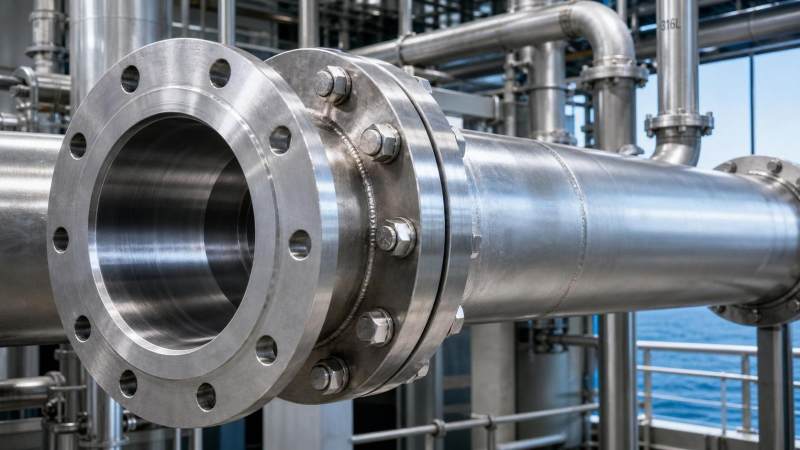
In recent years, operating conditions have become less forgiving across food, chemical, and marine sectors.
Food lines need cleaner surfaces and easier sanitation.
Chemical systems face stronger media, temperature swings, and stricter safety expectations.
Marine projects deal with salt spray, splash zones, crevice corrosion, and difficult maintenance access.
That is why pipe stainless can no longer be selected by price alone.
A lower initial quote may look attractive, but failure in service is far more expensive.
At the procurement level, the most reliable decisions balance corrosion resistance, cleanability, fabrication, availability, and long-term total cost.
Start with the Real Application Conditions
Before comparing grades, define how the pipe stainless system will actually be used.
This step sounds basic, but it prevents many specification errors.
Key questions to clarify
- What media will contact the internal surface?
- Will the pipe stainless face chlorides, acids, alkalis, or cleaning chemicals?
- Is the system welded, bent, polished, or exposed outdoors?
- What temperature range and pressure level are expected?
- Are there hygiene, inspection, or certification requirements?
- How costly would downtime or replacement be?
These questions shape the correct pipe stainless specification more than catalog descriptions ever will.
How to Choose Pipe Stainless for Food Processing
Food applications demand a pipe stainless surface that stays clean, resists contamination, and tolerates repeated washdowns.
Surface finish matters almost as much as alloy selection.
Smooth finishes reduce product buildup and help shorten cleaning cycles.
What usually matters most
- Resistance to food acids, moisture, and cleaning agents.
- Weld quality and internal smoothness.
- Compatibility with sanitary design requirements.
- Stable supply for replacement and expansion.
For many food systems, austenitic grades are preferred because they perform well under frequent cleaning and variable processing conditions.
Still, not every surrounding component requires the same grade as the main process line.
In support structures, covers, kitchen equipment, and non-critical exterior parts, ferritic stainless can be a sensible cost-control option.
A useful example is 430 Stainless Steel Coil, which is widely used in kitchenware, food industry equipment, and food and beverage packaging components.
With tensile strength of at least 520MPa and yield strength of at least 275MPa, it supports applications needing good formability and dependable strength.
That does not mean it replaces every sanitary pipe stainless grade.
It means buyers can assign materials more precisely and avoid over-specifying every part of a food project.
How to Evaluate Pipe Stainless for Chemical Service
Chemical handling is where pipe stainless selection becomes especially unforgiving.
A grade that performs well in one plant may fail quickly in another.
The reason is simple: concentration, temperature, flow rate, and contamination levels all affect corrosion behavior.
A practical review process
- List all chemicals, including cleaning fluids and occasional exposure media.
- Check operating temperature, idle conditions, and concentration peaks.
- Review welded areas, bends, and low-flow sections for localized corrosion risk.
- Match the pipe stainless grade to the harshest realistic condition.
- Confirm standards, traceability, and mill documentation before ordering.
For many chemical environments, a generic stainless choice is not enough.
Pitting, crevice attack, and stress corrosion can appear even when the metal looks acceptable on paper.
This is why experienced buyers ask suppliers for application guidance, not just quotations.
From a sourcing perspective, suppliers that understand both material science and fabrication usually reduce project risk.
What Changes in Marine Pipe Stainless Applications
Marine environments punish weak specifications faster than most industrial settings.
Salt, humidity, splash exposure, and poor drainage all work against the material.
A pipe stainless system near the coast may behave very differently from one in inland service.
Marine decision points
- Continuous seawater contact requires far stronger corrosion resistance.
- Splash zones often fail first because oxygen and salt concentrate together.
- Hidden joints and clamps can trap moisture and trigger crevice corrosion.
- Surface finish and maintenance access affect service life more than many teams expect.
In practical terms, marine pipe stainless selection should include both alloy and design review.
Even a strong grade can disappoint if the geometry traps chlorides or weld finishing is poor.
This also explains why lifecycle thinking matters so much in ship parts, coastal facilities, and offshore support structures.
Compare More Than Grade Names
When selecting pipe stainless, grade is only one part of the decision.
Buyers should also compare finish, tolerances, weldability, test reports, and production consistency.
A supplier with modern production and strict quality control can make these factors easier to verify.
That is especially relevant when products must comply with ASTM, EN, JIS, and GB requirements across export markets.
How to Reduce Sourcing Risk for Pipe Stainless
In real purchasing work, risk usually comes from unclear specifications and uneven supplier capability.
A structured sourcing checklist helps prevent both.
Use this checklist before approval
- Confirm the exact service environment for each pipe stainless section.
- Request chemical composition and mechanical property records.
- Verify finish options such as BA, 2B, NO.1, NO.4, HL, or 8K when relevant.
- Check available dimensions, lead times, and batch consistency.
- Review certifications such as ASTM, AISI, JIS, EN, ISO, SGS, or BV.
- Ask whether OEM or custom fabrication support is available.
This is where experienced exporters can add value beyond material supply.
Hongteng Fengda, for example, supports global industrial and manufacturing projects with stable production, customized solutions, and international standard compliance.
That kind of support helps buyers control cost without losing sight of long-term reliability.
Make the Final Decision with Lifecycle Cost in Mind
The best pipe stainless choice is rarely the cheapest line item.
It is the option that performs reliably under real operating stress and stays practical to source over time.
For food processing, focus on hygiene, finish, and cleanability.
For chemical service, match the grade to the harshest realistic media condition.
For marine projects, account for chlorides, trapped moisture, and difficult maintenance access.
When pipe stainless is evaluated this way, the result is usually better uptime, lower replacement risk, and smoother project execution.
A disciplined specification process, paired with a dependable supplier, gives the project a much stronger foundation from the start.
Please give us a message


Please enter what you want to find