Choosing the right steel exporter is critical for maintaining stable supply, complete shipping documents, and manageable trade risk. For business evaluators, the real challenge is not just price, but whether a supplier can deliver consistent quality, comply with international standards, and support smooth cross-border transactions. This article explains how to assess a steel exporter’s production capacity, document reliability, and risk control ability so you can make safer sourcing decisions and build a more dependable long-term supply chain.
The core search intent behind this topic is practical supplier evaluation. Readers are usually not looking for general trade theory. They want a clear way to judge whether a steel exporter can support ongoing procurement without causing delivery delays, customs issues, quality disputes, or financial exposure.
For business evaluators, the most important concerns are stable output, specification consistency, valid export documents, clear quality control, and the supplier’s ability to respond when problems occur. They also want evidence, not sales language, because procurement risk often appears after the first shipment rather than before it.
The most useful content, therefore, is actionable evaluation criteria: what to verify, what documents to request, what warning signs to notice, and how to compare suppliers beyond unit price. Strong articles on this subject should emphasize capacity, compliance, communication, and risk control while avoiding broad descriptions with little decision value.
What Business Evaluators Really Need to Confirm First
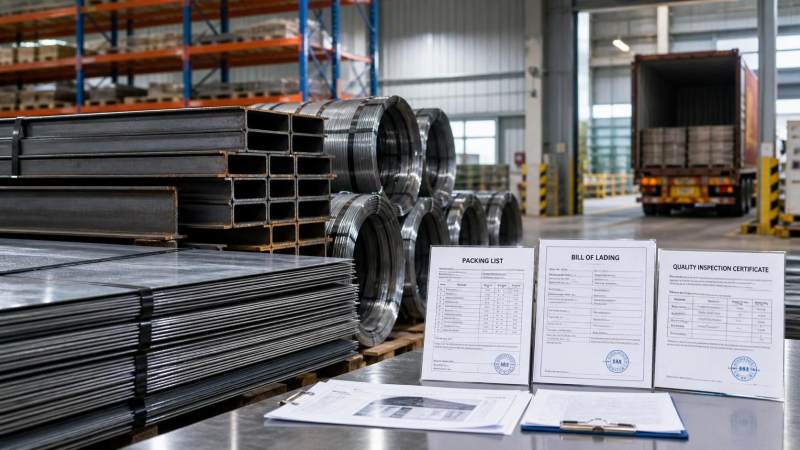
When assessing a steel exporter, the first question should be whether the company can support continuity, not whether it offers the lowest quotation. A low initial price loses value quickly if supply becomes unstable or if shipment documents are incomplete.
In most steel procurement decisions, risk comes from inconsistency. One shipment may meet requirements, while later orders show variation in dimensions, coating, mechanical properties, packing, or lead time. That is why evaluators should judge the exporter as a long-term operating partner, not just a trading contact.
A reliable exporter should be able to explain its product scope, production arrangement, inspection process, delivery schedule, and export handling method in a structured way. If answers are vague, delayed, or frequently changing, that usually signals future execution problems.
For structural and industrial sourcing, stability matters even more than headline pricing. Buyers working on construction, manufacturing, and project supply chains often face schedule penalties, installation delays, or downstream rework when material arrivals become uncertain.
How to Check Whether Supply Capacity Is Truly Stable
Stable supply starts with a realistic understanding of the exporter’s manufacturing model. You need to know whether the supplier is a direct manufacturer, an exporter coordinating multiple mills, or a mixed operation combining its own production with external sourcing.
None of these models is automatically bad, but each creates different risks. Direct manufacturers usually offer stronger process control and production visibility, while pure trading firms may provide flexibility but depend heavily on third-party mill schedules and document accuracy.
Ask for evidence of factory capability, including major product categories, workshop equipment, production lines, normal output range, and lead time by order type. Capacity claims should match the products being discussed, not remain at a generic corporate level.
For a company such as Hongteng Fengda, the relevant strength lies in structural steel manufacturing and export support for global construction and industrial demand. A buyer should confirm how that capability translates into actual order execution for the specific steel categories being sourced.
It is also important to verify standard coverage. Exporters serving multiple regions should be familiar with ASTM, EN, JIS, and GB requirements and understand how to align production with project specifications, local compliance expectations, and customer inspection standards.
Another useful checkpoint is order mix. If a supplier regularly handles both standard steel sections and customized structural components, that may indicate stronger process coordination. It often means the company is used to managing drawing review, tolerance control, and shipment planning.
Lead time consistency matters as much as nominal capacity. Ask how the exporter manages peak production periods, raw material fluctuations, and schedule conflicts between domestic and export orders. A dependable answer should include planning logic, not just reassurance.
You should also review packaging capability. Steel products travel through multiple handling points, and poor bundling, coil protection, or marking can turn acceptable production into a claim issue at destination. Export readiness includes packaging discipline, not only manufacturing.
Which Documents Reveal Whether an Exporter Is Reliable
In cross-border steel trade, documents are not administrative details. They directly affect customs clearance, payment release, cargo identification, standards compliance, and claim resolution. An exporter with weak documentation control creates risk even if the material itself is acceptable.
At minimum, evaluators should review the supplier’s ability to prepare commercial invoices, packing lists, bills of lading, certificates of origin, inspection records, and mill test certificates. Depending on the market, additional compliance files may also be required.
The real test is not whether the exporter says these documents are available. It is whether the documents are accurate, consistent across versions, and aligned with contract terms, product specifications, and shipment quantities. Small inconsistencies can cause costly clearance delays.
Mill test certificates deserve particular attention because they support traceability and technical confirmation. Review whether the data format is clear, whether heat numbers and specification references are present, and whether the certificate matches the actual shipped goods.
Document reliability also includes naming discipline. Product descriptions should be consistent across quotation, proforma invoice, production record, test report, packing list, and transport documents. Frequent wording changes are often a sign of poor internal control.
Ask the exporter how documents are checked before shipment. Strong suppliers usually have an internal review flow involving sales, production, quality, and logistics teams. Weak suppliers often rely on one person to compile everything at the end, which increases error rates.
For repeat purchases, document consistency is an excellent signal of operational maturity. A supplier that delivers accurate paperwork shipment after shipment is usually managing deeper systems correctly, including order coding, traceability, and communication between departments.
How to Evaluate Quality Control Beyond a Sample or One Shipment
Many buyers make the mistake of evaluating a steel exporter based on one approved sample or one successful trial order. That is not enough. Procurement risk is usually linked to repeatability across batches, months, and production cycles.
You should ask how incoming raw materials are controlled, how dimensions and properties are checked during production, and how final inspection is recorded before dispatch. A serious exporter should be able to describe checkpoints clearly and provide examples of inspection records.
For products used in industrial, construction, or fabrication settings, tolerance consistency is often more valuable than attractive surface appearance alone. Quality control should cover dimensional accuracy, coating condition where applicable, strength performance, and packaging suitability.
It is also useful to ask whether third-party inspection can be arranged. Exporters confident in their systems are usually willing to support pre-shipment inspection, video inspection, or independent verification when the order value or project risk justifies it.
Product range can also indicate process capability. For example, a supplier handling structural sections along with application-oriented items such as Galvanized Stainless Steel Wire may show broader experience in matching specifications to use cases across construction, packaging, decoration, wire mesh, and industrial demand.
In that kind of product, evaluators would review practical indicators such as wire diameter range, zinc coating thickness, tensile strength, packaging format, and whether the material can tolerate cold stamping, rolling, or bending without coating damage.
That level of specification detail matters because it shows whether the exporter understands performance in application, not just commodity naming. Buyers should favor suppliers who connect technical data with actual usage conditions and transport requirements.
How to Assess Trade Risk Before Signing the Contract
Trade risk in steel export usually comes from four areas: payment exposure, delivery delay, specification dispute, and claims that become difficult to enforce across borders. Evaluators should measure all four before moving from quotation to order confirmation.
Start with payment terms. An exporter should be able to explain accepted methods such as T/T or L/C, deposit expectations, balance timing, and what documents support payment release. The right structure depends on order size, market practice, and trust level.
Then review contract clarity. Product specification, quantity tolerance, standards, packing method, delivery term, inspection basis, claim period, and force majeure language should all be clear. A vague contract creates risk even when both sides are acting in good faith.
Incoterms also deserve attention because they affect cost responsibility and logistical control. Buyers should confirm who handles inland transport, port charges, booking, insurance, and customs coordination. Misunderstandings here often create disputes that look like pricing issues later.
Country and route risk should also be considered. Ask about the exporter’s experience shipping to your region, including common ports, transit patterns, documentation requirements, and any frequent customs questions. Familiarity with destination procedures reduces operational friction.
Communication response time is another strong predictor of trade risk. If the supplier is slow to clarify technical points, revise documents, or acknowledge problems during quotation, that pattern usually becomes worse during production and shipment pressure.
A mature exporter should also have a corrective action approach. If coating thickness falls outside range, if marking is incomplete, or if loading is delayed, the supplier should be able to explain how it identifies the issue, communicates it, and proposes resolution.
What Warning Signs Usually Indicate Hidden Procurement Problems
Some risk signals appear early, but buyers ignore them because the quotation looks attractive. One common warning sign is a supplier that gives firm pricing quickly but avoids detailed discussion of standards, tolerances, testing, or packing requirements.
Another warning sign is inconsistent company identity across email signatures, bank details, product catalogs, and shipping documents. This does not always mean fraud, but it does require careful verification before any payment commitment is made.
Be cautious if the exporter cannot provide recent shipment references by region or product type. A steel exporter serving international markets should have a record of actual export execution, even if customer names must remain confidential.
Overpromising lead times is also a red flag. If one supplier promises delivery dramatically faster than the market norm without explaining how, evaluators should verify whether production is truly available or whether the quote is designed mainly to win the order.
Watch for broad claims without supporting detail. Statements like “best quality,” “full standards,” or “quick documents” have little value unless backed by sample certificates, inspection examples, production photos, packing details, or a clear export workflow.
A Practical Evaluation Framework for Comparing Steel Exporters
To make supplier comparison more objective, business evaluators should use a structured scorecard. This helps reduce bias toward price alone and creates an internal record that supports procurement decisions during audit or management review.
Useful scoring categories include manufacturing capability, export experience, standards familiarity, quality control system, document accuracy, packaging method, lead time credibility, communication quality, payment flexibility, and claim-handling responsiveness.
Each category should be evaluated using evidence. For example, manufacturing capability can be supported by product scope and production data. Document reliability can be checked through sample files. Quality control can be reviewed through certificates and inspection records.
It is also wise to separate “quotation attractiveness” from “execution confidence.” A supplier may score well on initial cost but poorly on traceability or documentation discipline. That distinction helps procurement teams explain why the cheapest option is not always the safest.
For long-term sourcing, the best steel exporter is usually the one that reduces total operating risk. Stable quality, dependable lead time, and clean documents protect project schedules, inventory planning, and downstream customer commitments far more than small unit price differences.
Conclusion
Evaluating a steel exporter should be approached as a risk-management exercise, not a price comparison exercise. Business evaluators need clear evidence that the supplier can maintain stable supply, issue accurate documents, meet technical standards, and respond professionally when issues arise.
The most dependable decision comes from checking manufacturing reality, document control, quality repeatability, contract clarity, and communication discipline together. When these areas are strong, the exporter is far more likely to support safe, efficient, and scalable procurement.
For companies sourcing structural steel and related industrial products internationally, that evaluation discipline is what turns a supplier into a workable long-term partner. It also helps reduce trade friction, protect project performance, and build a more resilient global supply chain.
Please give us a message


Please enter what you want to find