Choosing the right pre-painted galvanized steel coil supplier is rarely a simple price comparison. For business evaluation teams, the real issue is whether a manufacturer can keep coating quality stable across repeated orders, deliver on time under fluctuating steel market conditions, and support claims with traceable production control. A low offer may look attractive in a quotation sheet, but in practice, inconsistent paint thickness, poor substrate quality, color variation, packaging damage, or delayed shipment can quickly erase any nominal savings.
In the PPGI market, the difference between a tradable supplier and a dependable manufacturer is often visible only after several order cycles. That is why evaluation should go beyond brochures, mill certificates, and sample coils. Buyers need to examine how the factory manages galvanized substrate sourcing, coating lines, curing control, inspection records, export packing, and production scheduling. These factors have a direct impact on scrap rates, customer complaints, installation performance, and downstream project timing.
When a buyer is assessing a pre-painted galvanized steel coil PPGI manufacturer, the most practical question is not “Can they produce PPGI?” but “Can they produce the same quality repeatedly, at the required lead time, with manageable commercial risk?”
Stable quality starts with the substrate, not the paint surface
Many procurement failures happen because evaluation focuses too much on the painted appearance of the top surface. Gloss, color, and visual finish matter, but they do not tell the whole story. PPGI performance begins with the galvanized base steel: thickness tolerance, zinc coating mass, flatness, mechanical properties, and surface cleanliness all influence final coating adhesion and forming performance.
If a manufacturer does not control or clearly disclose the source and grade of the galvanized substrate, quality consistency becomes harder to predict. Some factories rely on mixed sourcing from different upstream mills, which may be acceptable for low-risk applications but problematic for projects requiring tight consistency. Buyers should ask:
- Is the GI substrate produced in-house or sourced externally?
- Are upstream mills stable from order to order?
- What zinc coating range is commonly supplied, such as Z80, Z120, Z180, or other specified levels?
- How are thickness tolerances verified before painting?
- Can the supplier provide traceability from base coil to finished PPGI coil?
A manufacturer with stable substrate sourcing usually has a stronger foundation for long-term consistency than one that buys opportunistically based only on weekly raw material prices.
Coating system matters more than many buyers initially expect
Commercial teams sometimes assume all PPGI is broadly similar if nominal thickness and color code match. In reality, coating systems can differ significantly in durability, formability, chalk resistance, and corrosion performance. Polyester, SMP, HDP, and PVDF systems serve different end-use conditions. The supplier should be able to explain not only what is available, but why a certain paint system is suitable for roofing, sandwich panel production, appliance shells, rainwater goods, or indoor industrial use.
Evaluation should include the following practical points:
- Top coat and back coat thickness control
- Primer specification
- Paint brand or paint source consistency
- Curing temperature control
- Adhesion, T-bend, pencil hardness, impact, and solvent resistance testing
- Outdoor durability expectations under the target climate
A serious manufacturer will not treat paint thickness as only a contractual number. It will treat it as a controlled process variable. If the answer to technical questions is vague, or if all products are presented as suitable for every application, that usually indicates limited process discipline.
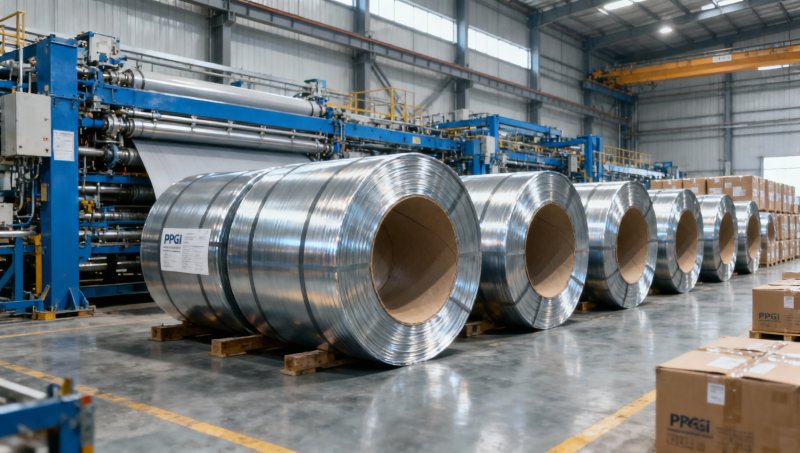
Production control is the best predictor of repeatability
For business evaluators, the most useful signal is whether the factory operates with defined production control rather than informal workshop habits. Stable quality is usually supported by documented operating standards, calibrated inspection tools, and retained production records. This becomes especially important when orders are repeated across months with different raw material costs, line loading, or labor conditions.
Questions worth asking during supplier screening include:
- How many coating lines are in operation, and what is their practical monthly capacity?
- What is the normal thickness and width range handled on each line?
- How is color matching controlled between batches?
- Are wet film and dry film thickness measured during production or only after completion?
- How are edge defects, roller marks, orange peel, pinholes, and curing issues handled?
- What percentage of output is typically downgraded or reworked? 【待核实 if not disclosed】
In supplier visits or video audits, buyers should pay attention to details that are rarely highlighted in sales presentations: coil identification labels, segregation of conforming and non-conforming material, condition of the painting line, storage protection for finished coils, and whether inspection data appears systematic or improvised.
Lead time reliability depends on scheduling discipline, not only stated capacity
One of the most common misconceptions in steel sourcing is that larger capacity automatically means faster delivery. In practice, lead time reliability depends on how the manufacturer schedules substrate arrivals, allocates line time, manages color changeovers, and handles export documentation and container loading. A factory may have high nominal annual output but poor planning visibility for smaller or customized export orders.
For PPGI, lead time risk often comes from four areas:
- volatile substrate availability;
- overloaded coating lines during peak season;
- non-standard colors or special paint systems requiring longer preparation;
- port congestion or container booking delays.
Buyers should therefore request more than a quoted lead time. Ask for the supplier’s typical production cycle by order type, peak-season variation, and on-time shipment history if they are willing to share it. Even if exact KPI disclosure is limited, the quality of the response often reveals the maturity of their delivery management.
A useful commercial test is to compare how a supplier handles two scenarios: a standard repeat order and a custom order with special color, thickness, or coating system. Manufacturers with real scheduling control can explain both clearly. Traders or loosely managed factories often respond with general promises.
Certification is necessary, but not sufficient
Certificates help reduce risk, but they should not be mistaken for proof of daily operational stability. ISO certification, third-party inspection reports, and compliance with customer-requested standards are relevant, yet buyers should verify whether these are tied to actual production routines. A supplier may hold valid certification while still showing inconsistency in process control or documentation accuracy.
For export-oriented PPGI purchasing, common checks include:
- quality management certification such as ISO 9001 if applicable;
- SGS, BV, or other third-party inspection support when required;
- material test certificate format and traceability;
- coating and thickness inspection records;
- packaging specifications aligned with sea freight risk.
For some buyers, it is also useful to review how the supplier manages claims. A factory with a clear non-conformance process, retained samples, and batch records is usually more reliable than one that focuses only on pre-shipment paperwork.
Export experience reduces hidden transaction cost
Business evaluation should include the supplier’s export execution ability, not only manufacturing ability. Many sourcing problems arise after production: incorrect labels, inconsistent packing lists, missing documents, poor container loading, weak moisture protection, or misunderstanding of destination market requirements.
A manufacturer with mature export experience usually understands:
- how to protect coils against transit corrosion and edge damage;
- how to load mixed specifications efficiently;
- how to prepare commercial documents accurately;
- how to coordinate with inspections and freight timelines;
- how to communicate quality deviations before shipment rather than after arrival.
This matters because the lowest ex-works cost can become the highest landed cost if repacking, claim handling, demurrage, or project delays follow.
In adjacent flat steel categories, the same logic applies. Buyers sourcing corrosion-resistant materials for fabricated components, equipment housings, or transport applications often evaluate not just the material itself but the supplier’s consistency in finish, size control, and certification support. That is one reason products such as 430 Stainless Steel Plate are commonly reviewed with attention to mechanical properties, finish options like BA, 2B, NO.1, NO.4, HL, and 8K, and third-party verifiability rather than price alone. The evaluation framework is different from PPGI in technical detail, but similar in commercial logic: repeatability matters more than a single acceptable sample.
Samples can mislead if they are not linked to real production conditions
Receiving a good-looking sample is not enough. Samples are useful only when buyers know whether they came from standard production, trial production, or hand-selected stock. Commercially, the bigger concern is batch consistency after the order is confirmed.
A better approach is to request evidence from actual production runs:
- recent test reports for comparable specifications;
- photos or videos of coil marking and packaging from shipped orders;
- batch-based inspection records;
- references in similar markets or applications where available.
For color-critical applications, buyers may also want clear agreement on color tolerance basis. Visual approval of a swatch without batch control terms can lead to disputes later.
Price evaluation should separate visible cost from risk cost
In steel procurement, a lower unit price often hides risk transfer from supplier to buyer. This is especially true in PPGI, where quality variation may not appear until forming, outdoor exposure, or end-customer use. A business evaluation team should compare offers in terms of total sourcing risk, not just base material price.
Useful cost questions include:
- Does the quoted price reflect the same zinc coating and paint system?
- Are nominal and minimum thickness defined clearly?
- Is packaging comparable across suppliers?
- Are tolerance claims realistic and measurable?
- How likely is rework, claim handling, or production delay if inconsistency occurs?
The cheapest offer may be economically rational for low-end, non-critical applications with flexible delivery schedules. It is far less attractive for project-based procurement, repeat distribution programs, or customers who impose strict appearance and service-life requirements.
What to verify before approving a long-term supplier
For business evaluation personnel, the most reliable approval process combines technical review, commercial comparison, and operational validation. Before entering a framework agreement or repeat purchase arrangement, buyers should be comfortable with five points.
- Specification control: the supplier understands the difference between what is quoted and what is actually required in service.
- Traceability: each coil can be linked to substrate, coating batch, and inspection records.
- Capacity realism: stated production volume matches the supplier’s ability to deliver the buyer’s actual order pattern.
- Export execution: packing, documents, and shipment coordination are proven, not assumed.
- Claim response: problems can be investigated and resolved through records, not arguments.
Where possible, trial orders should be structured to test more than product quality. They should also test communication speed, flexibility on documentation, packaging discipline, and shipment accuracy. These are often the same factors that determine whether the relationship remains efficient after larger volumes begin.
The best manufacturer is not always the biggest one
In today’s market, buyers may encounter large integrated mills, specialized coating factories, OEM-oriented processors, and export traders presenting themselves as manufacturers. Each may fit a different sourcing model. A large supplier may offer stronger raw material access and broader specification coverage, while a mid-sized specialized factory may provide better responsiveness and tighter control for customized export orders.
The key is alignment between supplier capability and purchase profile. If your orders require strict repeat color control, predictable monthly replenishment, and responsive coordination on mixed specifications, the ideal supplier may be the one with the strongest operational discipline rather than the most impressive capacity statement.
For procurement and commercial evaluation teams, selecting a PPGI manufacturer should be treated as a risk assessment exercise supported by technical evidence. Price remains important, but it should be read in context: substrate consistency, coating control, scheduling reliability, certification credibility, and export execution determine whether that price is truly competitive over time. In stable sourcing programs, the supplier that causes fewer surprises usually creates the lower real cost.
Please give us a message


Please enter what you want to find