Choosing the right Galvanized Steel Wire Rope supplier is a critical step for procurement and evaluation teams seeking consistent quality, compliance, and long-term supply stability. Beyond price, buyers should assess manufacturing standards, export experience, customization capability, and delivery reliability to reduce sourcing risk and support project performance. This guide outlines the key factors that matter when evaluating potential suppliers.
For buyers in construction, lifting, marine, infrastructure, and industrial manufacturing, the supplier review process usually affects more than one purchase order. It can influence project safety, maintenance cycles, claim exposure, and cash-flow planning over 6–24 months.
A dependable Galvanized Steel Wire Rope supplier should be evaluated through production capability, raw material control, coating consistency, tensile performance, documentation accuracy, and export service reliability. For commercial assessment teams, a structured review model reduces hidden risk and improves long-term sourcing decisions.
Core Criteria for Evaluating a Supplier
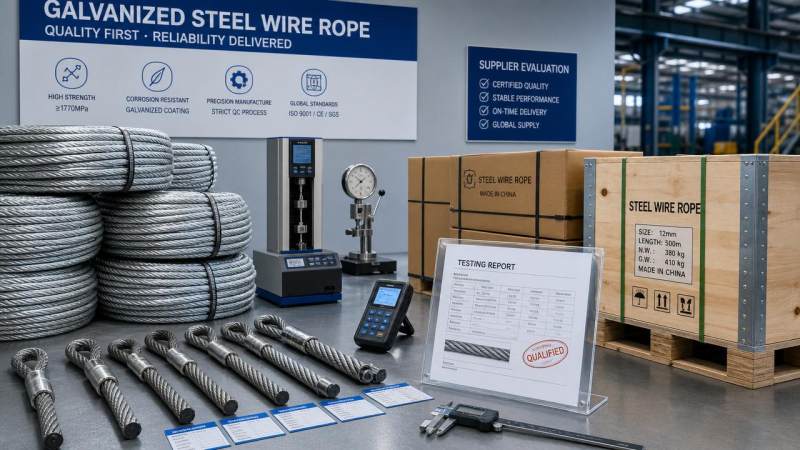
When screening a Galvanized Steel Wire Rope supplier, procurement teams should begin with 4 core questions: Can the factory produce to specification, can it prove compliance, can it deliver consistently, and can it support international trade requirements without delay?
Manufacturing Capability and Process Control
Wire rope quality starts long before final packing. Buyers should verify whether the supplier controls rod selection, drawing, stranding, galvanizing, and final inspection. A factory with in-house or closely managed upstream processes usually offers better consistency than a trader with fragmented subcontracting.
In practical terms, ask about monthly capacity, common rope constructions, diameter range, and lead time stability. For many industrial orders, a normal lead time may fall within 15–35 days depending on size mix, coating requirement, and order volume.
What buyers should confirm
- Whether raw material inspection is done for each batch
- Whether zinc coating thickness is checked by standard method
- Whether tensile strength and elongation are recorded before shipment
- Whether rope construction tolerances are controlled within agreed limits
- Whether production records can be traced back by heat or batch number
Standards, Testing, and Documentation
A qualified Galvanized Steel Wire Rope supplier should be comfortable working with ASTM, EN, JIS, or GB requirements depending on destination market and application. Commercial teams should not only ask if the supplier “meets standards,” but also request sample mill test data, inspection formats, and packaging labels used for export shipments.
At minimum, documentation should cover diameter, construction, surface finish, tensile data, net weight, batch reference, and shipment quantity. If the rope is intended for lifting, port handling, or infrastructure use, the review threshold should be stricter than for general fencing or light industrial use.
The table below helps assessment teams compare suppliers on operational points that directly affect quality, compliance, and delivery performance.
The strongest suppliers are not always the cheapest on unit price. They are usually the most predictable across these 4 areas, which matters more when annual volumes, safety exposure, or project deadlines are significant.
Commercial Review Factors Beyond Price
Commercial evaluation should go beyond quotation comparison. Two suppliers may offer prices within a 3%–8% gap, yet total sourcing cost can differ more once packaging loss, late delivery, claim handling, and communication efficiency are included.
Export Experience and Market Familiarity
A supplier serving North America, Europe, the Middle East, or Southeast Asia should understand destination-specific documentation, labeling practices, and standard references. Export experience often reduces avoidable errors in container loading, moisture protection, and customs paperwork.
For example, a supplier used to international steel business is more likely to respond clearly on Incoterms, loading plans, coil identification, and shipping schedules within 24–48 hours. This responsiveness can save days during approval and dispatch stages.
Customization and Adjacent Product Support
In many sourcing programs, buyers do not purchase wire rope alone. They often need related steel inputs for fabrication, reinforcement, fencing, packaging, or component manufacturing. A supplier or manufacturing group with broader steel processing capability can simplify vendor management and reduce coordination cost.
For buyers that also source low-carbon wire products, Mild Steel Wire Rod can be relevant for downstream applications such as wire mesh, fences, tie ropes, hangers, filter baskets, and basic wire rope production. Typical grades include Q195 and Q235, with wire diameters from 0.25 mm to 5.0 mm, zinc coating thickness of 8–25 g/m2, and tensile strength in the 350–550 Mpa range.
This type of low carbon steel material is often chosen because it balances cost and ductility. It is commonly supplied in 50–1,000 kg coils with plastic film inside and woven bag outside, or in bobbin packaging, which may help buyers align input forms with workshop handling requirements.
Questions to ask during quotation review
- What is the standard MOQ for each diameter and construction?
- How many days are required for sample approval and bulk production?
- Can the supplier support OEM labels, private marks, or mixed container loading?
- What is the acceptable tolerance for diameter, coating, and weight per coil?
- How are claims handled if quality deviation is found after arrival?
The following comparison table can help commercial teams translate quotations into a more practical supplier decision model.
A price comparison becomes more reliable when these variables are weighted. For many commercial reviews, lead time stability and claim response quality are as important as the initial unit rate.
How to Conduct a Practical Supplier Assessment
A structured review process makes supplier selection more objective. For evaluation teams, a 5-step method is often effective: requirement definition, technical screening, sample review, commercial negotiation, and trial order monitoring.
Step 1: Define the application clearly
Before contacting any Galvanized Steel Wire Rope supplier, clarify whether the product will be used for lifting, static support, barriers, marine exposure, general industrial fastening, or agricultural purposes. The service environment influences coating expectations, rope construction, and inspection depth.
Step 2: Screen technical fit
Request specification sheets, sample test records, and standard references. The goal is to check whether the supplier understands required diameter, strength level, construction details, and corrosion resistance expectations rather than simply offering a generic product.
Step 3: Review samples and packaging
Sample review should include visual surface inspection, dimensional verification, marking format, and packing quality. Even if the product passes basic mechanical review, poor export packaging can still create losses during a 20–40 day sea transit cycle.
Step 4: Validate execution ability
Check production lead time, shipment planning, and communication discipline. Ask for a realistic production schedule rather than the shortest possible promise. Consistency across 3 consecutive orders is usually more valuable than one fast first shipment.
Step 5: Monitor the first order closely
The first bulk order is the best audit stage. Track whether pre-shipment documents match the confirmed specification, whether packing labels are correct, and whether the delivered quantity and condition match the packing list. A supplier that performs well at this stage is usually a better candidate for long-term contracts.
Common Risks and Warning Signs
Even experienced buyers can miss warning signals when a quotation looks competitive. The most common risk is not always visible in the first email; it usually appears in inconsistent data, vague replies, or missing process details.
Red flags during supplier evaluation
- No clear answer on applicable ASTM, EN, JIS, or GB standard
- No batch traceability or no sample inspection records
- Unusually short lead times with no production explanation
- Large price gap without justification on material or coating level
- Reluctance to discuss claim procedure or replacement terms
Why these signs matter
If a Galvanized Steel Wire Rope supplier cannot explain coating control, tensile range, or export packing details, the risk is usually transferred to the buyer. That may result in higher inspection cost, reordering pressure, or disputes after the goods arrive on site.
For steel buyers managing multiple SKUs, supplier discipline matters because one weak shipment can affect installation plans, subcontractor timing, and inventory turnover. A careful evaluation process helps prevent these downstream problems before the contract is placed.
Choosing a Long-Term Steel Supply Partner
The best sourcing relationship is built on repeatability. Buyers should look for suppliers that combine product quality with broader steel industry knowledge, especially when projects involve structural sections, fabricated components, or custom steel supply in parallel with wire products.
As a structural steel manufacturer and exporter from China, Hongteng Fengda supports global construction, industrial, and manufacturing buyers with stable production capacity, strict quality control, and solutions aligned with ASTM, EN, JIS, and GB requirements. This background can be valuable for customers seeking a supplier that understands both product compliance and project delivery demands.
A reliable supplier review should therefore balance 4 dimensions: technical conformity, operational reliability, export readiness, and long-term cooperation value. When these elements are verified early, purchasing teams can reduce sourcing risk, control total cost, and improve supply continuity.
If you are evaluating steel product sources for international projects, now is a good time to compare specifications, discuss custom requirements, and confirm feasible delivery plans. Contact us to get tailored support, review product details, or explore more steel solutions for your sourcing program.
Please give us a message


Please enter what you want to find