Choosing the right stainless steel square bar supplier requires more than checking price alone. Buyers should compare quality standards, production capacity, export experience, and product range, including stainless steel pipe wholesale, angle stainless steel supplier options, and related structural materials such as steel angle for construction. A reliable partner helps reduce sourcing risk, ensure compliance, and support long-term project performance.
For procurement teams, engineers, distributors, and project managers, supplier comparison is not only a purchasing task but also a risk-control process. A supplier that looks competitive on unit price may create hidden costs through inconsistent tolerances, delayed shipment, incomplete documents, or poor corrosion performance in service environments.
In the steel industry, stainless steel square bar sourcing often overlaps with broader structural steel needs. Many buyers also compare related categories such as angle steel, channel steel, beams, and fabricated components, especially when one project requires multiple materials under ASTM, EN, JIS, or GB standards. This makes a structured supplier evaluation method essential.
Define What You Need Before Comparing Suppliers
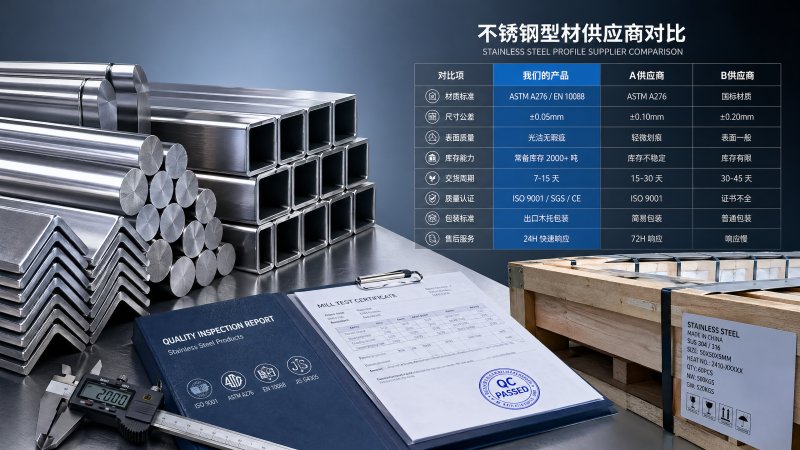
A meaningful comparison starts with a clear requirement sheet. Stainless steel square bar can vary by grade, size range, finish, straightness, cut length, packaging method, and end use. If your team sends only a basic inquiry such as “best price for square bar,” you will likely receive quotations that are difficult to compare fairly.
Technical evaluators should define at least 6 core points: material grade, bar size, length tolerance, surface requirement, applicable standard, and final application. For example, a square bar used in food equipment, marine fixtures, or fabricated brackets may require different corrosion resistance, dimensional consistency, and test documentation.
Procurement and finance teams should also separate “landed cost” from “ex-works price.” A quote that is 3% lower at first glance may become 8% to 12% higher after adding export packing, inland transport, port charges, inspection costs, and delivery delays. Supplier comparison should therefore include commercial and operational variables, not just material pricing.
Key Requirement Areas to Clarify
When comparing a stainless steel square bar supplier, users from engineering, QC, and purchasing should align on one internal checklist. This reduces back-and-forth communication and helps the supplier quote the right product from the first round.
- Material and standard: such as ASTM, EN, JIS, or GB, plus whether mill test certificates are required.
- Dimensions and tolerances: side length, length, straightness, corner condition, and acceptable tolerance range.
- Surface and processing: pickled, polished, cut-to-length, drilled, machined, or OEM fabricated condition.
- Commercial terms: MOQ, Incoterm, delivery window, inspection requirement, and payment terms.
A supplier that asks detailed follow-up questions is often easier to work with than one that replies with a very fast but generic quote. In many B2B steel projects, accurate early communication can save 7 to 15 days during approval and production release.
The table below shows a practical framework for defining your supplier comparison baseline before RFQ submission.
The main takeaway is simple: a supplier can only be compared accurately when all bidders are quoting the same technical and commercial basis. Without that, the lowest quote may not represent the lowest actual project cost.
Assess Quality Control, Standards, and Manufacturing Capability
Once specifications are clear, the next step is to verify whether the supplier can consistently meet them. In stainless steel square bar procurement, quality is not just about appearance. It includes chemistry control, dimensional accuracy, straightness, surface finish, mechanical properties, and batch traceability across repeated orders.
Ask how the supplier controls quality from raw material intake to final packing. A reliable manufacturer should be able to explain at least 4 checkpoints: incoming material verification, in-process dimensional inspection, final visual and measurement checks, and document review before shipment. This is especially important for buyers supplying regulated industrial or construction applications.
Production capability also matters. A supplier with stable equipment, repeatable processes, and experience in export packaging is better positioned to handle both standard orders and custom requests. For project-based sourcing, consistent lead times within 20 to 45 days are often more valuable than a low quote followed by uncertain delivery.
What Technical Teams Should Verify
Quality control and compliance are easier to compare when buyers use a standard review matrix. This helps technical staff, QC managers, and project owners distinguish between a trading response and a true manufacturing capability.
- Confirm supported standards such as ASTM, EN, JIS, and GB for relevant product categories.
- Review tolerance capability, including cut accuracy and out-of-straight limits where applicable.
- Check whether heat numbers and batch traceability are maintained on documents and packaging.
- Ask whether third-party inspection can be arranged before loading if the order is high-value or project-critical.
For broader sourcing programs, some buyers prefer suppliers that can also support related items. For example, if one vendor can supply square bars, angle sections, channel steel, beams, and fabricated structural parts, the buyer may reduce administration time by 15% to 25% across one procurement cycle.
Why Broader Product Capability Can Reduce Risk
Many importers begin with stainless steel square bar but later expand to additional metal products for the same project. In those cases, evaluating a supplier’s wider steel portfolio becomes practical. A company experienced in structural steel exports may help coordinate specifications, packing plans, and shipment consolidation more efficiently.
For example, projects in infrastructure, utility construction, and manufacturing often require anti-corrosion steel in parallel with stainless materials. In this context, products such as Galvanized Round Steel may be relevant for electric power towers, communication towers, highway protection, street light poles, marine components, and building steel structure components.
That product category typically covers diameter ranges from 16 mm to 250 mm, customizable lengths, and tensile strength around 570–820 MPa. Common standards include ASTM, EN, JIS, GB, BS, and AiSi, while hot galvanizing offers long anti-corrosion life for outdoor service. For buyers comparing suppliers, the ability to source both stainless and galvanized steel from one export-capable partner can simplify procurement planning.
The following table can be used to compare manufacturing and quality capability across shortlisted suppliers.
A qualified supplier should make technical risk easier to see and easier to manage. Clear process visibility is often a better indicator of long-term reliability than polished sales language.
Compare Export Experience, Communication, and Commercial Terms
For international buyers, export experience can directly affect delivery success. A stainless steel square bar supplier may produce acceptable material but still create problems if documentation is incomplete, packaging is unsuitable for sea transport, or communication slows after order confirmation. These issues can delay customs clearance by several days or even weeks.
Commercial teams should evaluate response quality as carefully as price. Good suppliers usually answer within 24 to 48 hours, confirm the latest lead time, explain packaging details, and identify quote assumptions early. Poor suppliers often avoid specifics on packing, test documents, or deviation handling, which increases risk during execution.
If your company serves North America, Europe, the Middle East, or Southeast Asia, export familiarity matters because each market may have different labeling, documentation, and acceptance expectations. Suppliers with ongoing overseas business are generally better prepared for packing marks, inspection coordination, and container loading discipline.
Commercial Terms That Should Be Compared Side by Side
Before final selection, buyers should standardize the commercial review. This is especially useful for purchasing managers, finance approvers, and business evaluators who need to compare total transaction risk instead of headline price.
- MOQ and production flexibility for trial orders, repeat orders, and mixed-size orders.
- Lead time by order type, such as stock supply, standard production, or OEM processing.
- Payment structure, including deposit percentage, balance terms, and document release timing.
- Packaging method, bundle weight, labeling, seaworthy protection, and claim handling policy.
A supplier that can support both standard specifications and customized structural steel components may be more valuable over a 12-month sourcing cycle than one that competes only on a single order. The long-term advantage comes from reduced supplier switching, better forecast alignment, and fewer technical misunderstandings.
Questions to Ask During Final Supplier Review
Use a short but disciplined question set during final evaluation. Ask how the supplier handles quantity deviation, replacement claims, third-party inspection, and schedule changes. Also confirm whether the company can provide related structural materials such as angle steel, channel steel, steel beams, and cold formed profiles when project scope expands.
For many B2B buyers, one responsive and technically consistent partner is more efficient than managing 3 to 5 fragmented vendors. This is particularly true when procurement, QC, and project teams are spread across different regions and need one point of accountability.
When reviewing suppliers from China, buyers often prioritize stable production capacity, consistent quality control, and dependable lead times. A manufacturer-exporter with broad international experience can help reduce sourcing risk and support smoother coordination from quotation through shipment.
Common Mistakes, Practical Scoring, and Final Selection Tips
A common mistake in stainless steel square bar sourcing is selecting a supplier after comparing only 2 items: price and nominal grade. This approach ignores tolerance capability, surface consistency, export execution, and after-sales responsiveness. In practice, these factors often determine whether the order creates extra internal cost.
Another mistake is overvaluing sample quality without checking repeatability. A supplier may deliver one acceptable sample batch but struggle on a larger production run. That is why buyers should review process control, documented inspection steps, and realistic capacity rather than relying only on first impressions.
A structured scoring method is useful for decision-makers. Many companies use a weighted model across 5 categories: technical compliance, quality system, capacity and lead time, export service, and total cost. Weighting can vary, but technical and delivery factors often account for 50% to 70% of the final decision in project-based procurement.
Example Supplier Scoring Matrix
The table below provides a practical model for procurement, engineering, and management teams to score shortlisted suppliers using the same criteria.
This type of matrix makes cross-functional decisions faster because it gives finance, QC, engineering, and management a shared basis for approval. It also reduces the chance that a low-price offer wins despite weaker overall execution capability.
Frequently Asked Questions
How many suppliers should be compared? In most B2B steel purchases, 3 qualified suppliers provide enough price and capability contrast. Fewer than 2 comparisons may limit visibility, while more than 5 can slow decision-making without adding much value.
What documents should be requested before ordering? At minimum, request a formal quotation, specification confirmation, mill test certificate format, packing details, and draft commercial terms. For higher-risk orders, add third-party inspection options and pre-shipment photo confirmation.
How important is supplier product range? It becomes very important when your projects involve multiple steel categories. A supplier that can support square bars, stainless-related options, and structural steel products may improve procurement efficiency and reduce coordination cost across repeated orders.
The best stainless steel square bar supplier is not simply the one with the lowest number on a quote sheet. It is the one that can meet specification requirements, maintain consistent quality, communicate clearly, and deliver on schedule with reliable export support.
For buyers looking for a long-term steel partner, it makes sense to evaluate broader capability as well. A professional structural steel manufacturer and exporter from China with experience in angle steel, channel steel, steel beams, cold formed profiles, and customized structural steel components can help streamline sourcing across multiple project needs.
If you are comparing suppliers for upcoming construction, industrial, or manufacturing projects, now is the right time to build a clearer evaluation checklist. Contact us to discuss your material requirements, request a tailored quotation, or learn more about practical structural steel sourcing solutions for global projects.
Please give us a message


Please enter what you want to find