Choosing the right steel wire rope manufacturer can directly impact safety, cost, and long-term project performance. Whether you are sourcing from a steel wire rope supplier, evaluating a Steel Wire manufacturer, or comparing broader options from a carbon steel manufacturer, understanding quality standards, production capacity, certifications, and delivery reliability is essential. This guide will help buyers and technical teams compare suppliers with confidence and make better purchasing decisions.
Understanding What You Are Really Comparing
When buyers compare steel wire rope manufacturers, they are not only comparing price per meter or tonnage capacity. They are comparing process control, material traceability, consistency between batches, and the supplier’s ability to support real operating conditions. In lifting, marine, mining, construction, logistics, and industrial handling, a rope that looks similar on paper can perform very differently after 3 months, 12 months, or 24 months of use.
A useful comparison starts with the product definition. Steel wire rope is a stranded mechanical product made from multiple steel wires twisted into strands and then laid around a core. Its performance depends on wire grade, tensile range, lubrication, lay direction, core type, coating, and dimensional accuracy. For technical evaluation teams, even a tolerance shift of 1 to 2 mm in diameter or a difference in lubrication quality can affect fatigue life and drum performance.
This is why a basic quote sheet is never enough. Procurement personnel, project managers, safety officers, and end users should compare manufacturers through a broader steel industry lens: raw material control, manufacturing discipline, export experience, inspection routines, and communication speed. A professional steel supplier should be able to explain both the product and the risk boundaries of the product.
Core elements behind supplier quality
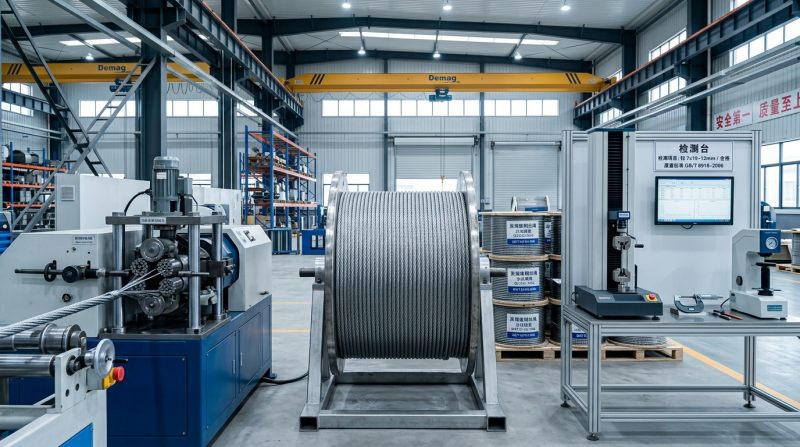
In the steel industry, product quality is usually built in 4 stages: raw material selection, forming or drawing, heat treatment or stabilization, and final inspection. If a steel wire rope manufacturer cannot describe these stages clearly, the buyer may face hidden variability. This matters even more for distributors and engineering contractors handling repeated orders over 6 to 18 months.
- Wire rod origin and chemistry stability influence tensile behavior and fatigue resistance.
- Drawing and stranding accuracy affect diameter tolerance, flexibility, and load distribution.
- Lubrication quality influences internal wear, corrosion protection, and service interval.
- Final testing determines whether the rope meets the declared specification in real use.
For global buyers, manufacturers with broader steel processing capability often show stronger discipline in materials management and standards compliance. This is one reason many international sourcing teams also review the overall capabilities of related steel producers. A company experienced in structural steel, beams, channels, cold formed profiles, and customized fabrication generally understands standard control, export packing, and specification matching at a deeper operational level.
Why the Market Pays Attention to Manufacturing Capability
The steel wire rope market is highly sensitive to reliability because the product often works in safety-related environments. Cranes, hoists, elevators, offshore equipment, and construction lifting systems can all be affected by early wear, broken wires, or unexpected deformation. As a result, technical and commercial teams increasingly look beyond the lowest quote and focus on the manufacturer’s production capability, quality system, and response speed.
Lead time is another major concern. In many project schedules, steel products are linked to installation windows measured in days, not months. A supplier that promises 15 to 20 days but routinely ships in 30 to 45 days can create equipment downtime, labor inefficiency, and contract penalties. For this reason, business evaluators and financial approvers often compare not just unit price but total supply risk.
Industry attention also reflects the increasing complexity of end-use requirements. Many buyers need mixed sourcing support: structural steel for project frames, steel components for fabrication, and specialized items for fluid, chemical, or high-corrosion environments. In some industrial projects, teams may source steel rope together with products such as 316 Stainless steel pipe for petroleum, chemical industry, shipbuilding, boiler fields, or foodstuff processing, where corrosion resistance and high-temperature stability are important over long service periods.
The table below shows the main market concerns when evaluating steel wire rope manufacturers and why each point matters in real purchasing decisions.
A balanced evaluation uses all four areas together. A low-cost source may still be a high-cost option if replacement frequency, delivery delay, or claim handling creates downstream losses. For many steel projects, the real target is stable supply over the full project cycle, which can range from 3 months for a short order to 12 months or more for phased contracts.
The role of standards and documentation
Standards are a practical comparison tool because they convert general quality claims into measurable expectations. Buyers should confirm whether the manufacturer can produce according to the relevant rope construction, diameter range, tolerance, tensile requirements, and inspection documents requested by the project. The same discipline applies across steel products, from structural sections to stainless tubing made to ASTM, EN, JIS, or GB requirements.
For example, when a project also needs corrosion-resistant piping, product data should be equally transparent. A stainless item used in chemical or energy applications may require clear dimensions such as wall thickness from 1 mm to 150 mm, outer diameter from 6 mm to 2500 mm, and length options like 4000 mm, 6000 mm, or 12000 mm, along with standards such as ASTM A213, ASTM A312, ASTM A269, EN10216, or JIS G3459. This level of clarity is a good benchmark for judging whether a supplier communicates professionally.
How Different Buyer Groups Evaluate a Manufacturer
Not every stakeholder compares steel wire rope manufacturers in the same way. Operators focus on handling and service life. Technical evaluators focus on construction details and test conformity. Procurement staff look at commercial terms, MOQ, packaging, and lead time. Decision makers and finance teams often evaluate risk concentration, replacement cost, and supplier stability over multiple order cycles.
This means the best supplier is usually the one who can answer different questions with consistent evidence. A manufacturer serving international markets should be prepared to support technical files, quotation breakdowns, logistics coordination, and after-sales communication within 24 to 72 hours for standard inquiries. Delayed answers during evaluation often become delayed actions after purchase.
For distributors and project contractors, one additional factor matters: product range compatibility. Suppliers with broader steel manufacturing experience may be better at supporting combined sourcing packages. Hongteng Fengda, for example, focuses on structural steel manufacturing and export from China, supplying angle steel, channel steel, steel beams, cold formed steel profiles, and customized structural steel components while working under major international standards such as ASTM, EN, JIS, and GB.
Comparison priorities by stakeholder type
The following table can help internal teams align their review criteria before requesting quotations or samples.
This comparison framework is especially useful when multiple departments influence the final supplier choice. Instead of debating one quotation line by line, teams can evaluate the full supply picture and identify where a manufacturer adds measurable value over a 6-month to 24-month horizon.
Questions that reveal supplier maturity
- Can the manufacturer explain how raw wire material is controlled and documented from batch to batch?
- What is the standard production lead time for regular sizes, and what changes during peak demand periods?
- Which inspections are routine, and which are available upon request before shipment?
- How are packing, spool identification, and export marks handled for international delivery?
- Can the supplier support customized steel requirements when the project includes other components beyond rope?
Strong manufacturers usually answer these questions directly and with reasonable limits. Weak suppliers often answer in broad terms without explaining process or responsibility. That difference becomes very important once orders move from sample level to container-level or project-level supply.
Practical Ways to Compare Suppliers Before You Buy
A practical comparison process does not need to be complicated, but it should be structured. For most industrial buyers, 5 steps are enough: define the application, confirm technical requirements, shortlist manufacturers, compare documentation quality, and verify delivery capability. This approach helps reduce sourcing errors early, before commercial negotiations create pressure to move too quickly.
Start with the application conditions. A steel wire rope used for static support is not evaluated the same way as one used in repeated bending or abrasive environments. Service temperature, corrosion exposure, bend radius, load frequency, and maintenance interval all matter. If the rope is part of a system replacement, match the new specification against the old operating record over at least the previous 6 to 12 months if data is available.
Then compare the manufacturer’s ability to provide consistent steel quality across product categories. This is especially relevant in projects where structural steel, fabricated sections, and corrosion-resistant steel components are purchased together. A supplier experienced in export-oriented steel manufacturing can often simplify specification coordination and reduce communication gaps between engineering, purchasing, and logistics teams.
Recommended supplier review checklist
- Confirm the exact rope construction, diameter range, lay direction, core type, and required mechanical performance.
- Request standard documentation, including material records, inspection reports, and shipment identification details.
- Check whether the supplier can meet typical delivery windows such as 15 to 30 days for standard items or longer for customized production.
- Review export packing details to reduce corrosion, deformation, or handling damage during transit.
- Ask how nonconformity is handled, including replacement timing, claim review, and communication responsibility.
If the project includes stainless systems, it is also useful to evaluate how the supplier handles specification-heavy items. For instance, a corrosion-resistant pipe may require surface conditions such as polishing, annealing, pickling, or bright finish, and may be supplied in 200 series, 300 series, or 400 series options depending on the application. Suppliers that present these details clearly usually communicate better across the whole order process.
Common warning signs during evaluation
Some risks can be spotted before the first order. If a quotation lacks specification discipline, if lead times change significantly from one email to the next, or if test documentation appears generic, caution is justified. Price alone should not outweigh missing technical detail, especially for products used in safety-sensitive environments.
Another warning sign is poor alignment between sales claims and manufacturing reality. Buyers should look for clear answers about capacity, process flow, and inspection. In many cases, a modestly higher unit cost is acceptable if it reduces replacement frequency, field failure risk, or delay-related cost by even 5% to 10% across the project lifecycle.
Finally, do not underestimate communication quality. Reliable steel suppliers support decision-making with practical information: standards, dimensions, delivery options, custom production feasibility, and documentation timing. This is particularly important when end markets include North America, Europe, the Middle East, and Southeast Asia, where project compliance and logistics expectations can differ.
A Broader Steel Supply Perspective for Long-Term Projects
For many buyers, selecting a steel wire rope manufacturer is part of a larger sourcing strategy. Industrial and construction projects rarely depend on one item alone. They often require structural steel sections, customized fabricated components, and application-specific materials with different standards, dimensions, and corrosion performance. That is why long-term value often comes from suppliers who understand the broader steel supply chain, not only a single product line.
Hongteng Fengda operates as a professional structural steel manufacturer and exporter from China, serving global construction, industrial, and manufacturing projects with angle steel, channel steel, steel beams, cold formed steel profiles, and customized structural steel components. With modern manufacturing facilities and strict quality control, the company supports buyers looking for stable production capacity, dependable lead times, and specification-based supply under ASTM, EN, JIS, and GB frameworks.
This broader manufacturing background matters because it supports disciplined order execution. Buyers often benefit when a supplier can help align standard sections, OEM steel components, and related material requirements in one communication chain. In practical terms, that can mean fewer sourcing gaps, lower coordination cost, and smoother project progress over 2 to 4 shipment stages.
Why this matters for decision makers
Executives and project leaders are often less concerned with one isolated unit price than with delivery confidence, risk control, and predictable quality. A capable steel manufacturer helps reduce uncertainty in three ways: by understanding international standards, by keeping production planning realistic, and by offering transparent communication when specifications or timelines need adjustment.
For quality and safety managers, the advantage is traceability and documentation discipline. For procurement teams, the advantage is fewer surprises in production and shipping. For distributors, the advantage is better repeat-order consistency. For end users, the advantage is practical reliability in the field. These are the factors that usually define supplier value over time.
If your project also requires stainless solutions, the same sourcing logic applies. A product like 316 Stainless steel pipe may be selected for significant improvements in corrosion resistance, high-temperature stability, and mechanical properties compared with standard 304 tubing, especially in petroleum, biotechnology, shipbuilding, or nuclear-related environments. A supplier that understands these distinctions is better positioned to support technically mixed projects.
Why Choose Us and What You Can Discuss With Our Team
Choosing a steel supplier is easier when the discussion is practical. Our team focuses on helping buyers evaluate steel products based on actual project requirements, not generic claims. Whether you are comparing steel wire rope manufacturers, planning structural steel procurement, or reviewing customized steel components for export, we support specification-based communication and realistic delivery planning.
As a structural steel manufacturer and exporter from China, Hongteng Fengda works with global buyers who need consistent quality, stable production capacity, and dependable lead times. We understand that sourcing decisions are made by multiple stakeholders, from engineers and quality teams to procurement managers and financial approvers. That is why we prioritize clear technical details, responsive communication, and practical support from inquiry to shipment.
You can contact us to discuss parameter confirmation, product selection, delivery schedules, OEM or customized structural steel solutions, applicable standards, packing requirements, sample support, and quotation planning. If your project includes multiple steel categories, we can also help you review how material specifications, fabrication needs, and export logistics fit together so you can reduce sourcing risk and move forward with greater confidence.
Please give us a message


Please enter what you want to find