Comparing steel beam factory price fairly requires more than checking a quote. Buyers should evaluate Steel Beam specifications, grade, coating such as Galvanized, and standards like S355JR, while also considering factors like I beam vs H beam, production capacity, and delivery reliability. For importers, engineers, and project teams, a clear comparison method helps control cost, reduce sourcing risk, and choose the right structural steel partner.
What should you compare before judging a steel beam factory price?
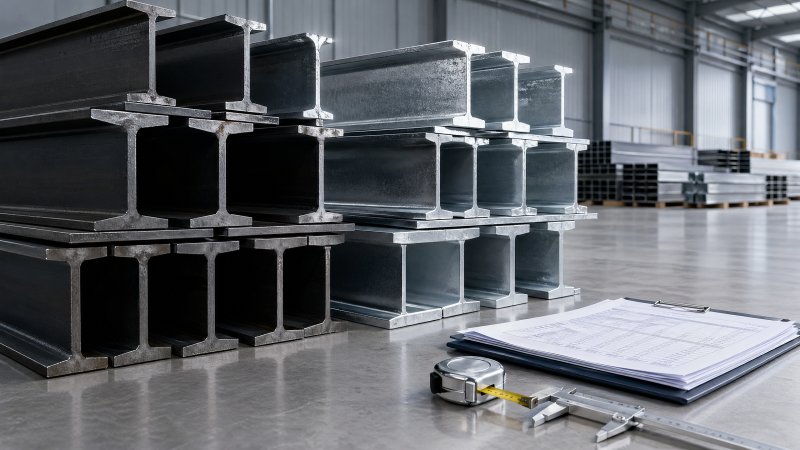
A low steel beam factory price can look attractive at first, but it often hides differences in material grade, section tolerance, coating scope, packaging, or delivery terms. In structural steel sourcing, a fair comparison starts with aligning 3 core elements: the same beam type, the same quality standard, and the same commercial basis such as EXW, FOB, CFR, or CIF.
For example, an H beam quote under EN or ASTM requirements is not directly comparable with a beam supplied only to a local mill standard. The same applies to S355JR versus lower-strength alternatives, or galvanized steel beams versus black steel beams. If one supplier includes mill test certificates, third-party inspection, and export packing while another does not, the price difference is not a fair price gap.
This matters to different decision makers in different ways. Engineers focus on load-bearing suitability and dimensional consistency. Procurement teams focus on total landed cost and lead time. Finance reviewers care about hidden charges, claims risk, and payment terms. Project managers look at whether production can support 2–4 week or 4–8 week delivery windows without disrupting site schedules.
As a structural steel manufacturer and exporter from China, Hongteng Fengda supports buyers by comparing like-for-like specifications, not headline numbers only. With experience in steel beams, angle steel, channel steel, cold formed profiles, and customized structural components, the company helps global customers reduce sourcing errors before orders are placed.
The 5 comparison points that should always be aligned
- Beam section and size: I beam, H beam, flange width, web thickness, length tolerance, and cut-to-length requirements.
- Material grade and standard: ASTM, EN, JIS, or GB, plus grade mapping such as S355JR or equivalent performance requirements.
- Surface condition: black steel, primer coating, hot-dip galvanized, or special anti-corrosion preparation.
- Commercial scope: testing, documents, marking, bundling, loading, and port delivery terms.
- Lead time and capacity: whether the factory can support small batches, repeat orders, or project releases in 1, 2, or 3 shipment phases.
When these 5 points are aligned, the buyer can start comparing steel beam factory price on a fair basis. Without that alignment, even a 3%–8% quote difference may be misleading because the scope and risk profile are different.
How do I beam, H beam, grade, and coating change the real price?
The biggest reason buyers struggle to compare steel beam factory price is that technical differences directly affect steel consumption, fabrication complexity, and downstream performance. I beam and H beam are often discussed together, yet their geometry and use cases can lead to different structural efficiency and procurement outcomes depending on span, load path, and connection design.
Grade also matters. A beam supplied to a higher-grade requirement may support improved strength margins, but that does not always mean it is the most economical option. In some projects, a lower grade with larger section size may still be acceptable. In others, higher grade helps reduce member weight or satisfy code requirements. The point is not to chase the lowest unit price, but to compare the usable structural value.
Coating is another common source of confusion. Galvanized steel beams usually carry additional processing cost, but they may reduce maintenance exposure in outdoor, humid, or corrosive environments. If one quote includes galvanizing thickness requirements, drainage hole preparation, and rework handling, while another quote lists a bare beam only, the apparent price gap is incomplete.
Buyers handling mixed material packages should also consider adjacent products used in industrial and fabrication programs. In some applications involving equipment panels, enclosures, or formed parts, corrosion-resistant flat products may be sourced alongside structural sections. For example, 430 Stainless Steel Plate is often used in automotive trim, electrical components, kitchen supplies, and conveyor-related parts, with common thickness ranges from 0.3mm to 200mm and finishes such as BA, 2B, NO.1, and HL.
Practical comparison table for steel beam quotations
The table below helps engineers, buyers, and commercial reviewers compare steel beam quotes using the same technical and commercial checkpoints instead of relying on price alone.
A quote becomes much easier to evaluate when every row above is documented. This is especially useful when approval must pass through technical review, procurement comparison, and financial sign-off in 3 separate stages.
A note on mixed-material procurement
Where project procurement includes both structural steel and corrosion-resistant sheet or plate items, it helps to compare properties by use, not by category alone. For instance, the stainless plate product mentioned above offers tensile strength of at least 520, yield strength of at least 275, elongation around 55–60, and certifications such as ISO, SGS, and BV as listed in its product data. That kind of structured parameter review is the same discipline buyers should apply when reviewing steel beam offers.
What hidden cost items often distort a steel beam factory price?
Many sourcing teams compare only ex-factory numbers and miss the hidden costs that appear later. In B2B steel purchasing, the real decision should be based on total acquisition cost over the order cycle, not just the initial unit rate. Small omissions in freight preparation, documentation, packaging, or quality claims can erase the advantage of a lower quote.
A practical review usually covers at least 6 cost dimensions: raw material basis, processing, coating, inspection, logistics, and after-sales risk. For export orders, especially to North America, Europe, the Middle East, and Southeast Asia, document compliance and packing stability are not minor details. They affect customs handling, receiving efficiency, and the chance of cargo damage or rejection.
Lead time also carries a cost. If one factory offers a lower steel beam factory price but requires 6–10 weeks, while another can deliver within 3–5 weeks, the latter may better support fabrication schedules, crane bookings, and site milestones. Delay costs are rarely visible in the quote, but project teams feel them immediately.
For distributors and repeat buyers, consistency matters just as much as price. A supplier with stable production capacity and repeatable quality can reduce re-qualification effort, emergency buying, and stock buffer pressure over monthly or quarterly purchasing cycles.
Total cost checkpoints for fair price evaluation
Use the following cost table when comparing offers from different structural steel factories. It highlights where a seemingly lower steel beam factory price may actually create a higher landed or project cost.
A fair decision is often the result of risk-adjusted costing. This helps technical evaluators, procurement teams, finance approvers, and business managers speak the same language during supplier comparison.
A 4-step method to compare quotations fairly
- Normalize the specification. Confirm section, grade, coating, tolerance, length, and standard in one shared sheet.
- Separate base price from add-ons. Show processing, galvanizing, inspection, and freight terms as independent lines.
- Score delivery and quality risk. Use 3 levels such as low, medium, and high based on evidence, not assumptions.
- Review total project impact. Include delivery windows, claim exposure, and internal handling cost over the full order cycle.
This method is especially effective for project tenders, frame agreements, and distributor restocking because it turns scattered quotations into a decision-ready comparison.
Which standards, quality checks, and supplier capabilities matter most?
When buyers compare steel beam factory price, standards and supplier capability should be checked together. A factory may offer an attractive quote, but if it cannot consistently supply to ASTM, EN, JIS, or GB requirements, the savings may disappear in rework, rejected goods, or engineering compromise. The same is true if the plant has limited export handling experience.
Quality control in structural steel should cover at least 4 layers: incoming material verification, dimensional control during production, final inspection before packing, and document review before shipment. For safety-sensitive applications, these layers help quality personnel and site teams reduce the risk of mismatch, coating omission, or traceability gaps.
Capability is also operational. Can the supplier handle standard and OEM requirements? Can it support repeated orders with consistent tolerances? Can it ship mixed structural steel packages that include angle steel, channel steel, steel beams, cold formed profiles, and customized components? These practical questions often decide whether the quoted steel beam factory price is sustainable.
Hongteng Fengda focuses on exactly this type of buyer need. With modern manufacturing facilities and strict quality control, the company supports global construction, industrial, and manufacturing projects with stable production, dependable lead times, and customized structural steel solutions for multiple export markets.
Key qualification and review points
- Standard compliance: confirm whether supply can follow ASTM, EN, JIS, or GB based on project documentation.
- Inspection scope: check if dimensional records, material certificates, and shipment documents are issued consistently.
- Production planning: ask whether lead time is fixed, estimated, or dependent on rolling schedule and coating queue.
- Export execution: verify packing method, marking practice, and communication response during the 7–15 day pre-shipment phase.
Common mistakes buyers should avoid
One mistake is comparing beams only by weight. Another is assuming equivalent grade names always mean equivalent supply quality. A third is treating galvanized and black steel offers as direct substitutes. These shortcuts may save time during initial inquiry, but they create confusion during technical review and receiving inspection.
Another common issue is leaving delivery terms undefined. If one quote is FOB and another is CIF, the numbers cannot be compared directly. Always confirm at least 5 commercial items: price basis, payment term, delivery term, document package, and claim handling procedure.
FAQ: practical questions buyers ask before placing a steel beam order
The following questions reflect the most common concerns from importers, technical reviewers, project managers, distributors, and financial approvers when they evaluate steel beam factory price and supplier reliability.
How can I compare quotations from 2 or 3 suppliers fairly?
Use one normalized comparison sheet. Keep beam type, section size, grade, coating, standard, quantity, packing, and delivery term identical across all suppliers. Then separate the total into base material, processing, coating, inspection, and logistics. This simple structure reveals whether a quote is truly lower or merely narrower in scope.
What is more important: lower price or shorter lead time?
It depends on project stage. For stock replenishment, a lower cost may be acceptable if delivery is predictable. For active construction or fabrication schedules, a 2–3 week difference can affect installation sequence, labor planning, and cash flow. In most B2B steel projects, the best choice is the offer with the most balanced total cost, quality control, and delivery certainty.
Should I always choose galvanized steel beams?
Not always. Galvanized steel beams are often suitable for outdoor exposure, humid service, and applications where maintenance access is limited. But for indoor dry environments or painted fabrication systems, black steel or alternative coating routes may be more economical. The decision should be based on service condition, lifecycle expectation, and downstream processing.
What documents should I request before approval?
At minimum, request a detailed quotation, material standard reference, dimensional specification, packing description, and delivery term confirmation. For many project orders, buyers also request mill test certificates, inspection records, and pre-shipment photos. These documents support technical sign-off, receiving checks, and internal audit review.
Why work with a structural steel exporter that understands both price and project risk?
A fair steel beam factory price is not just a number. It is the result of matching specification, standard, processing scope, quality control, and delivery execution to the needs of the actual project. That is why experienced buyers do not ask only for the cheapest quote. They ask for a quote they can approve, receive, and use with confidence.
Hongteng Fengda supports this process with structural steel manufacturing and export experience across beam, angle, channel, cold formed, and custom component categories. The goal is practical: reduce sourcing risk, control total cost, and help customers complete construction or industrial projects on schedule.
If you are comparing steel beam factory price for a current inquiry, you can request support for 6 key topics: section and grade confirmation, I beam versus H beam selection, galvanized or black surface choice, standard alignment, delivery schedule planning, and export document requirements. This is especially useful when multiple departments need one clear recommendation.
Contact us to discuss your beam specification, target standard, quantity range, coating requirement, and delivery destination. We can help review drawings, compare quotation scope, discuss typical lead time windows, and prepare a solution that fits your technical, commercial, and project priorities.
Please give us a message


Please enter what you want to find