Choosing the right stainless steel square pipe for outdoor use affects durability, maintenance frequency, and whole-life project cost. A careful comparison helps avoid early corrosion, deformation, surface damage, and installation issues.
When evaluating stainless steel square pipe, focus on exposure conditions, grade, wall thickness, finish, fabrication quality, and supplier consistency. The right option depends on the outdoor scene, not only on the initial price.
Why Outdoor Conditions Change How You Compare Stainless Steel Square Pipe
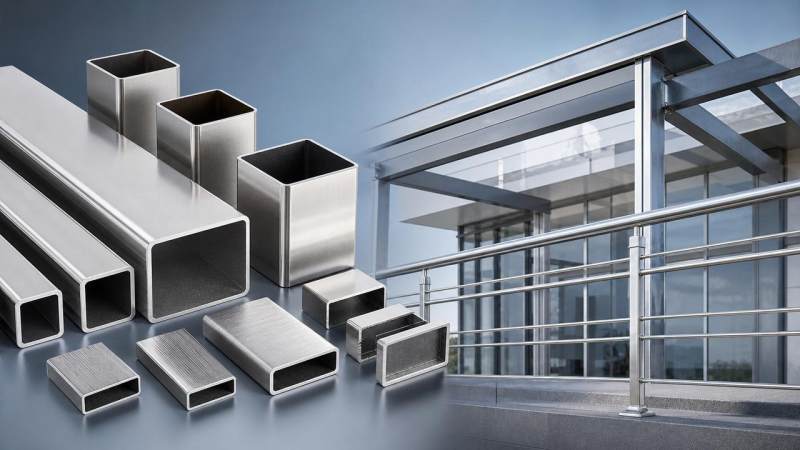
Outdoor environments are rarely uniform. Rain, humidity, salt, pollution, temperature swings, and UV exposure create very different performance demands for stainless steel square pipe.
A pipe suitable for a covered walkway may fail faster in a coastal fence system. The comparison process must begin with the actual service environment and load requirements.
This is especially important in steel-related construction and fabrication projects, where repair access, appearance standards, and structural safety all influence material selection.
Compare Stainless Steel Square Pipe by Typical Outdoor Use Scenarios
Scenario 1: Coastal railings, marine zones, and salt-heavy sites
Salt is one of the most aggressive outdoor corrosion drivers. In these locations, stainless steel square pipe needs stronger pitting and crevice corrosion resistance.
Grade 316 usually performs better than 304 in chloride-rich air. If the project is very close to seawater, surface finish and cleaning plans become equally important.
Scenario 2: Urban structures exposed to rain and pollution
City environments combine moisture, dust, acidic deposits, and traffic pollution. Here, stainless steel square pipe must resist staining while keeping a presentable surface.
304 is often acceptable for moderate urban exposure. Still, welded areas, rough finishes, or poor drainage can create localized corrosion even with a suitable grade.
Scenario 3: Outdoor frames, canopies, and support members
When stainless steel square pipe works as a structural or semi-structural member, mechanical properties matter as much as corrosion resistance.
Wall thickness, straightness, dimensional tolerance, and weld integrity influence load capacity, connection fit-up, and fabrication efficiency.
Scenario 4: Decorative gates, facades, and visible exterior features
Appearance-driven projects require stable surface quality. Scratches, inconsistent polish, and heat tint near welds can reduce visual value and increase finishing costs.
For these uses, compare stainless steel square pipe not only by alloy, but also by finish grade, protective packaging, and surface inspection standards.
Key Factors to Compare Before Buying Stainless Steel Square Pipe
1. Material grade and corrosion resistance
The first question is usually 304 or 316. For general outdoor use, 304 stainless steel square pipe can perform well in many inland conditions.
For coastal, chemical, or high-humidity areas, 316 stainless steel square pipe offers better resistance because of its molybdenum content.
Ask for mill certificates and confirm compliance with ASTM, EN, JIS, or other specified standards. Grade claims should always be verifiable.
2. Wall thickness and load suitability
Thicker walls usually improve strength, impact resistance, and service life. However, excessive thickness can increase cost and fabrication difficulty.
Compare stainless steel square pipe using actual span, connection method, wind load, and expected service load. Decorative installations need different thickness than support frames.
3. Surface finish and maintenance demand
Smooth surfaces retain fewer contaminants and are easier to clean. Common finishes include mill finish, brushed finish, and polished finish.
In outdoor visible installations, a better finish can reduce stain retention and improve long-term appearance. It may also lower maintenance frequency.
4. Weld seam quality and fabrication performance
Many stainless steel square pipe products are welded. Poor seam quality can affect corrosion behavior, strength consistency, and downstream processing.
Check whether the pipe supports reliable cutting, bending, welding, and drilling. Ask about weld bead treatment, passivation, and dimensional stability.
5. Supplier quality control and delivery reliability
Outdoor projects often depend on schedule accuracy. Compare stainless steel square pipe suppliers by inspection process, traceability, packaging, and lead-time discipline.
A reliable supplier should provide consistent sizes, material documentation, responsive communication, and export-ready packing for long-distance delivery.
How Requirements Differ Across Outdoor Stainless Steel Square Pipe Applications
Practical Selection Tips for Outdoor Stainless Steel Square Pipe
- Define whether the application is decorative, load-bearing, or mixed-use.
- Map the site exposure level, especially salt, standing water, and pollutants.
- Choose grade after evaluating environment, not only budget.
- Confirm wall thickness with structural calculations or fabrication needs.
- Review finish samples under natural light if appearance matters.
- Request certificates, dimensional reports, and inspection records.
- Check packaging quality for export and outdoor storage conditions.
This approach makes stainless steel square pipe comparison more objective. It also reduces the risk of choosing material that performs well on paper but poorly on site.
Common Mistakes When Comparing Stainless Steel Square Pipe for Outdoor Use
Choosing by price alone
The cheapest stainless steel square pipe may require more maintenance, earlier replacement, or additional finishing work. Total installed cost matters more than unit price.
Ignoring local corrosion triggers
Distance from the sea, deicing salts, industrial fumes, and trapped moisture can dramatically change expected service life. Generic “outdoor grade” descriptions are not enough.
Overlooking design details
Even good stainless steel square pipe can corrode if water collects in joints or if dissimilar metals create galvanic issues. Design and installation affect results.
Failing to verify supplier consistency
One good sample does not guarantee batch consistency. Large outdoor projects need repeatable quality, stable supply, and dependable lead times.
What to Do Before Placing an Order
Prepare a simple comparison checklist. Include grade, size, thickness, finish, tolerance, application environment, certification, and expected fabrication steps.
Then compare stainless steel square pipe suppliers against the same criteria. This prevents specification gaps and improves quotation accuracy.
For broader outdoor steel projects, it is also helpful to work with a supplier that supports multiple structural product categories and custom processing needs.
Hongteng Fengda is a professional structural steel manufacturer and exporter from China, supplying reliable steel products for global construction and industrial applications.
Beyond stainless steel square pipe sourcing evaluation, projects may also require beams, channels, angle steel, or custom components for industrial structure use.
For example, Structural Steel I Beam is available in grades such as Q195-Q235, Q345, SS355JR, SS400, A36, and St52.
It supports industrial structure applications, hot rolled molding, thickness from 4.5mm to 15.8mm, length from 6m to 12m, and standards including JIS, ATSM, DIN, GB, and EN.
With capabilities such as bending, welding, decoiling, punching, and cutting, this kind of structural steel option can complement outdoor framework planning efficiently.
In the end, the best stainless steel square pipe is the one matched to its real outdoor environment, structural role, and maintenance target. A disciplined comparison leads to longer service life and lower project risk.
Please give us a message


Please enter what you want to find