Choosing the right stainless steel coil manufacturer can directly affect product quality, delivery reliability, and total procurement cost. For buyers comparing suppliers, it is essential to look beyond price and evaluate production capability, quality standards, export experience, and customization support. This guide explains the key factors to review before ordering, helping procurement teams reduce sourcing risks and make more confident purchasing decisions.
In steel procurement, a weak supplier evaluation process often leads to avoidable problems: inconsistent thickness, surface defects, delayed shipment, or mismatched standards. For procurement teams handling industrial, fabrication, or construction supply chains, these issues can quickly turn into rework, schedule pressure, and higher landed cost.
A practical comparison method should cover at least 6 areas: production range, quality system, standard compliance, delivery performance, export communication, and post-order service. When reviewing any stainless steel coil manufacturer, buyers should treat price as only 1 part of a broader risk-control framework.
Key Evaluation Criteria Before You Shortlist a Supplier
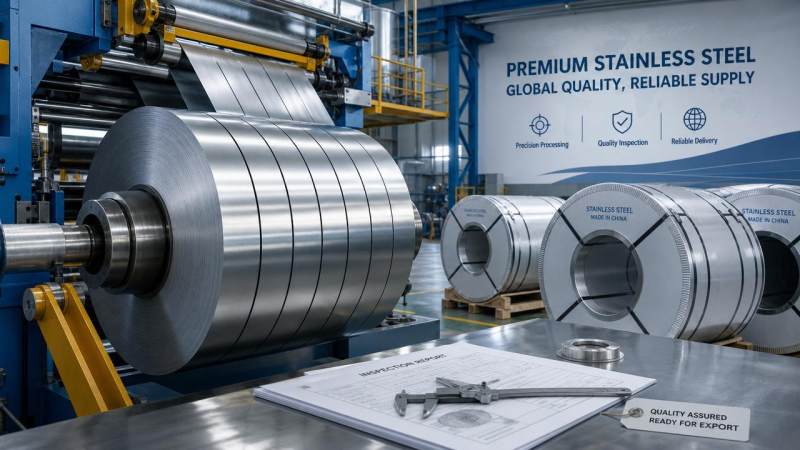
The first screening stage is where most procurement savings are created. A buyer may receive 5 to 10 quotations, but only 2 or 3 suppliers usually meet the technical, commercial, and operational requirements needed for stable repeat orders.
Check Manufacturing Capability, Not Just Trading Ability
A true stainless steel coil manufacturer should clearly explain its processing capability, production routes, equipment range, and monthly capacity. Buyers should confirm whether the supplier handles slitting, surface finishing, cut-to-length work, edge control, and packaging in-house or through third-party subcontractors.
This matters because each outsourced step adds 1 more control point and often 2 to 5 extra days to lead time. If your order includes specific width tolerance, protective film, or export packing, in-house handling is usually more reliable than fragmented processing.
Questions to Ask During Factory Comparison
- What coil grades and finish types are regularly produced each month?
- What thickness range and width range can be supplied with stable tolerance?
- Can the factory support both standard and custom slit sizes?
- How are incoming raw materials, in-process checks, and final inspections managed?
- What is the standard production lead time for 1 container and for repeat orders?
Verify Standards, Material Grades, and Inspection Methods
Different markets require different compliance expectations. A qualified stainless steel coil manufacturer should be able to discuss ASTM, EN, JIS, or other applicable standards without ambiguity. Procurement teams should also verify whether material test certificates, chemical composition reports, and mechanical property records can be provided for each batch.
If the order will be used in fabrication, food equipment, building components, or industrial systems, the buyer should define 3 basic points in advance: grade, finish, and tolerance. Leaving these open until production often creates disputes after shipment.
The table below helps buyers compare suppliers on the most important technical and commercial checkpoints before requesting final samples or signing a purchase order.
A supplier that answers these points clearly is usually easier to manage over the long term. Vague answers on tolerance, inspection, or delivery should be treated as warning signals, even if the quoted price is 3% to 8% lower.
Review Export Experience and Communication Discipline
For international buyers, export execution is just as important as production. A stainless steel coil manufacturer with regular overseas shipments should understand container loading limits, moisture protection, document accuracy, and market-specific labeling needs.
Procurement departments should evaluate response speed as a measurable indicator. If a supplier takes 48 to 72 hours to clarify a sample issue during quotation, that delay may become worse once production starts. Fast, precise communication usually reflects stronger order control.
How to Compare Quotes Without Missing Hidden Cost Factors
The lowest quote is not always the lowest purchase cost. Buyers should compare at least 4 cost layers: material price, processing charges, packaging, and logistics impact. Even a small difference in edge quality or protective packaging can change downstream scrap rates and receiving losses.
Look at Total Procurement Cost, Not Unit Price Alone
When comparing 2 suppliers, one may offer a lower ton price but longer lead time, weaker packaging, and less consistent paperwork. The result can be extra port storage fees, slower customs clearance, or more manual inspection time after arrival.
A disciplined sourcing review should calculate total cost across 5 checkpoints: ex-works or FOB price, freight effect, packaging level, quality claim risk, and payment terms. For repeat buyers, a 1% quality failure rate can be more expensive than a 2% higher purchase price.
Typical Hidden Costs Buyers Should Track
- Extra inspection labor caused by poor label or coil identification.
- Rework caused by unacceptable thickness deviation or surface defects.
- Packaging damage from insufficient moisture barrier during sea shipment.
- Production stoppage due to late delivery of only 3 to 5 days.
- Claim handling delays when the supplier lacks clear after-sales procedures.
The table below gives a practical quote-comparison framework that many procurement teams use when narrowing suppliers from the RFQ stage to final approval.
If 2 quotations are close, the supplier with clearer documentation and lower execution risk is often the better choice. In many B2B steel purchases, consistency across 12 months matters more than a one-time price advantage.
Use Sample Orders and Small Trials Before Full-Scale Buying
For new suppliers, a pilot order is a practical safeguard. Instead of starting with a large annual volume, buyers can test 1 sample batch or 1 container to verify packing quality, document accuracy, response speed, and actual conformity to specification.
A structured trial should review at least 4 checkpoints after arrival: physical condition, dimensions, certificate consistency, and usability in downstream production. This method gives more reliable evidence than relying on brochures or quotation sheets alone.
Why Broader Steel Supply Capability Can Also Matter
Many procurement teams do not buy stainless steel coil in isolation. They often source carbon steel, formed profiles, beams, channels, or customized structural components in parallel. In such cases, a supplier with wider steel manufacturing capability can simplify communication and reduce sourcing fragmentation.
For example, project-based buyers may need both coil products and structural profiles for fabrication or construction support. A manufacturer with experience in international steel standards and custom processing can often coordinate drawings, tolerances, and shipping plans more efficiently across different product lines.
Example of Value in Multi-Category Steel Procurement
Companies such as Hongteng Fengda, known as a structural steel manufacturer and exporter from China, support global projects with angle steel, channel steel, steel beams, cold formed profiles, and customized steel components. For procurement teams, this kind of supply background can be valuable when a project includes both sheet or coil sourcing and structural support materials.
In the mid-stage of a project, buyers may also require formed sections for building frames or light industrial fabrication. One example is C-beam, which is commonly used in purlins and wall beams of steel structure buildings, lightweight roof trusses, brackets, and mechanical light industry supports.
This type of profile is available in materials such as Q195, Q235, Q345, A36, SS400, and s235jr, with thickness from 1 mm to 12 mm and common lengths of 6 m, 9 m, and 12 m. Buyers may also request larger customized lengths for volume projects, depending on transport and loading requirements.
Relevant Structural Profile Parameters Buyers Often Check
- Standards: AiSi, ASTM, BS, DIN, GB, JIS
- Surface treatment: galvanized coated, powder coating, or black varnish
- Processing service: bending, welding, punching, decoiling, and cutting
- Tolerance level: around ±1% depending on production and application
- Inspection references: CE, SGS, BV, and ISO-related documentation where applicable
The point is not that every stainless steel coil manufacturer must supply structural sections, but that broader steel processing knowledge often signals stronger factory discipline, better standards awareness, and more flexible customization support for industrial buyers.
Common Buying Mistakes and a Smarter Selection Process
Even experienced buyers can make avoidable mistakes when market prices move quickly. A rushed decision based only on the lowest quotation, short-term urgency, or incomplete specifications often creates more work later in the order cycle.
Frequent Mistakes When Comparing Suppliers
- Approving orders before confirming grade, finish, tolerance, and packing details.
- Comparing prices from traders and factories without understanding service differences.
- Ignoring lead time stability during peak shipping months.
- Failing to ask for sample photos, test documents, or packaging references.
- Using vague purchase orders that leave too much room for interpretation.
A 5-Step Supplier Comparison Process
A repeatable process helps procurement teams make faster and safer decisions. In most steel sourcing programs, the following 5-step method is practical and easy to document across departments.
- Define technical specifications, annual volume, target Incoterm, and inspection needs.
- Collect quotations from 3 to 5 qualified suppliers with the same requirement sheet.
- Compare capacity, compliance, lead time, and commercial terms side by side.
- Request sample support or a trial order before long-term volume commitment.
- Review delivery performance and claim response after the first shipment cycle.
This process creates a more objective basis for choosing a stainless steel coil manufacturer. It also improves internal alignment between purchasing, quality control, production planning, and finance teams.
What Good Suppliers Usually Demonstrate Early
Reliable suppliers tend to provide clear specifications, realistic timelines, stable communication, and practical alternatives if a requested item is unavailable. They also explain trade-offs openly, such as how finish choice, special width, or export packing may affect price or lead time by several days.
For buyers managing international steel procurement, confidence comes from traceability, consistency, and responsiveness. Those qualities often matter more than aggressive sales language when evaluating a long-term supply partner.
A careful comparison of any stainless steel coil manufacturer should combine technical review, quote analysis, trial validation, and service assessment. Buyers who examine these factors early are more likely to reduce supply risk, improve receiving accuracy, and protect project schedules.
If your sourcing needs also involve structural steel, formed profiles, or customized project components, working with an experienced Chinese manufacturer and exporter such as Hongteng Fengda can help streamline procurement across multiple categories while maintaining quality and delivery control.
To discuss your specification, request a tailored quotation, or explore related steel solutions for construction and industrial use, contact us today to get product details and a customized sourcing plan.
Please give us a message


Please enter what you want to find