When evaluating h beam suppliers, unit price is only one part of the real cost. Procurement teams also need to compare quality consistency, standard compliance, production capacity, delivery reliability, and export support to avoid costly project delays and sourcing risks. This guide explains how buyers can assess suppliers more strategically and choose a partner that delivers long-term value, not just a lower quote.
For steel buyers, a low quote can quickly lose its advantage if beam dimensions vary, mill documents are incomplete, or shipping dates move by 2–4 weeks. In structural projects, even a small deviation in section size, straightness, or coating condition can create downstream fabrication issues, site delays, and reinspection costs.
That is why professional procurement teams compare h beam suppliers across technical, operational, and commercial factors. A qualified supplier should not only offer competitive pricing, but also stable manufacturing, clear standards compliance, dependable export execution, and responsive communication throughout the order cycle.
What Procurement Teams Should Compare First
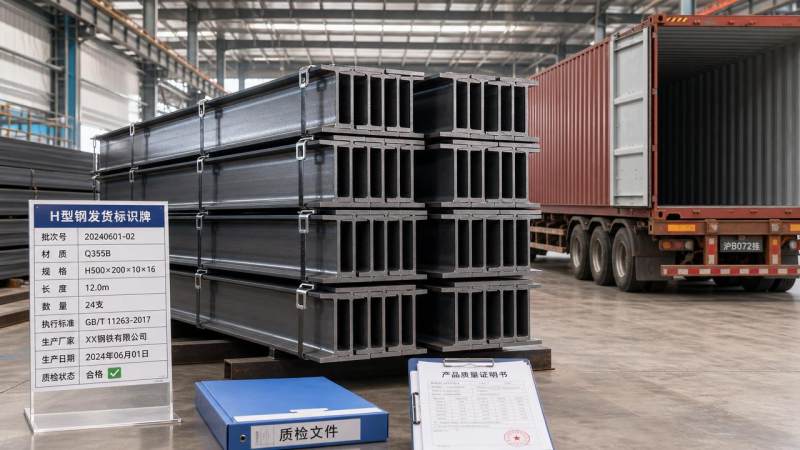
The first screening stage should narrow the field from 8–10 potential vendors to 3–5 serious candidates. At this point, buyers should focus on measurable factors that affect total procurement cost, not only the quoted price per ton.
Look Beyond the Lowest Quote
A lower unit price may reflect thinner tolerances, downgraded raw material sourcing, less stable rolling schedules, or reduced inspection scope. For structural steel, a difference of 1%–3% in purchase price can be outweighed by much larger costs in welding adjustments, schedule disruption, and replacement freight.
Buyers should request a complete quotation checklist covering steel grade, applicable standard, section size range, length tolerance, testing scope, packing terms, port of loading, Incoterms, and lead time. This reduces the risk of comparing offers that appear similar but are not technically equivalent.
Core Evaluation Criteria for h Beam Suppliers
A practical supplier comparison matrix helps procurement teams evaluate both risk and long-term value. The table below shows 6 common purchasing dimensions used in steel sourcing decisions.
This comparison shows why experienced buyers do not rank h beam suppliers by price alone. In most structural steel purchases, quality consistency, documentation accuracy, and delivery discipline have a direct impact on project cost and schedule.
Why Standards and Documentation Matter
For H beams used in industrial plants, buildings, warehouses, and infrastructure, standards define more than nominal size. Buyers should confirm yield strength, tensile strength, chemical composition, dimensional tolerance, and inspection method according to the required market standard.
If a supplier offers ASTM-equivalent material without complete mill test certificates or traceable batch records, procurement risk increases sharply. Even where substitution is technically possible, engineering approval can add 3–7 working days and create avoidable coordination pressure.
Minimum document set to request
- Commercial quotation with technical scope
- Mill test certificate with heat number traceability
- Dimensional inspection record
- Packing list and marking method
- Delivery schedule by lot or container
- Export document list for destination customs clearance
How to Verify Manufacturing Strength and Quality Control
After the first screening, buyers should validate whether shortlisted h beam suppliers can consistently produce to the required standard. This stage often determines whether the supplier is suitable for repeat business or only for low-risk spot purchasing.
Check Production Capacity Against Your Project Rhythm
A supplier may quote competitively for 200 tons but struggle when the order increases to 1,000 tons across multiple sizes. Procurement teams should ask about rolling frequency, available stock, minimum rolling lot, and the realistic lead time for both regular and nonstandard sections.
For many export projects, a practical planning window is 20–45 days for production plus vessel scheduling, depending on section size, quantity, and season. If the supplier cannot explain its production queue clearly, delivery risk is higher than the quotation suggests.
Review Quality Control at More Than One Stage
Reliable structural steel manufacturing requires control at 4 key stages: raw material intake, rolling or forming, final dimensional inspection, and shipment release. Buyers should ask how often tests are performed and whether records can be shared before shipment.
This quality logic also applies to other steel products used in industrial and infrastructure supply chains. For example, Galvanized Round Steel often requires controlled diameter tolerance such as ISO h8 below 10.00 mm and ISO h9 above 10.00 mm, plus anti-corrosion treatment, straightness control, and spectrotest verification. The same discipline in process control is a useful signal when assessing a supplier’s broader steel manufacturing capability.
The table below outlines common verification points that buyers can use during supplier evaluation, factory audit, or pre-shipment review.
If a supplier can present these controls clearly, buyers gain better confidence in repeatability. This is especially important for multi-batch purchases, OEM structural parts, or projects requiring ASTM, EN, JIS, or GB compliance across several product categories.
Assess Communication Speed and Technical Support
A technically capable mill can still become a difficult supplier if communication is slow or unclear. In practice, buyers should look for quotation feedback within 24–72 hours, drawing or specification review within 2–3 working days, and timely updates when schedule changes occur.
Strong h beam suppliers usually provide practical support during clarification: confirming equivalent grades, reviewing tolerance expectations, advising on packing for long-sea transport, and identifying which items should be custom-produced instead of sourced as stock material.
Comparing Delivery Reliability, Export Execution, and Total Cost
For international buyers, the true difference between h beam suppliers often appears after purchase order release. A supplier that manages export documents, packaging, and shipment coordination well can save days at port and reduce claim exposure during transit and unloading.
Delivery Reliability Is a Cost Factor
Procurement teams should ask for realistic production and dispatch milestones: order confirmation, raw material allocation, rolling date, inspection completion, packing completion, and estimated vessel booking. A reliable timeline is more useful than an overly aggressive promise that slips later.
In many projects, a 7-day delay on critical H beams can affect crane booking, fabrication line loading, and site erection sequencing. That makes on-time delivery performance a measurable commercial factor, not just a service preference.
Export Capability Reduces Hidden Procurement Risk
Export-ready steel suppliers should be familiar with container loading plans, break bulk options for oversized sections, corrosion protection during sea transport, and document accuracy for customs and banking requirements. Errors in packing list data, HS coding, or certificate wording can add both time and cost.
This matters for buyers in North America, Europe, the Middle East, and Southeast Asia, where document expectations and import procedures may vary. A supplier with regular export experience can often prevent problems before cargo reaches the port.
Use a Total Cost Comparison Instead of Unit Price Alone
A more effective sourcing method is to compare total landed and project-use cost. This includes product price, freight, inspection, packaging, customs-related corrections, expected scrap or rework, and the financial impact of schedule slippage.
A practical 5-step buyer checklist
- Confirm technical standard and acceptable equivalent grades.
- Compare quotations line by line, including inspection and packing scope.
- Verify production lead time by size, quantity, and rolling lot.
- Review export document capability and shipment method.
- Score suppliers on quality, delivery, service, and total risk.
For sourcing teams managing several steel categories, it is often useful to evaluate whether the supplier can support adjacent products as well. For instance, a manufacturer offering beams, channels, cold formed profiles, and Galvanized Round Steel for applications such as power towers, highway protection, marine components, or building steel structure parts may provide better supply chain coordination than a single-item trader.
Common Mistakes When Screening h Beam Suppliers
- Accepting the cheapest quote without checking whether the grade and standard match exactly.
- Ignoring lead time differences of 10–20 days during peak procurement season.
- Failing to request pre-shipment inspection records for first orders.
- Comparing traders and manufacturers without clarifying who controls production.
- Assuming export documents will be correct without sample review.
These mistakes are common because they do not create visible problems at quotation stage. However, once cargo is rolling or already on the water, correction options become limited and expensive.
What a Strong Long-Term Steel Supply Partner Looks Like
The best h beam suppliers combine manufacturing discipline with practical export service. They can support standard specifications, discuss OEM structural steel components, respond clearly to technical questions, and maintain stable execution from inquiry to delivery.
For procurement teams buying from China, this often means choosing a supplier with modern facilities, strict quality control, and familiarity with ASTM, EN, JIS, and GB standards. A partner that can support angle steel, channel steel, steel beams, cold formed steel profiles, and customized structural steel components may help reduce supplier fragmentation and improve order coordination.
Questions to Ask Before You Place the Order
- Can you provide the required standard and complete mill documentation for each batch?
- What is the normal lead time for my size range and tonnage?
- How do you control dimensional consistency and lot traceability?
- What export markets do you serve regularly?
- Can you support mixed steel product orders or customized components?
When these questions are answered with specific details rather than general claims, buyers can compare h beam suppliers with more confidence. This leads to better supplier selection, fewer project surprises, and stronger long-term purchasing results.
If you are sourcing structural steel for construction, industrial, or manufacturing projects, working with an experienced Chinese manufacturer and exporter can improve cost control without sacrificing quality or delivery reliability. Contact Hongteng Fengda to discuss your beam requirements, request a tailored quotation, or explore broader structural steel supply solutions for your next project.
Please give us a message


Please enter what you want to find