Choosing an h beam manufacturer based on price alone can lead to costly delays, inconsistent quality, and supply risks. For business decision-makers sourcing structural steel, it is essential to compare manufacturers by production capability, quality standards, export experience, customization support, and delivery reliability. This guide explains the key factors that help global buyers make smarter, lower-risk purchasing decisions.
Why is price-only comparison a risky way to choose an h beam manufacturer?
For procurement leaders, project owners, and industrial buyers, the lowest quotation rarely reflects the full cost of supply. A cheaper offer from an h beam manufacturer may hide weaker raw material control, inconsistent dimensional tolerances, poor packaging, limited testing, or unstable delivery schedules. These issues often become visible only after the order is in production or already on site, when correction costs are much higher.
In structural steel purchasing, one late shipment can affect fabrication planning, transport booking, erection sequencing, and even contractual milestones. If a supplier cannot maintain consistency across batches, buyers may face reinspection, rework, or rejection. That means the real comparison should include total procurement risk, not just the unit price per ton.
A capable h beam manufacturer creates value by reducing uncertainty. Stable production, compliant steel grades, reliable documentation, and clear communication often protect margins better than an initially low quote. For business decision-makers, the smarter question is not “Who is cheapest?” but “Who can deliver the required result with the lowest overall risk?”
What should buyers check first when comparing h beam manufacturers?
The first step is to verify whether the supplier matches your actual project profile. Some companies are traders, some are small processors, and some are true structural steel manufacturers with in-house production and export systems. For large or repeated purchases, this distinction matters. A manufacturer with direct control over production planning, inspection, and loading usually offers better consistency than a supply chain built entirely on subcontracting.
Start by checking five basics: manufacturing scope, steel standards, capacity, export markets, and document support. Ask whether the company supplies standard and custom beam sizes, whether it works with ASTM, EN, JIS, or GB specifications, and whether it can provide mill test certificates, dimensional inspection records, and traceability data. If your project involves fabrication compatibility, coating preparation, or special cutting, these details should be discussed early rather than after price approval.
It is also worth checking responsiveness. In many global sourcing cases, communication quality is an early sign of operational quality. A serious h beam manufacturer should be able to answer technical questions clearly, confirm tolerances, explain lead times, and identify risks before the purchase order is issued.
How do production capability and quality systems affect purchasing decisions?
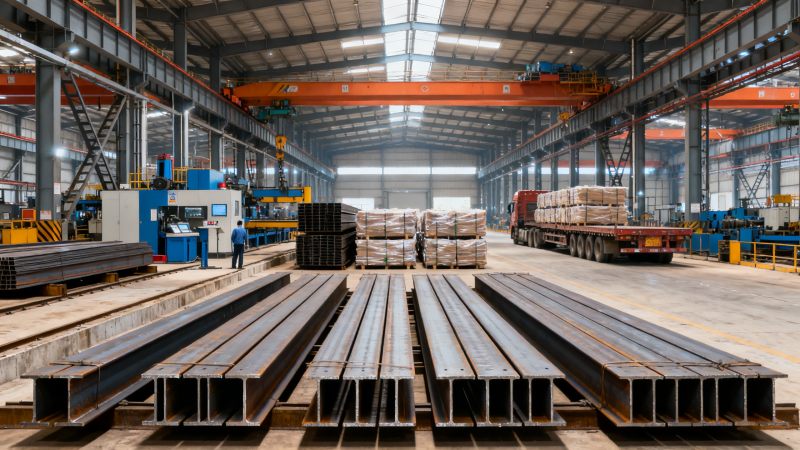
Production capability is not just about volume. It also includes process stability, equipment condition, manufacturing flexibility, and the ability to maintain quality across repeat orders. If an h beam manufacturer can produce multiple structural steel categories such as angle steel, channel steel, steel beams, cold formed profiles, and customized components, that usually indicates stronger operational depth and better support for integrated procurement.
Quality systems are equally important. Buyers should ask how incoming raw materials are verified, how in-process inspections are performed, and how final checks are documented. For structural applications, dimensional accuracy, straightness, surface condition, and mechanical property compliance all influence downstream fabrication and installation. A supplier that follows recognized standards such as ASTM, EN, JIS, and GB is generally easier to qualify for international projects.
Decision-makers managing broader steel sourcing often benefit from evaluating whether the same supplier can support adjacent product categories. For example, companies that understand corrosion-sensitive applications may also offer materials such as 304L Stainless Steel Pipe for industrial systems requiring ultra-low-carbon composition, superior corrosion resistance, toughness, and machinability. With wall thickness options from 0.5mm to 50mm, multiple outer diameter ranges, lengths up to 12000mm, and standards including ASTM, GB, EN, AISI, JIS, and DIN, this kind of portfolio depth suggests a more mature technical and export organization rather than a narrow, price-driven seller.
Why does export experience matter when selecting an h beam manufacturer?
Export experience reduces hidden friction. International buyers do not only purchase steel; they purchase coordination across specifications, commercial terms, inspection records, packaging, customs paperwork, and shipping schedules. An h beam manufacturer that regularly serves North America, Europe, the Middle East, or Southeast Asia is more likely to understand destination-specific documentation and quality expectations.
Experienced exporters usually prepare commercial invoices, packing lists, certificates, marking requirements, and shipment details more accurately. They also tend to communicate more effectively about port timelines, container loading, breakbulk options, and lead time risks. For enterprise buyers, this reduces the chance of avoidable delay at customs or at the jobsite.
Another benefit is issue handling. Even strong supply chains face occasional changes in vessel schedules, raw material availability, or specification clarification. A seasoned h beam manufacturer is more likely to respond with alternatives, updated timelines, and practical solutions instead of silence or confusion. That operational maturity can be more valuable than a small price advantage.
Can customization and service support be more important than a lower quote?
Yes, especially for project-based or repeat industrial sourcing. Many buyers do not need a generic beam; they need a beam that fits a specific standard, cutting length, fabrication plan, or regional compliance requirement. A competent h beam manufacturer should be able to support OEM requirements, custom dimensions, additional processing, and coordination with project drawings where needed.
Service support also includes pre-sales and after-sales discipline. Before order confirmation, buyers should expect detailed quotations, clear lead times, coating or packaging clarification, and honest comments about feasibility. After order confirmation, they should receive production updates, inspection support, and shipment coordination. These service elements directly affect internal procurement efficiency, especially for companies managing multiple suppliers and project deadlines at once.
This is where strategic suppliers stand out. A structural steel manufacturer and exporter with modern production facilities, strict quality control, stable capacity, and customized solution capability often helps partners reduce sourcing risks and control cost more effectively over the full project cycle. For decision-makers, that means fewer disruptions, fewer claims, and smoother execution.
What are the most common mistakes buyers make when evaluating suppliers?
One common mistake is assuming all h beam manufacturer quotations are based on the same technical assumptions. In reality, offers may differ in steel grade, tolerance range, test scope, packaging method, delivery term, or whether the price includes cutting and marking. Without line-by-line comparison, buyers may accept a low quote that does not match the true project requirement.
A second mistake is focusing only on one successful shipment sample. Consistency matters more than a single good batch. Buyers should ask about repeat order control, monthly output, and how the manufacturer handles mixed-size orders or peak season scheduling. If the supplier cannot maintain performance under pressure, future orders may become unpredictable.
A third mistake is neglecting document and communication quality. In global steel sourcing, delayed certificates, unclear markings, or incomplete packing lists can create serious downstream problems. A reliable h beam manufacturer should treat documentation as part of the product, not as an afterthought.
Finally, many buyers underestimate logistics reliability. A supplier may produce acceptable material but still fail in booking, bundling, or loading execution. The result is the same from the project perspective: delay, cost, and avoidable stress.
How can business decision-makers build a practical supplier comparison process?
The most effective method is to use a weighted evaluation model. Instead of awarding business to the lowest bid automatically, compare each h beam manufacturer across commercial, technical, operational, and service criteria. This creates a more defendable internal decision and helps procurement teams align with engineering, quality, and project management departments.
A practical scorecard might assign weight to price, standards compliance, production capability, delivery history, customization support, communication speed, and export documentation quality. For high-risk or time-sensitive projects, delivery reliability and quality assurance may deserve more weight than nominal price.
It is also wise to request samples of key documents before placing the first large order: material certificates, inspection reports, packing examples, and shipment labels. If possible, conduct a video audit or factory review. Even a short structured assessment can reveal whether the supplier operates like a true manufacturing partner or simply a low-cost intermediary.
What should you confirm before requesting a final quotation or starting cooperation?
Before moving to final pricing, decision-makers should confirm the exact steel standard, grade, size range, dimensional tolerances, quantity split, inspection requirements, surface condition, marking rules, packaging method, delivery term, and target shipment schedule. These details protect both sides from misunderstanding and make quote comparison far more meaningful.
If your organization is evaluating a new h beam manufacturer, ask for examples of recent export destinations, normal lead times, and how the supplier handles urgent orders or schedule changes. If your project requires related steel products, custom structural components, or corrosion-resistant materials, it is useful to understand whether the supplier can support a broader sourcing plan rather than a single item purchase.
The best long-term sourcing decisions usually come from selecting a supplier that combines competitive pricing with reliable quality, consistent production, international compliance, and responsive service. If you need to confirm a specific specification, delivery window, customization scope, testing requirement, or cooperation model, those should be the first points discussed before requesting a final offer.
Please give us a message


Please enter what you want to find