Selecting the optimal Steel Rod diameter is crucial for procurement managers aiming to minimize material waste and maximize machining efficiency. As a foundational raw material, the right Steel Rod ensures precise dimensional tolerances while significantly reducing production costs and lead times. In this guide, we explore the essential factors to consider when choosing the perfect diameter for your machining parts, helping you make informed purchasing decisions that align with international standards and optimize your supply chain.
Decoding Machining Requirements and Initial Tolerances
When specifying a diameter for a machining project, the final part drawing is only half the story. The initial condition of the raw material dictates how much material must be removed. Hot-rolled steel rods typically come with a scaled surface and wider dimensional tolerances, often ranging from ±0.2mm to ±0.5mm depending on the diameter. If your final machined part requires a tight tolerance, such as an h7 fit, starting with a hot-rolled rod means you must account for a larger machining allowance to ensure the surface decarburization and scale are completely removed.
Beyond dimensional tolerances, the surface condition of the raw material plays a critical role. Hot-rolled rods have a mill scale that must be completely removed during machining. If the machining allowance is insufficient, residual scale can cause premature tool wear or surface defects on the finished part. In some cases, if the part requires subsequent heat treatment or specific coatings, the initial surface quality and decarburization layer depth become even more critical.
Conversely, cold-drawn, peeled, or turned steel rods offer much tighter tolerances, sometimes as precise as ±0.05mm, along with a superior surface finish. While the per-ton price for cold-drawn or peeled rods might be higher, the reduced machining time, lower tool wear, and decreased scrap rate often result in a lower total cost per finished part. Procurement decisions should never be based solely on the raw material price per kilogram; the total cost of ownership, including machine hours and consumables, must be the primary metric.
Calculating the Optimal Machining Allowance
Finding the sweet spot for machining allowance is a balancing act. If the allowance is too small, you risk leaving hard scale or surface defects on the final part, leading to quality failures. If it is too large, you are essentially paying for raw material only to turn it into chips.
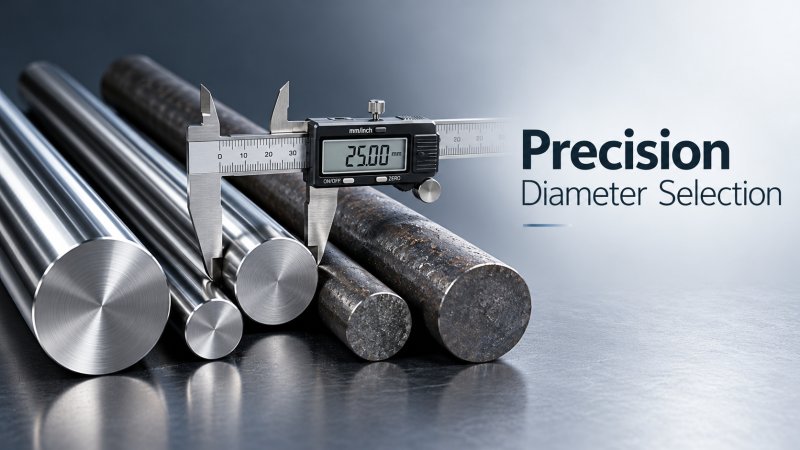
For standard turning operations, a general rule of thumb is to add 1.5mm to 3mm to the final diameter for hot-rolled rods, and 0.5mm to 1.0mm for cold-drawn or peeled rods. However, these numbers are not absolute. They depend on the specific steel grade, the hardness of the material, and the capabilities of your CNC lathes. Harder grades or materials prone to work hardening may require slightly larger allowances to ensure a clean cut without excessive tool deflection.
The choice of machining process also influences the required diameter. For parts that will undergo extensive milling on a machining center, the raw rod diameter must be large enough to accommodate the milling cutter's path without requiring excessive setups. Conversely, for parts primarily turned on a CNC lathe, the allowance can be more precisely calculated based on the chucking requirements. Additionally, consider the straightness of the rod. If the rod has a slight bow, a larger diameter allowance might be necessary to ensure the final part remains within tolerance after the center holes are drilled and the part is turned between centers.
Navigating International Standards and Specifications
Global supply chains mean that steel rods sourced from different regions must comply with varying international standards. Standards like ASTM (US), EN (Europe), JIS (Japan), and GB (China) have distinct chemical compositions, mechanical properties, and dimensional tolerances. For instance, a 40mm diameter rod under ASTM A29 might have slightly different tolerance limits compared to a 40mm rod under EN 10058.
When sourcing globally, procurement managers must ensure that the specified diameter and tolerance class match the standard required by the end-user or the local regulatory body. Misalignment here can lead to rejected shipments or costly re-machining. It is highly recommended to explicitly state the required standard and tolerance class in the purchase order, rather than just relying on the nominal diameter.
Documentation is just as important as the physical dimensions. When procuring steel rods for critical applications, ensuring that the material comes with a proper Mill Test Certificate (MTC) is non-negotiable. The MTC should verify the chemical composition and mechanical properties according to the specified standard. Furthermore, the dimensional inspection report should accompany the shipment, confirming that the actual diameters fall within the agreed tolerance class.
Strategic Sourcing and Comprehensive Supply Capabilities
Procuring steel for complex projects often involves more than just round bars. Facilities and construction sites require a holistic supply chain to avoid dealing with multiple vendors. Hongteng Fengda operates as a professional structural steel manufacturer and exporter based in China, providing reliable steel products and customized solutions for global construction, industrial, and manufacturing projects.
We specialize in angle steel, channel steel, steel beams, cold formed steel profiles, and customized structural steel components, supplying both standard specifications and OEM solutions. With modern manufacturing facilities and strict quality control, our products comply with major international standards, including ASTM, EN, JIS, and GB. Serving customers across North America, Europe, the Middle East, and Southeast Asia, we support global buyers with stable production capacity, consistent quality, and dependable lead times.
In many heavy machinery and infrastructure projects, machining parts are integrated into larger structural assemblies that also require specialized flooring. For example, equipment floors often require an A36 Patterned steel plate to provide anti-skid surfaces and enhanced performance. By consolidating your structural steel and specialized plate requirements with a single, reliable partner, you help reduce sourcing risks, control costs, and complete projects efficiently. We are committed to being a trusted long-term partner, delivering value through quality, reliability, and professional service.
Avoiding Common Procurement Pitfalls
Even experienced buyers can fall into traps when ordering steel rods. One common mistake is ignoring the supplier's standard length offerings. Ordering standard 6-meter or 12-meter lengths might seem convenient, but if your parts are only 1.5 meters long, you will generate significant offcut waste. Requesting cut-to-length services from the mill or service center, even at a slight premium, usually pays for itself in reduced scrap and secondary handling costs.
Another pitfall is assuming that all suppliers hold the same inventory of non-standard diameters. If your design specifies a highly unusual diameter, you might face long lead times or be forced to accept a larger diameter and machine it down, increasing costs. Always check the supplier's standard stock range during the design phase and adjust the nominal diameter to the nearest available standard size if the structural integrity allows.
Finally, do not overlook the impact of packaging and transportation on the final product. Steel rods, especially those with tighter tolerances or specific surface finishes like peeled or polished rods, are susceptible to surface damage during transit. Ensure that your supplier uses appropriate protective packaging, such as wooden crates, steel frames, or waterproof wrapping, to prevent rust, scratches, or bending. Clarifying packaging requirements in the purchase order prevents these hidden costs and delays.
Next Steps for Procurement Managers
Choosing the right Steel Rod diameter is a multifaceted decision that bridges design engineering, machining capabilities, and procurement strategy. By understanding the relationship between initial material tolerances, machining allowances, and total production costs, procurement managers can make choices that optimize both efficiency and budget. Before finalizing your next purchase order, take a moment to review the tolerance specifications, evaluate the total cost of ownership, and confirm the supplier's ability to meet your specific dimensional and delivery requirements.
Please give us a message


Please enter what you want to find