Selecting the correct rebar diameter for slab foundations is a critical engineering decision that directly impacts structural integrity, crack control, and overall project costs. For procurement professionals, the challenge often lies in translating structural calculations into precise purchasing specifications without over-ordering or compromising safety. The core judgment for rebar sizing is never arbitrary; it is the direct result of evaluating dead and live loads, soil bearing capacity, slab thickness, and the specific environmental conditions the foundation will face. Making an informed choice requires aligning engineering blueprints with material availability and international compliance standards, ensuring that the purchased steel performs exactly as the structural design intends.
Evaluating Slab Thickness and Load Requirements
The thickness of the concrete slab is the primary driver for rebar diameter selection. In standard residential construction, ground-bearing slabs typically range from 4 to 6 inches thick. For these lighter applications, smaller diameter bars, such as 8mm or 10mm, are usually sufficient to handle standard live loads like furniture, vehicles, and foot traffic. The primary role of the steel in this context is temperature and shrinkage crack control rather than massive structural reinforcement.
However, when dealing with commercial warehouses, industrial facilities, or heavy machinery areas, slab thickness often increases to 8 inches or more. These environments introduce significant point loads, dynamic forces, and heavy static weights. In such scenarios, structural engineers will specify larger diameters, frequently moving to 16mm, 20mm, or even 25mm rebar. The thicker the slab and the heavier the anticipated load, the greater the tensile stress the foundation will experience, necessitating a larger cross-sectional area of steel to prevent structural failure. Procurement teams must ensure that the specified diameter matches the exact load-bearing calculations provided by the structural engineer, as substituting a smaller diameter to save costs can lead to catastrophic deflection or cracking under operational loads.
Soil Conditions and Environmental Settlement Risks
The ground beneath the slab dictates how much stress the foundation will endure over time. If a project is located on stable, well-compacted granular soil, the risk of differential settlement is minimal, and standard rebar sizing based purely on load calculations is usually adequate. The slab acts primarily as a platform, and the reinforcement handles minor thermal movements.
Conversely, building on expansive clay, soft soils, or areas with a high water table introduces significant settlement risks. When soil shifts, absorbs moisture, or loses bearing capacity, the slab can bend, creating immense tensile stress on the bottom surface. In these conditions, engineers often increase the rebar diameter or reduce the spacing between bars to create a stiffer structural matrix. For procurement professionals, this means the material requirements might shift from standard sizes to heavier grades. Understanding the geotechnical report is essential, as it explains why a project might require 20mm or 25mm bars even if the slab thickness seems moderate. Additionally, in regions prone to frost heave, the foundation must resist upward forces during freeze-thaw cycles, further justifying the need for robust, larger-diameter reinforcement to maintain slab continuity.
Balancing Diameter, Spacing, and Concrete Cover
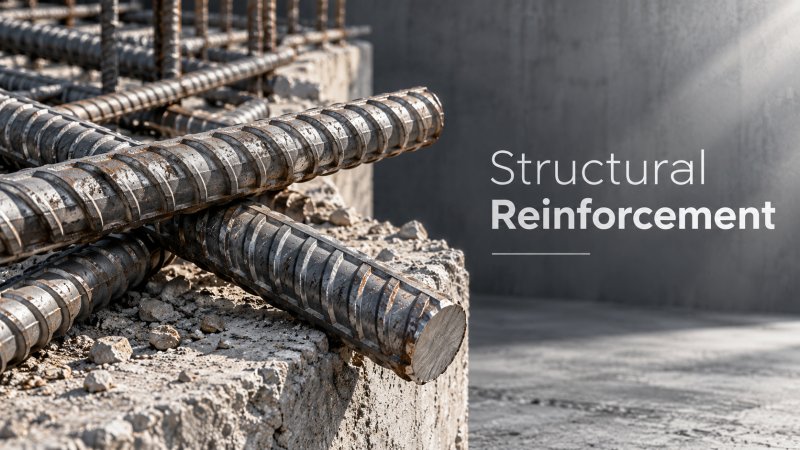
Rebar diameter cannot be evaluated in isolation; it is intrinsically linked to bar spacing and the required concrete cover. A common misconception in material selection is that simply using the thickest possible rebar is the safest approach. In reality, using excessively large diameters with wide spacing can lead to poor crack distribution. Concrete naturally cracks between the bars; if the spacing is too wide, the individual cracks will be wider, compromising the durability and water resistance of the slab.
Engineers balance this by selecting a diameter and spacing combination that ensures cracks remain tightly distributed and microscopic. For example, using more frequent 10mm bars might provide better crack control in a thin slab than using fewer 16mm bars, even if the total steel area is mathematically similar. Furthermore, the concrete cover—the distance from the surface of the rebar to the outer edge of the concrete—is critical for corrosion protection. Thicker bars require more concrete cover to protect the steel from moisture and chlorides. If the slab thickness is limited, specifying a very large diameter might leave insufficient cover, accelerating rust and concrete spalling. Procurement specifications must therefore account for the exact spacing and cover requirements detailed in the structural drawings.
Material Grades, Standards, and Sourcing Compliance
Once the diameter is established, the next critical step for procurement is ensuring the material grade and manufacturing standards align with the project's regional codes. Rebar is not a universal commodity; its yield strength, ductility, and chemical composition vary significantly by standard. In North America, ASTM A615 is the standard specification for deformed and plain carbon-steel bars. In Europe, BS4449 dictates the requirements for steel reinforcement. Meanwhile, projects in Asia or those utilizing Chinese manufacturing often specify GB1449.2, with common grades like HRB335, HRB400, and HRB500.
The HRB400 grade, for instance, offers a yield strength of 400 MPa, making it a highly efficient choice for modern slab foundations where high tensile strength is required without increasing the bar diameter. When sourcing these materials, buyers often deal with suppliers who provide the foundational raw materials for these structural components. A reliable manufacturer might supply high-quality Wire rod that is subsequently processed into specific rebar profiles, ensuring consistent mechanical properties and dimensional accuracy across the entire batch. The tolerance for diameter deviation must be strictly controlled, typically within ±1%, to guarantee that the structural calculations remain valid on site.
Procurement professionals must verify that the supplier holds relevant certifications, such as ISO, SGS, BV, CE, or specific national standards like JIS G3112-2004. They must also be able to provide mill test certificates for every shipment. This documentation proves that the chemical composition and tensile strength meet the specified grade. Relying on uncertified materials to cut costs introduces hidden risks, as substandard steel may yield prematurely under load or fail to bend correctly during on-site installation.
Surface Treatment, Processing, and Delivery Specifications
The environment where the slab foundation will be poured also influences the procurement specifications beyond just diameter and grade. If the foundation is in a highly corrosive environment, such as a coastal area, a marine facility, or a chemical processing plant, standard black rebar may not suffice. In such cases, the procurement team needs to specify surface treatments. Options include epoxy coating, galvanization, or specialized anti-rust oils and transparent oils applied during transit and storage to prevent scaling before the concrete is poured.
The processing services required before delivery also need clear definition in the purchase order. While rebar is often delivered in standard lengths like 9m or 12m, some projects require specific cutting, bending, or decoiling services to match the exact layout of the slab. Pre-fabricated rebar cages or precisely cut bars reduce on-site labor, minimize waste, and speed up the construction schedule. Clear communication regarding packing is also vital. Rebar should be bundled securely, often with color-coded PVC ties or specific marking tags, to allow site managers to quickly identify the diameter and grade upon arrival. Misidentification on a busy construction site can lead to the wrong diameter being placed in critical load-bearing zones, completely nullifying the engineering design and requiring costly rework.
Finalizing the Procurement Strategy
Choosing the correct rebar diameter is a multi-variable equation that balances structural loads, soil mechanics, crack control, and material standards. For procurement professionals, the goal is to act as a bridge between the structural engineer's precise calculations and the manufacturer's production capabilities. This requires a thorough review of the structural drawings, geotechnical reports, and local building codes before issuing any purchase orders.
It also demands selecting a manufacturing partner capable of delivering consistent quality across various sizes, from 6mm to 50mm, and grades like HRB400 or HRB500. By focusing on strict dimensional tolerances, verified material certifications, and appropriate surface treatments, buyers can ensure that the foundation receives the exact reinforcement it needs to perform safely and durably over its designed lifespan. Partnering with an established structural steel manufacturer like Hongteng Fengda provides the assurance of stable production capacity, modern manufacturing facilities, and strict quality control, mitigating sourcing risks and keeping complex construction projects on schedule and within budget.
Please give us a message


Please enter what you want to find