Choosing structural steel beams for construction requires more than checking size and cost. From load capacity and span to steel beam weight calculator use and compliance standards, the right decision affects safety, efficiency, and budget. This guide explains how to select the best steel beam for bridge, building, and industrial applications while helping buyers compare specifications with confidence.
Why Beam Selection Changes by Application Scenario
Structural steel beams are used across buildings, bridges, workshops, heavy equipment platforms, storage facilities, and industrial support frames, but the same beam type is not suitable for every job. A 6-meter interior floor beam in a warehouse faces different demands than a 20-meter bridge girder or a crane runway beam in a fabrication plant. That is why experienced buyers and engineers do not start with price alone. They begin with the actual service condition, expected loading pattern, and compliance requirements.
For project managers and procurement teams, this scenario-based approach reduces costly redesigns. If the wrong section is ordered, the result may be over-weight steel, delayed welding, transportation constraints, or poor fit-up on site. In many projects, even a 5% to 10% error in beam specification can affect total steel tonnage, installation time, and foundation demand. Correct beam selection therefore helps control both direct material cost and indirect project risk.
For quality, safety, and financial decision-makers, another reason to focus on scenarios is that beam selection links structural performance with delivery strategy. Standard I-beams and H-beams may be widely available, while custom fabricated sections can require extra lead time of 2 to 6 weeks depending on drilling, cutting, cambering, and coating scope. A good structural steel supplier should help customers match beam choice to use case, standards, and project schedule instead of pushing a one-size-fits-all option.
Core factors that should be checked before comparing quotations
- Span length, support condition, and allowable deflection limits.
- Dead load, live load, impact load, and whether loading is static or cyclic.
- Section type requirement, such as I-beam, H-beam, channel combination, or built-up beam.
- Material grade and standard, such as ASTM, EN, JIS, or GB equivalents.
- Fabrication scope, including hole making, end plate welding, stiffeners, and surface treatment.
- Transport limits, installation method, and site lifting capacity.
These checkpoints matter whether you are an engineering evaluator reviewing structural safety, a distributor serving local demand, or a buyer comparing global sourcing options from China and other markets.
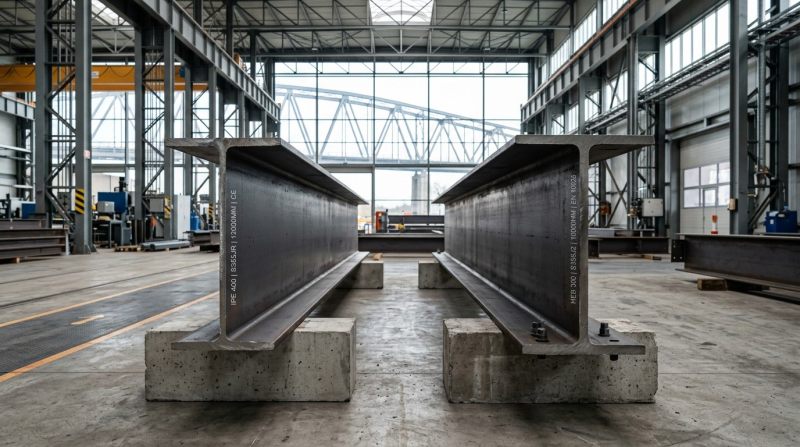
Typical Scenarios: Buildings, Bridges, and Industrial Structures
The most common structural steel beam selection decisions can be grouped into three broad scenarios: building structures, bridge and infrastructure works, and industrial or equipment-support applications. Each one has distinct priorities. In building projects, efficient floor framing, connection compatibility, and installation speed are often the main concerns. In bridges, span efficiency, fatigue behavior, and stricter load combinations become more important. In industrial structures, concentrated loads, vibration, and maintenance access may drive the beam choice.
The table below provides a practical comparison that can help technical teams, end users, and commercial evaluators understand where selection priorities usually differ. These ranges are typical project considerations, not design substitutes, but they are useful for early-stage beam screening and supplier discussions.
This comparison shows why a low unit price does not always mean a better choice. A lighter beam may reduce steel tonnage in one building frame but become unsuitable in a bridge if fatigue life or lateral stability is not adequate. Conversely, an over-conservative section may improve perceived safety but create higher transport cost, larger base reactions, and more site welding. Selection should be balanced, not extreme.
Building projects: what matters most
In multi-story buildings, warehouses, mezzanines, and commercial structures, the key objective is often to achieve required load performance with efficient section weight. Many projects involve repetitive framing, so even a small reduction in beam mass per meter can influence total procurement cost across 50, 100, or 300 pieces. In these cases, buyers should compare section modulus, depth constraints, and connection simplicity, not just nominal size.
Building applications also require close attention to serviceability. Even when strength checks are acceptable, excessive deflection can cause flooring problems, partition cracking, or occupant discomfort. A beam that passes ultimate load criteria may still underperform in use if vibration or sag becomes visible. This is especially relevant in office floors, light industrial workspaces, and elevated platforms where occupant sensitivity is higher.
For projects that combine beams with decking, plates, or customized steel parts, material coordination can improve sourcing efficiency. Some buyers also source plates or coil-based fabricated parts together with beam packages. For example, for connection plates, stiffeners, brackets, or formed accessories used in welded, bolted, or riveted construction, Flat Rolled Steel Coil in grades such as A36, Q235, or S235JR may support bridge, building, and equipment fabrication where good weldability and a yield strength around 250 MPa are required.
Bridge projects: where caution must increase
When choosing structural steel beams for bridge work, loading complexity increases. Vehicle movement introduces dynamic effects, and repeated stress cycles raise fatigue concerns at welds, web openings, and connection zones. In this scenario, the best steel beam for bridge use is not chosen only by maximum load rating. It must also match fabrication quality, inspection requirements, and the governing bridge design standard.
Longer spans may justify built-up or custom sections instead of stock beams. That decision affects mill supply, fabrication process, nondestructive testing needs, and shipping segmentation. A project with 18-meter to 30-meter members may need splice planning before the purchase order is issued. Commercial teams should therefore ask not only for ton price, but also for section availability, length limits, and whether shop assembly or field assembly is more practical.
Bridge buyers should also verify corrosion protection expectations. The beam may require primer only, full paint systems, or coordination with galvanizing depending on environment and project specification. Exposure near marine, industrial, or de-icing salt conditions can change lifecycle cost significantly over 10 to 20 years. A lower initial steel price can become less attractive if maintenance frequency increases.
Industrial structures: concentrated loads change the logic
Industrial applications often include machine bases, pipe racks, crane support structures, platforms, and energy or mining facilities. Unlike regular floor framing, these scenarios may apply concentrated point loads, eccentric loading, thermal movement, or repeated operational vibration. In such conditions, a beam that looks adequate in a general steel beam weight calculator may still need stiffeners, flange checks, or connection redesign.
For operators and maintenance teams, access and durability are just as important as structural strength. Deep beams may reduce vibration but create interference with cable trays, ducts, or maintenance clearances. In a plant retrofit, this becomes a real problem because existing equipment cannot always be relocated. Therefore, beam depth, flange width, and hole or notch limitations should be reviewed together with the installation drawing, not after fabrication begins.
Industrial buyers also tend to value dependable lead times because shutdown windows may be short. If a structure must be installed during a 7-day or 14-day maintenance stoppage, missed delivery can affect production cost far beyond the beam price itself. In these cases, supplier communication, fabrication sequence control, and packaging identification matter almost as much as material grade.
How to Match Beam Specifications to Real Project Demands
Once the application scenario is clear, the next step is to narrow the beam specification. Most teams evaluate four dimensions first: section shape, steel grade, dimensions and weight, and fabrication details. This is where many misjudgments happen. A buyer may compare two beams that look similar on paper but differ in moment capacity, flange thickness, weld preparation, or standard equivalence. Early clarification avoids RFQ confusion and quotation mismatches.
For practical sourcing, a steel beam weight calculator is useful for estimating tonnage, transport planning, and preliminary budget. However, it should not replace structural verification. Weight per meter can help compare logistics and cost, but a lighter section is not automatically better if it increases deflection, requires more bracing, or complicates welding. In many projects, the lowest installed cost comes from balanced optimization rather than minimum beam mass.
Below is a specification-oriented view that can support technical evaluation, purchasing review, and project approval discussions. It also helps distributors and contractors prepare more accurate inquiries when contacting manufacturers and exporters.
Specification areas to confirm
1. Section type and geometry
H-beams are often preferred where higher flange efficiency and stronger biaxial behavior are needed, while I-beams may suit many standard framing cases. Custom built-up beams may be selected for larger spans or special loading. The right choice depends on span-to-depth limits, support condition, and connection layout. A standard section may reduce lead time by several days to several weeks if local or export stock is available.
2. Material grade and compliance standard
Material grade should align with the project standard and fabrication method. International buyers often compare ASTM, EN, JIS, and GB-based products, but equivalence should be checked carefully rather than assumed. Yield strength, tensile range, weldability, and impact requirements can all affect suitability. Quality control teams should request mill documentation consistent with the contract specification.
3. Weight, fabrication, and handling
Beam weight influences shipping mode, lifting plan, and erection sequence. Members above certain transport lengths may require segmentation, and very heavy sections can exceed crane capacity on small job sites. If cutting, punching, drilling, beveling, or plate welding is required, those details should be defined before production. Buyers who issue clear fabrication lists usually receive more accurate pricing and shorter approval cycles.
The table below summarizes how specification priorities usually shift by project objective.
For many buyers, this framework makes quoting more transparent. It clarifies whether a price difference comes from steel weight, grade level, fabrication complexity, or service scope. That supports better internal approval, especially when engineering, finance, and purchasing teams evaluate the same offer from different angles.
Common Mistakes When Choosing Structural Steel Beams
A frequent mistake is selecting by size name alone without checking actual section properties. Two beams with similar nominal depth may differ materially in flange width, web thickness, and section modulus. This can lead to underestimation of deflection or overestimation of connection compatibility. Technical evaluators should always review detailed section data instead of relying on verbal descriptions.
Another common error is treating beam purchase as a pure commodity order. In reality, many project issues come from omitted details such as end preparation, hole coordinates, camber needs, surface finish, or bundle marking. A beam that meets the material standard but arrives with incomplete fabrication can still delay site work. For project execution, production details are often as important as section choice.
A third mistake is ignoring future operating conditions. Some structures may face vibration, temperature shifts, impact loading, or corrosive environments over years of use. If these conditions are not considered during beam selection, later reinforcement or maintenance can become much more expensive than making the right decision at procurement stage. This is particularly relevant in energy, mining, transportation, and heavy manufacturing facilities.
Quick checklist before placing an order
- Confirm application scenario: building, bridge, industrial platform, or mixed-use support.
- Verify span, load type, support condition, and any deflection or vibration limits.
- Check required standard and grade, especially if comparing ASTM, EN, JIS, and GB supply.
- Review fabrication scope including holes, stiffeners, plates, cutting, and coating.
- Use weight calculations for budgeting and shipping, but confirm engineering suitability separately.
- Ask for realistic production and export lead times, usually in the range of 2 to 8 weeks depending on scope.
Teams that follow this checklist usually reduce revision cycles and improve quotation accuracy. It also becomes easier to compare suppliers on a like-for-like basis, which matters for distributors, contractors, and owners making final sourcing decisions.
How a Reliable Structural Steel Supplier Supports Better Decisions
The right supplier does more than ship steel. In structural beam projects, support quality often affects purchasing success as much as product quality. Buyers need clear communication on standards, dimensions, tolerances, fabrication capability, and delivery schedule. A manufacturer with stable production and export experience can help customers compare alternatives more effectively, especially when orders involve both standard sections and customized structural components.
Hongteng Fengda is a structural steel manufacturer and exporter from China serving construction, industrial, and manufacturing projects in North America, Europe, the Middle East, and Southeast Asia. Its product scope includes angle steel, channel steel, steel beams, cold formed steel profiles, and custom structural steel components. For global buyers, this matters because beam sourcing often connects with other framing or plate-based items in the same project package.
With modern manufacturing facilities and quality control aligned with common international standards such as ASTM, EN, JIS, and GB, the company supports customers looking for stable supply, consistent quality, and dependable lead times. That combination is useful for technical evaluators checking compliance, for purchasing departments comparing delivery risk, and for business decision-makers trying to control total project cost instead of chasing the lowest headline quotation.
Why many buyers prefer a coordinated steel sourcing partner
When beam selection includes accessories, welded plates, formed profiles, or application-specific steel parts, supplier coordination reduces interfaces and documentation gaps. For example, some projects need beam members together with plate parts processed from Flat Rolled Steel Coil, available in hot rolling and cold rolling options, widths from 45 mm to 2200 mm, and thickness ranges from 0.2 mm to 100 mm depending on product form and application.
This kind of coordinated sourcing can support bridges, buildings, storage tanks, heavy equipment frames, automobiles, agricultural equipment, and mechanical parts where good weldability and practical fabrication matter. It is especially useful when project teams want fewer vendor interfaces, clearer material traceability, and more predictable production planning across several steel components.
For many customers, the real value lies in reducing uncertainty. If the supplier can help confirm beam selection, verify standards, organize custom processing, and communicate realistic export timing, the purchasing process becomes more manageable from technical review to final installation planning.
Contact Us for Scenario-Based Beam Selection Support
If you are comparing structural steel beams for a building, bridge, plant, platform, or equipment-support project, the best next step is to confirm your actual use scenario and key technical conditions. A suitable beam choice depends on span, loading, fabrication scope, standard requirements, installation constraints, and target lead time. The earlier these details are clarified, the easier it becomes to avoid over-specification, under-specification, and sourcing delays.
Contact us to discuss beam section selection, material grade confirmation, weight and logistics estimates, customization options, and applicable standards. We can also support questions related to related steel products, sample needs, delivery timing, and quotation comparison for export supply from China. This helps contractors, distributors, project owners, and engineering teams move from general research to a more workable procurement plan.
Why choose us: we focus on structural steel manufacturing and export with practical support for global construction and industrial applications. Whether you need standard steel beams, custom structural components, or guidance on integrating multiple steel items into one sourcing package, our team can help you confirm parameters, evaluate feasibility, plan delivery, and communicate pricing more clearly. Send your drawings, specification list, or project requirements to start a more accurate discussion.
Please give us a message


Please enter what you want to find