Choosing the right stainless steel square pipe is essential for strength, durability, and long-term project value. Whether you are comparing welded stainless tubing, seamless steel tube, or corrosion-resistant pipe options, understanding material grades, dimensions, load requirements, and application standards can help you avoid costly mistakes and improve procurement efficiency.
For engineers, buyers, project managers, distributors, and quality teams, the selection process is rarely just about price per ton. It also involves corrosion performance, fabrication method, dimensional tolerance, surface finish, compliance standards, and delivery reliability. In construction, manufacturing, food equipment, decorative architecture, and industrial support structures, a wrong pipe choice can lead to early rusting, welding issues, load failure, or unnecessary overspending.
This guide explains how to evaluate stainless steel square pipe from a practical B2B perspective. It covers grades, production methods, specification checks, common risks, and procurement tips, helping global buyers make sound decisions for both standard and customized projects.
Understand the Basic Selection Criteria First
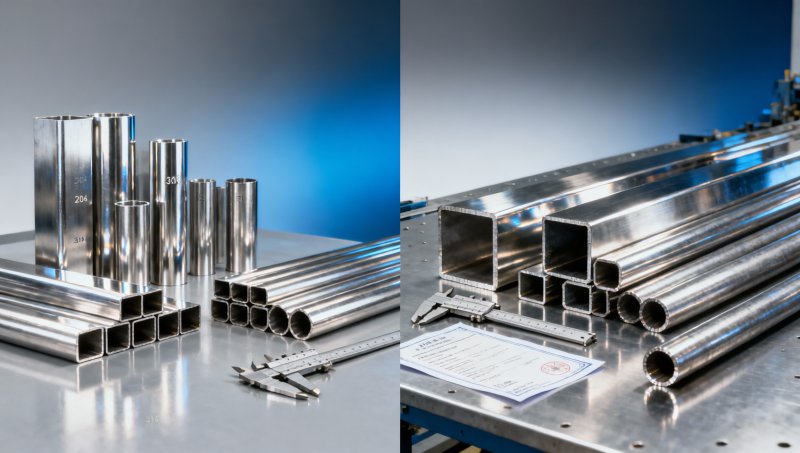
Before comparing suppliers, it is important to define what the stainless steel square pipe will actually do in service. A pipe used for an indoor support frame has very different requirements from one exposed to coastal air, chemical splash, or repeated cleaning cycles. In most projects, the first 4 checkpoints are material grade, size, wall thickness, and manufacturing process.
The most common stainless steel grades for square pipe include 201, 304, and 316. Grade 201 is usually selected for lower-cost indoor applications where corrosion exposure is limited. Grade 304 is the mainstream choice for general construction, decoration, food equipment frames, and industrial use. Grade 316 provides improved resistance in marine, chloride-rich, and chemical environments, but often comes with a higher material cost that may range 15%–35% above 304 depending on market conditions.
Wall thickness also changes both structural performance and processing behavior. For example, 1.0 mm to 1.5 mm square pipe may be sufficient for lightweight furniture, partitions, and decorative systems. For load-bearing frames, machine guards, or welded structural assemblies, many buyers move toward 2.0 mm to 4.0 mm or more, depending on span, connection design, and safety requirements. Thin-wall pipe may reduce weight, but it can dent more easily during handling and may deform during welding if heat input is not controlled.
Length and tolerance matter as much as grade. Standard commercial lengths are often 5.8 m, 6.0 m, or 6.1 m, while project-based orders may require custom cutting. If your installation needs tight fit-up, check side dimension tolerance, wall thickness tolerance, straightness, squareness, and end condition. A low-cost offer can become expensive if field trimming, grinding, and rework add 3–7 extra labor hours per batch.
Core factors buyers should confirm
- Application environment: indoor, outdoor, marine, humid, food-contact, or chemical exposure.
- Load requirement: decorative use, light structural support, medium-duty frame, or heavy-duty fabrication.
- Processing needs: welding, bending, cutting, polishing, drilling, or laser fabrication.
- Standard requirement: ASTM, EN, JIS, or GB, depending on project documentation and destination market.
- Surface finish: mill finish, brushed, polished, or pickled, based on appearance and post-processing needs.
The table below gives a practical comparison of the grades and selection logic commonly used in stainless steel square pipe procurement.
In practice, the best selection starts with a clear service condition and fabrication plan. Buyers who define those 3 to 5 project variables early usually shorten supplier communication cycles and reduce mismatch risk during production.
Welded vs Seamless Stainless Steel Square Pipe
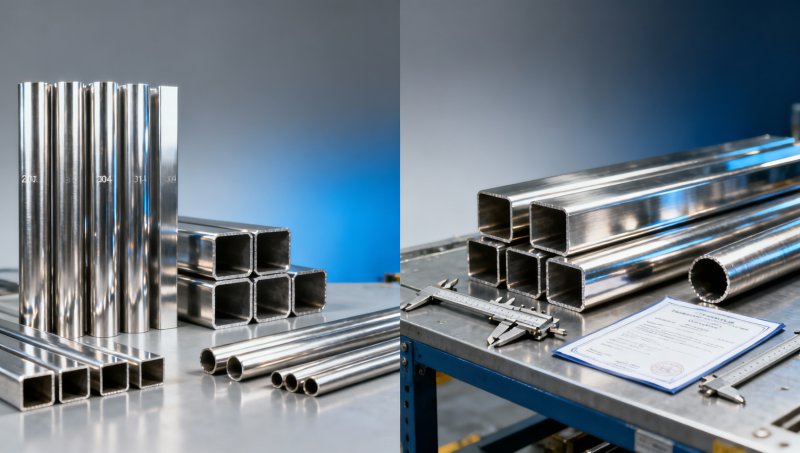
One of the most common questions is whether welded stainless tubing or seamless steel tube is better. The answer depends on application, budget, and certification requirements. For most square pipe uses in construction, furniture frames, architectural systems, handrails, and general industrial fabrication, welded square pipe is the mainstream option because it is cost-effective, widely available, and suitable for large-volume supply.
Welded square pipe is made by forming stainless strip or coil and welding the longitudinal seam. Modern production lines can deliver consistent dimensions and good appearance, especially for standard sizes. For many commercial projects, welded products provide the best balance of price, lead time, and usability. When sourced from a manufacturer with stable forming and weld control, the performance is adequate for a large range of non-pressure and structural applications.
Seamless tube is produced differently and is often selected where higher pressure resistance, more uniform structure, or special engineering requirements apply. However, for square sections, seamless availability can be more limited, and cost can increase significantly. It is not uncommon for seamless options to cost 25%–60% more than welded alternatives in similar stainless grades, especially in lower-volume orders or custom dimensions.
The key is not to assume that seamless is always superior. If the application does not involve internal pressure, extreme loading, or special certification, specifying seamless may add cost without meaningful benefit. For procurement teams and financial approvers, this is a critical decision point because it affects both unit price and delivery schedule.
Comparison by application logic
The following table shows where each production type usually fits in real project planning.
A practical sourcing strategy is to match the production method to the actual service condition instead of defaulting to the highest-cost option. This improves cost control without sacrificing performance.
Related material planning for fabrication projects
Many buyers who purchase stainless steel square pipe also need other steel materials for brackets, covers, cold-formed parts, and welded assemblies. In mixed-material fabrication, flat products may be specified for stamping, bending, or deep drawing components. One example is High Carbon Steel Plate , which is available in models such as SPCC, SPCCT, SPCD, SPCE, SPCF, and SPCG, with width options from 100 mm to 3000 mm, length from 1 m to 12 m, and thickness from 0.1 mm to 400 mm.
For industrial manufacturing, refrigerators, switchboards, automobile chassis parts, roof panels, and formed sheet components may require high tensile strength, smooth surface finish, and good stamping or bending performance. When buyers coordinate square pipe with flat steel procurement in the same project cycle, they can reduce sourcing fragmentation and improve production scheduling across 2 or 3 fabrication stages.
Check Dimensions, Standards, and Quality Control Details
Even the correct grade can fail a project if dimensions and inspection points are not clearly controlled. Stainless steel square pipe should be verified not only by nominal size, but also by actual outer dimension, wall thickness consistency, straightness, corner profile, weld quality, and surface condition. For projects with assembly tolerances tighter than ±1.0 mm, these details directly affect installation time and final appearance.
International buyers should confirm which standards the material must meet. In global structural and industrial supply, common references include ASTM, EN, JIS, and GB. The required standard can influence chemistry control, testing method, marking practice, and document package. If the project serves North America, Europe, the Middle East, or Southeast Asia, standard alignment should be reviewed before order confirmation, not after production begins.
Quality teams often focus on 6 inspection items: material grade verification, dimensional tolerance, surface defects, weld seam condition, mechanical property consistency, and packaging integrity. For export shipments, packaging matters more than many first-time buyers expect. If bundle protection is weak, polished or decorative tube can arrive with scratches, edge dents, or moisture staining after 20–40 days of sea transport.
A reliable supplier should be able to support both standard specifications and OEM requirements, especially when projects need cut-to-length service, special finish, or custom profile combinations. Manufacturers with modern production facilities and stable quality control are usually better positioned to keep dimensional variation and lead times under control.
Inspection points before shipment
- Confirm material certificate matches the ordered grade and standard.
- Measure at least 3 positions per bundle for outer size and wall thickness consistency.
- Check whether the weld seam is smooth enough for the intended fabrication process.
- Review surface finish under normal lighting for scratches, scale, pits, or discoloration.
- Verify bundle tags, quantity count, and export packing method before container loading.
The table below can be used as a practical quality checklist during supplier evaluation and pre-shipment review.
For many projects, quality control is not a separate step but part of cost management. Rejecting one container due to preventable defects can affect project schedules by 2–6 weeks, especially when replacement production and ocean freight are involved.
Match the Pipe to the Real Application and Procurement Plan
Application-based selection is the most effective way to avoid overbuying or under-specifying stainless steel square pipe. A decorative building facade, a food-processing support frame, a warehouse partition, and a machine enclosure may all use square stainless sections, but their priority ranking is different. Some focus on corrosion resistance and appearance, while others prioritize rigidity, weldability, and cost per meter.
Procurement teams should also evaluate total landed cost instead of material price only. The final cost can include cutting loss, polishing, fabrication difficulty, test requirements, package type, inland transport, sea freight, and customs handling. A pipe that is 8% cheaper at ex-works level may not remain cheaper after extra polishing, thicker protective wrapping, or delayed shipping are added.
For distributors and project buyers, lead time is another major factor. Standard sizes may ship in 7–20 days depending on quantity and finish, while custom dimensions or OEM fabrication can take 3–6 weeks or more. If your project has a fixed installation window, supplier production planning should be checked at the quotation stage, not just in the purchase order.
Manufacturers that serve multiple export regions often help reduce sourcing risk because they understand documentation, standards, and packaging expectations for different markets. A professional structural steel manufacturer and exporter with stable capacity can support buyers with standard sections, customized components, and consistent delivery schedules across repeated orders.
Practical procurement questions to ask suppliers
- Can the supplier provide the exact stainless grade, finish, and dimensional range required by the project?
- What is the normal production cycle for standard orders versus OEM or cut-to-length orders?
- What inspection documents and marking details are included before shipment?
- How is export packaging arranged to reduce scratch, moisture, and deformation risk?
- Can the supplier combine square pipe with other structural steel products for one-stop sourcing?
Why integrated sourcing matters
For global buyers managing construction, industrial, and manufacturing projects, integrated sourcing can save both time and coordination effort. Companies such as Hongteng Fengda support projects with angle steel, channel steel, steel beams, cold formed steel profiles, and customized structural steel components. This kind of supply capability is useful when stainless steel square pipe is only one part of a larger package involving multiple steel sections and OEM parts.
When a supplier can work to ASTM, EN, JIS, and GB requirements and maintain stable production capacity, buyers often gain better schedule visibility, more consistent quality, and fewer communication gaps between technical review and commercial execution.
Common Mistakes, Maintenance Advice, and Final Buying Tips
Several common mistakes appear repeatedly in stainless steel square pipe purchasing. The first is choosing grade by price alone. The second is assuming all stainless materials resist all corrosion equally. The third is ignoring fabrication compatibility, especially when the pipe will be welded, polished, or exposed to contamination from carbon steel tools. Any of these errors can shorten service life and raise maintenance cost.
Another frequent issue is underestimating the effect of environment. In indoor dry areas, 304 may perform well for many years with limited maintenance. In coastal or chloride-rich conditions, tea staining or more severe corrosion may appear if the grade is too low or surface cleanliness is poor. In these cases, moving from 304 to 316 and improving cleaning frequency from occasional wiping to scheduled monthly maintenance may provide better long-term value.
Maintenance itself is straightforward but should not be neglected. Use non-contaminating cleaning tools, avoid prolonged exposure to chloride-rich deposits, and separate stainless materials from carbon steel dust during storage and fabrication. For visible architectural applications, periodic cleaning every 1–3 months in harsh outdoor environments helps preserve appearance and reduces surface contamination buildup.
The most effective final buying tip is to align technical requirements, quality checkpoints, and delivery expectations before production starts. That means confirming grade, size, tolerance, finish, quantity, packing, test documents, and shipping timeline in one clear specification sheet. This simple step reduces disputes and helps procurement, quality, finance, and project teams work from the same approval basis.
FAQ
How do I choose between 304 and 316 stainless steel square pipe?
Choose 304 for general indoor and outdoor use where corrosion exposure is moderate. Choose 316 when the pipe will face seawater spray, chlorides, chemical cleaning agents, or aggressive industrial environments. If appearance retention over 5–10 years is critical in coastal zones, 316 is often the safer choice.
What wall thickness is suitable for structural use?
There is no single answer because load, span, joint design, and code requirements all matter. In light-duty applications, 1.2 mm to 1.5 mm may be enough. For medium structural frames, many projects use 2.0 mm to 4.0 mm. Heavier-duty work may require thicker sections plus engineering verification.
What should buyers check before placing a bulk order?
At minimum, confirm 6 items: grade, size, wall thickness, finish, standard, and lead time. Also ask for inspection documents, packaging details, and whether the supplier can support repeated orders with consistent tolerance control.
How long does international delivery usually take?
Production for standard material may take roughly 7–20 days, while custom or OEM orders often require 3–6 weeks. Ocean transit depends on destination and shipping schedule, so total project planning should include both manufacturing and logistics time.
Choosing stainless steel square pipe is ultimately about matching material performance to service environment, fabrication method, project budget, and delivery schedule. When buyers compare grade, wall thickness, production method, tolerance, inspection requirements, and export support together, they make stronger decisions and reduce downstream risk.
If you are sourcing stainless steel square pipe or related structural steel products for construction, industrial, or manufacturing projects, working with an experienced Chinese structural steel manufacturer and exporter can simplify specification control, quality management, and global delivery planning. Contact us now to discuss your project, get a customized solution, or request detailed product and sourcing support.
Please give us a message


Please enter what you want to find