Choosing the right Rebar grade and size affects far more than reinforcement quantity. It shapes structural capacity, crack control, durability, installation speed, compliance, and purchasing efficiency across the whole concrete project cycle.
That is why Rebar selection deserves early attention. A practical decision balances design load, concrete section limits, exposure conditions, fabrication realities, and the steel supply chain behind the specification.
In steel-related construction, this decision also connects with broader material planning. Suppliers with stable quality systems, international standard compliance, and dependable lead times help reduce avoidable risk before concrete is even poured.
What Rebar grade and size really mean
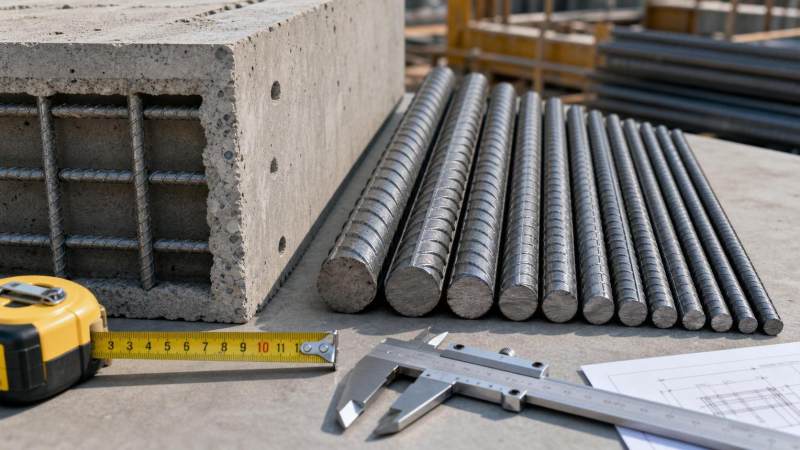
At a basic level, Rebar grade refers to strength. It indicates the yield performance the bar can deliver before permanent deformation becomes a design concern.
Rebar size refers to bar diameter and cross-sectional area. That dimension influences how much tensile force the bar can carry and how easily it fits within the concrete member.
These two variables work together. A higher grade does not automatically solve every design need, and a larger bar is not always the most efficient answer.
For example, fewer large bars may satisfy area requirements, but they can reduce spacing flexibility, complicate placement, and weaken crack distribution in some members.
Why the market pays closer attention now
Concrete projects today face tighter cost control, shorter schedules, and stricter performance expectations. That makes Rebar decisions more visible at both design and execution stages.
International work adds another layer. ASTM, EN, JIS, and GB references may define grade naming, testing, chemistry, and tolerances differently, even when practical performance seems similar.
This is where an experienced structural steel supply partner matters. Hongteng Fengda supports global construction and industrial projects with steel products aligned to major international standards.
That broader manufacturing discipline matters because reinforcement choices are rarely isolated. They sit inside larger packages involving beams, channels, profiles, fabricated components, and delivery coordination.
Start with structural demand, not catalog preference
A sound Rebar selection begins with the member itself. Slabs, beams, columns, walls, footings, retaining elements, and bridge components do not place the same demand on reinforcement.
Load type matters as much as magnitude. Static building loads, traffic loads, seismic action, impact, vibration, and temperature-related movement can push selection in different directions.
Usually, the most useful questions are straightforward:
- What tensile force must the reinforced section resist?
- How much concrete cover is available?
- What spacing is needed for concrete flow and vibration?
- Will congestion around laps, hooks, or inserts create placement problems?
- Does the design prioritize crack control, ductility, or compact detailing?
When these questions are answered early, the Rebar schedule tends to be cleaner, easier to fabricate, and less likely to cause site delays.
How grade selection affects performance and constructability
Higher grade Rebar can reduce total steel quantity in some designs. That may lower weight, simplify transport, and create more usable space inside a dense concrete section.
But higher strength is only one part of the decision. Bendability, weldability, ductility class, and code acceptance are equally important in real projects.
In seismic regions, ductile behavior becomes especially important. A bar with adequate strength but poor deformation capacity can create problems where energy dissipation is required.
For corrosive or exposed environments, the grade discussion often overlaps with coating or protection strategy. Reinforcement, embedded steel, drainage details, and adjacent pipe systems should be reviewed together.
In mixed material packages, corrosion resistance may also be relevant beyond reinforcement. For related infrastructure needs, Hot diped-Galvanized Pipe can be a practical option where long service life and surface protection matter.
Its galvanized layer improves corrosion resistance and supports applications across construction, transport, industrial equipment, utility lines, and structural support systems, with ASTM, EN, JIS, DIN, AISI, and GB references available.
Why bar size is often the more practical decision
On active projects, bar size often drives field efficiency more directly than grade. Oversized Rebar may look efficient on paper, yet cause congestion at beam-column joints or wall intersections.
Smaller bars usually improve distribution and crack control. They can also make it easier to maintain spacing, especially in slabs, shear walls, and heavily detailed foundation zones.
Larger bars can still be the right choice in footings, columns, transfer members, and other sections where high force demand and available concrete volume allow efficient placement.
A useful comparison is below.
Site conditions can change the right answer
The best Rebar specification on paper can become inefficient when site conditions are poor. Access limits, crane capacity, weather exposure, and labor skill level all affect what works smoothly.
Marine zones, industrial pollution, deicing salts, and wet-dry cycles also matter. Durability planning should review reinforcement protection together with adjacent steel items and fluid-handling components.
That coordination is often overlooked. For example, when a project includes pipe supports, utility routes, or exposed service lines, using properly specified galvanized products helps align service life expectations.
The same supply mindset applies to Rebar: traceable standards, consistent dimensions, controlled tolerances, and predictable delivery are often as valuable as nominal strength.
Common mistakes that create downstream cost
- Selecting Rebar grade only by price per ton.
- Ignoring lap length, bend radius, and anchorage implications.
- Using large bars in narrow members without checking congestion.
- Assuming standards from different regions are automatically equivalent.
- Leaving procurement too late for mill scheduling and fabrication.
A practical framework for selecting Rebar
A workable review process does not need to be complicated. It needs to connect design intent with fabrication and site execution.
- Confirm governing code and approved grade equivalents.
- Match Rebar strength to member demand and ductility needs.
- Check bar size against spacing, cover, and concrete placement paths.
- Review corrosion exposure and protection strategy.
- Compare shop fabrication limits and site handling constraints.
- Validate supplier consistency, certificates, and delivery timing.
This approach usually leads to better coordination across structural steel, reinforcement detailing, and related material packages.
Where to focus before releasing the order
Before final approval, review the Rebar schedule alongside drawings, bar bending details, lap zones, and concrete pour sequence. Small mismatches at this stage often become expensive on site.
It also helps to compare reinforcement choices with the rest of the steel package. Suppliers with experience in structural sections, custom components, and international delivery can support cleaner coordination.
The goal is not simply to specify stronger Rebar or larger Rebar. The goal is to choose reinforcement that fits the structural demand, project environment, and construction method without creating hidden tradeoffs.
A disciplined review of grade, size, standard, corrosion exposure, and supply reliability gives a clearer basis for the next step: finalizing a reinforcement plan that can be built as efficiently as it can be designed.
Please give us a message


Please enter what you want to find