Choosing the right metal angle with holes can significantly improve installation speed, structural reliability, and overall project cost control. For procurement teams sourcing structural steel, it is essential to evaluate material grade, hole accuracy, corrosion resistance, load requirements, and supplier consistency. This guide explains how to select the most suitable option for fast installation while reducing sourcing risks and ensuring dependable performance.
In practical purchasing work, fast installation is rarely determined by one factor alone. A metal angle with holes may look similar across suppliers, yet differences in steel grade, hole spacing tolerance, galvanizing quality, and batch consistency can directly affect labor time, fit-up efficiency, and rework rates on site.
For buyers serving construction, industrial fabrication, shelving systems, support frames, and equipment mounting projects, the right choice usually comes down to 5 core checks: material strength, dimensional accuracy, corrosion protection, processing quality, and delivery reliability. When these are verified before ordering, installation can often be reduced from multi-step field drilling to 2-step positioning and bolting.
Why Metal Angle With Holes Matters in Fast Installation Projects
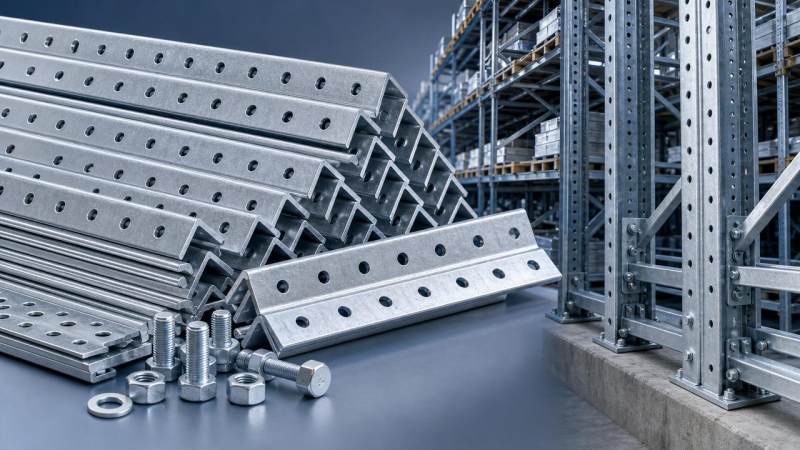
A metal angle with holes is designed to simplify assembly by eliminating or reducing secondary drilling, field marking, and alignment corrections. In steel-related projects, this saves labor hours, lowers tool wear, and helps crews maintain a predictable installation sequence across 10, 100, or even 1,000 repeated connection points.
For procurement teams, the value is not only in the unit price per ton or per piece. The real cost impact comes from installation speed, fewer errors, lower scrap, and better site coordination. If hole centers are off by even 1–2 mm in repeated assemblies, the hidden cost can quickly exceed the initial purchasing savings.
Typical applications where pre-punched angles save time
Pre-punched angle steel is commonly used in light structural frames, solar supports, cable trays, warehouse racks, guard structures, machine brackets, and modular construction assemblies. In these environments, repeated connections make standardized hole layouts especially valuable.
- Bolted support frames requiring consistent spacing
- Equipment mounting systems installed in confined areas
- Secondary steel components assembled in 2–4 stages
- Corrosion-prone outdoor structures needing galvanized protection
- OEM parts where dimensional repeatability affects final fit
How installation efficiency is affected
Compared with plain angle steel that must be drilled on site, a metal angle with holes can shorten assembly time by reducing layout steps, tool changes, and operator adjustments. In many routine steelwork applications, teams can save 15%–30% of installation time when the hole pattern matches the hardware and support structure from the start.
This matters even more in export projects, where local labor costs, site access restrictions, and compressed schedules increase the penalty of rework. Buyers should therefore treat hole design as a functional specification rather than a minor machining detail.
Basic selection priorities for procurement
Before comparing quotations, it helps to rank purchasing priorities in order of project impact. The table below shows the main decision points that usually determine whether a product supports fast installation or creates avoidable delays.
The key takeaway is simple: a lower-cost angle is not automatically a lower-cost solution. For fast installation, the best purchasing decision is usually the product that minimizes site correction work, not the one with the lowest ex-works price.
How to Evaluate the Right Specification Before You Order
To choose the right metal angle with holes, buyers should review 4 specification layers: section size, thickness, hole configuration, and steel grade. These four variables determine whether the angle can be installed quickly while still meeting structural and environmental requirements.
H4: Match section size and thickness to the actual load
In many procurement cases, overspecification increases cost while underspecification creates risk. Thickness should be selected based on connection load, span, support spacing, and whether the angle works as a bracket, frame edge, or reinforcement member. Common fabricated steel sections may range from 1.5 mm to 25 mm depending on the application.
If the metal angle with holes is used only for light-duty mounting, a thinner profile may be enough. For structural brackets, machine supports, or high-cycle loading areas, stronger grades such as Q235B or Q345B are often more appropriate than entry-level material.
Hole pattern should match hardware and assembly method
Hole design is one of the most overlooked purchasing variables. Buyers should confirm at least 6 points: hole diameter, slot or round shape, center-to-center spacing, edge distance, first-hole offset, and total hole count per length. A mismatch in any one of these points can delay installation.
For example, if the project uses M10 or M12 fasteners, the hole diameter should allow practical installation clearance without creating excessive movement. In export projects, confirming metric or imperial hardware at the quotation stage avoids preventable compatibility problems later.
Corrosion resistance must match the environment
Indoor dry installations and outdoor exposed structures should not be sourced to the same surface requirement. A metal angle with holes used in coastal, humid, chemical, or rooftop environments generally needs stronger corrosion protection than one used inside a warehouse or equipment room.
Typical options include bare carbon steel for controlled indoor use, pre-galvanized steel for moderate exposure, and hot-dip galvanized steel for more demanding service conditions. Stainless grades such as 304 or 316 may also be considered when corrosion resistance is a primary design requirement, although cost will be higher.
Check standards and tolerance consistency
Reliable suppliers should be able to manufacture to recognized standards such as ASTM, EN, JIS, or GB, depending on project requirements. For punched or drilled components, tolerance control is especially important because repeated deviation multiplies installation difficulty across the job site.
In related structural steel supply categories, buyers often review dimensions such as thickness tolerance of +/-0.02 mm and section height tolerance of +/-2 mm where applicable. While exact ranges depend on the product type, the principle remains the same: installation speed improves when the delivered parts are dimensionally consistent from the first bundle to the last.
The following table provides a practical reference for aligning specification choices with project conditions and purchasing priorities.
For most procurement teams, this structured review reduces sourcing risk more effectively than comparing only price and delivery time. It also improves communication between engineering, purchasing, and the installation contractor.
Supplier Evaluation: What Procurement Teams Should Ask Before Approval
Even when the specification is clear, supplier capability still determines whether the metal angle with holes will perform as expected. A qualified structural steel manufacturer should be able to provide material options, controlled processing, quality inspection records, and a stable export workflow.
Review manufacturing and customization capability
Procurement teams should confirm whether the supplier can handle both standard and OEM production. This includes section forming, punching or drilling, cutting, surface treatment, bundling, and export packing. If the project needs multiple steel components, integrated supply can also reduce coordination time.
As one example of related structural steel sourcing, some buyers also combine angle orders with Channel Steel Supplier support for connected frame systems. Typical channel steel options may cover grades such as Q195, Q235, Q235B, Q345B, Duplex, and 201/202/304/316, with thickness from 1.5 mm to 25 mm, height from 80 mm to 160 mm, and lengths of 6–12 m according to project needs.
Ask for 5 essential quality checkpoints
A dependable supplier should have a clear inspection process covering material verification, dimensional checks, hole position control, surface condition, and packing accuracy. These 5 checkpoints help buyers reduce the chance of receiving material that fits the drawing but creates problems during assembly.
- Confirm steel grade against the purchase order or drawing requirement.
- Check leg size, thickness, straightness, and cut length.
- Measure hole diameter, spacing, and edge distance on sample pieces.
- Inspect burr removal, deformation around holes, and coating continuity.
- Verify bundle labels, quantity counts, and export packing condition.
Evaluate delivery stability, not just nominal lead time
For B2B buyers, a quoted lead time means little without production stability. It is better to ask whether the supplier can maintain schedule consistency across repeated orders, mixed specifications, and urgent replenishment needs. In many steel supply programs, dependable lead times of 2–6 weeks are more valuable than an unrealistically short promise that later slips.
Export buyers should also confirm documentation support, packaging method, loading protection, and communication speed. A response cycle of 24–48 hours on technical questions often makes the difference between smooth project execution and prolonged approval delays.
Common Buying Mistakes and Practical Ways to Avoid Them
Many sourcing issues are preventable if buyers address installation details early. The most common mistake is treating a metal angle with holes as a generic commodity without checking how it will connect on site. Fast installation depends on design compatibility, not only on steel availability.
Mistake 1: Choosing by price per piece only
A lower unit price may still produce a higher total installed cost if field drilling, slot correction, or repainting becomes necessary. Buyers should estimate total cost across 3 layers: material, installation labor, and rework exposure. This approach is especially useful for projects with 100+ repeated connections.
Mistake 2: Ignoring tolerance and hole repeatability
When hole spacing varies across batches, the installation team loses time in sorting and matching components. Asking for a sample, pilot production, or first article inspection is often a low-cost step that prevents larger delays during bulk assembly.
Mistake 3: Underestimating the service environment
Indoor and outdoor conditions are not interchangeable. If the structure is exposed to moisture, chemicals, or temperature variation, corrosion protection should be specified from the start. Replacing rusted support components after 12–24 months is far more expensive than buying the correct finish initially.
Mistake 4: Ordering without a complete drawing or hole schedule
A clear drawing should include at minimum section size, length, hole diameter, hole spacing, edge distance, quantity, grade, and surface treatment. Without these details, quotation comparisons become unreliable, and the delivered product may not support fast installation.
A practical procurement checklist
Before placing an order, use the checklist below to improve consistency across internal approval and supplier communication.
- Define the installation method: bolting, framing, bracketing, or modular assembly.
- Confirm steel grade and thickness according to the load requirement.
- Verify hole pattern with the actual bolt or connector specification.
- Specify galvanizing or stainless option for the service environment.
- Request sample photos, inspection records, or a pre-shipment check.
- Align quantity, bundling, labeling, and delivery schedule before release.
Choosing the right metal angle with holes is ultimately a sourcing decision that balances speed, accuracy, durability, and supply reliability. For procurement teams, the best results usually come from matching the section and hole pattern to real installation conditions, verifying tolerances early, and working with a supplier that can maintain consistent quality across batches.
Hongteng Fengda supports global buyers with structural steel manufacturing, export coordination, standard specifications, and customized solutions for construction and industrial projects. If you need technical guidance on angle steel, related profiles, or integrated structural steel supply, contact us to get a tailored solution, discuss product details, and reduce sourcing risk before your next order.
Please give us a message


Please enter what you want to find