Choosing the right galvanized pipe for plumbing can significantly affect project cost, durability, and long-term performance. For procurement professionals, the challenge is finding material that meets quality standards without paying for unnecessary specifications or unstable supply. This guide explains how to compare grades, coatings, compliance, and sourcing factors so you can make cost-effective decisions with confidence.
Why buying galvanized pipe for plumbing has become a more strategic decision
In the steel supply market, galvanized pipe for plumbing is no longer a simple price comparison item. Procurement teams are facing a different landscape than they did a few years ago. Material costs fluctuate more often, project owners are paying closer attention to compliance, and buyers are under pressure to reduce lifecycle cost rather than only initial purchase cost. At the same time, supply chains have become more selective, with stable manufacturers gaining an advantage over traders that cannot guarantee coating consistency, test documentation, or delivery reliability.
This shift matters because plumbing pipe selection now affects not only installation budgets, but also maintenance exposure, inspection risk, and supplier performance metrics. For procurement personnel, overpaying often happens in subtle ways: choosing a higher specification than the application requires, accepting vague coating claims, overlooking tolerance issues that increase waste, or buying from a source that offers a low quote but poor batch consistency. The smarter approach is to understand what has changed in the market and use those signals to make better sourcing decisions.
The biggest market signals shaping galvanized pipe for plumbing purchases
Several clear trends are changing how buyers should evaluate galvanized pipe for plumbing. First, end users increasingly expect documented compliance with ASTM, EN, JIS, or GB standards rather than general verbal assurance. Second, price competition is pushing some suppliers to reduce zinc coating quality, wall thickness accuracy, or inspection depth. Third, buyers in construction and industrial sectors are moving toward total-value sourcing, meaning lead time stability, packaging quality, and after-sales response now carry more weight in supplier selection.
Another important signal is application-specific purchasing. Many projects previously used generalized material specifications, but current procurement practice is becoming more segmented. Pipe for water distribution, exposed utility runs, light industrial systems, and low-corrosion indoor environments may not require the same grade, coating mass, or dimensional control. This creates room to save money, but only when the technical requirement is matched correctly to the service condition.
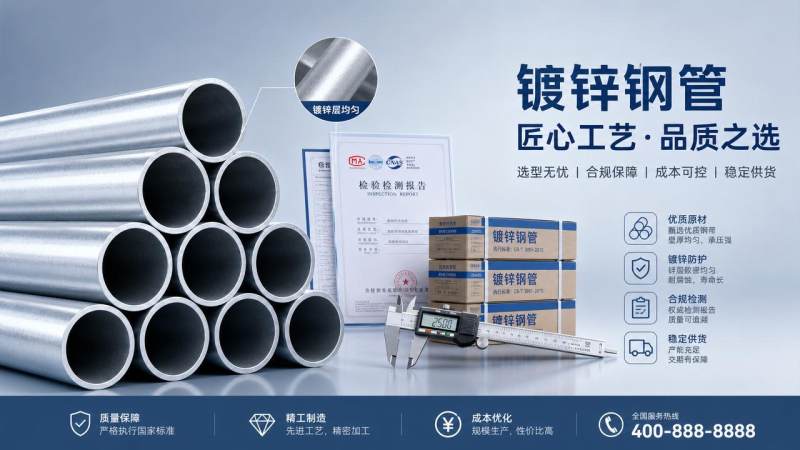
What is driving these changes in the steel and plumbing supply chain
The most direct driver is cost volatility in steel raw materials, energy, and transportation. When suppliers face margin pressure, the difference between a trustworthy quote and a risky quote becomes more significant. Low offers may reflect genuine efficiency, but they may also indicate thinner coating, less precise processing, or weaker traceability. Procurement teams that treat all galvanized pipe for plumbing as interchangeable are more likely to absorb hidden costs later.
A second driver is the global normalization of quality verification. Buyers across North America, Europe, the Middle East, and Southeast Asia increasingly expect consistent paperwork and standard compliance. This benefits manufacturers with modern facilities and controlled production systems. Companies like Hongteng Fengda, as a structural steel manufacturer and exporter from China, operate in an environment where international standards, stable production capacity, and dependable lead times have become practical sourcing advantages rather than marketing extras.
The third driver is project efficiency. Delayed deliveries, mismatched specifications, and quality disputes can damage procurement performance far beyond the value of one order. As a result, many buyers now prefer fewer but more dependable suppliers that can support multiple steel categories and customized solutions. This broader sourcing model is especially useful for contractors and industrial buyers purchasing more than one steel product family within a project cycle.
How to avoid overpaying without reducing quality
The key is not to buy the cheapest galvanized pipe for plumbing, but to buy the correct level of performance. Overpayment usually comes from four common mistakes.
1. Paying for standards your application does not actually require
Not every project needs the highest available grade or the most demanding coating requirement. If the plumbing system is used in a controlled indoor environment, the specification may differ from exposed outdoor or industrial service. Procurement should confirm pressure requirements, corrosion exposure, joining method, and local code expectations before comparing quotations.
2. Comparing quotes without checking coating and tolerance details
Two offers may look similar in price and nominal size, but differ in zinc coating uniformity, wall thickness tolerance, or end finishing. These differences affect service life and installation efficiency. A lower quote can become more expensive if it increases cutting loss, threading defects, or field rejection.
3. Ignoring supplier stability
A dependable supplier reduces non-material cost. Stable production scheduling, consistent batch quality, and accurate export documentation help avoid disruption. For international buyers, this is often where real savings are achieved.
4. Treating one project requirement as universal
Framework agreements can save time, but procurement still needs room to adjust specifications by project type. The right galvanized pipe for plumbing in residential work may not be the right choice for municipal or industrial applications.
What procurement teams should verify before placing an order
A practical buying process should focus on measurable details instead of broad claims. Ask suppliers to confirm base material grade, coating process, dimensional tolerances, testing scope, and the exact standard used for manufacturing and inspection. If the supplier also supports OEM or customized processing, clarify whether customization affects lead time or minimum order quantity.
It is also useful to evaluate whether the supplier understands adjacent steel demands within your projects. For example, some construction buyers sourcing galvanized pipe for plumbing also need structural products in the same procurement cycle. In such cases, a manufacturer with broader steel capability may create efficiency in coordination, logistics, and quality communication. Mid-project, buyers often combine plumbing materials with reinforcement or structural packages, and products such as Rebar may be sourced alongside pipe for civil engineering construction, foundations, beams, columns, walls, slabs, bridges, roads, tunnels, and other infrastructure needs. Typical options can include HRB335, HRB400, and HRB500, with multiple sizes from 6mm to 50mm, hot rolled or cold rolled technique, and standards such as ASTM A615, JIS G3112, and BS4449, which illustrates why integrated steel sourcing is gaining attention among larger buyers.
How these changes affect different buyers
The impact of current market changes is not the same for every procurement role. Contractors typically feel the strongest pressure from delivery timing and site acceptance. Distributors care more about repeatability, broad size availability, and competitive resale margins. Industrial buyers often focus on documentation, corrosion resistance, and batch traceability. For all of them, the purchase of galvanized pipe for plumbing is becoming more data-based and less dependent on generic supplier promises.
What to watch next in galvanized pipe for plumbing sourcing
Looking ahead, buyers should watch for three signals. The first is whether price competition continues to widen the gap between compliant and non-transparent suppliers. The second is whether project owners demand more explicit material records and third-party verification. The third is whether procurement departments continue consolidating steel purchases with suppliers that can support both standard and customized needs across multiple product categories.
In practical terms, this means the best buying strategy for galvanized pipe for plumbing will likely combine technical discipline with supplier partnership. Rather than requesting the most conservative specification by default, procurement teams should build a decision matrix based on actual service conditions, code requirements, quality evidence, and delivery performance. That approach protects budget without exposing the project to avoidable failure.
Action steps for cost-conscious procurement teams
If your team wants better value from galvanized pipe for plumbing purchases, start with a structured review. Confirm where your current specification may be overbuilt, identify which quality indicators are truly non-negotiable, and compare suppliers based on consistency rather than headline price alone. Ask whether the supplier can meet ASTM, EN, JIS, or GB requirements with clear documentation, and whether lead times remain dependable across repeat orders.
For organizations managing international projects, it also makes sense to work with manufacturers that combine stable production capacity, strict quality control, and export experience. This reduces sourcing risk and improves coordination when projects involve both plumbing materials and structural steel requirements.
Before your next order, focus on a few key questions: Does the specified galvanized pipe for plumbing match the real exposure condition? Are you paying extra for performance you will never use? Can your supplier prove coating, tolerance, and compliance consistently? And if the market tightens again, will that supplier still deliver on time? These are the questions that help procurement move from reactive buying to confident, cost-effective decision-making.
Please give us a message


Please enter what you want to find