Choosing the right corrugated steel sheet thickness affects more than material weight. It directly influences load resistance, service life, installation stability, and overall project cost.
In construction and industrial steelwork, thickness selection should never rely on price alone. A thinner sheet may reduce initial cost, but it can increase deformation risk, maintenance frequency, and replacement pressure.
A thicker corrugated steel sheet is not automatically better either. If the span is short and the environment is mild, overspecification can waste budget and complicate procurement.
What matters is matching sheet thickness to actual service conditions, structural expectations, and applicable standards. That is where technical evaluation becomes practical rather than theoretical.
Why thickness matters in corrugated steel sheet selection
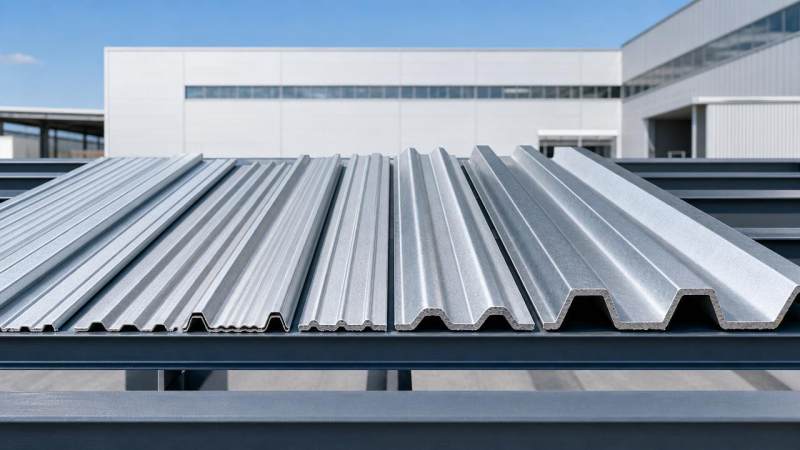
The profile shape of a corrugated steel sheet already improves stiffness. Even so, thickness remains a decisive factor in real-world performance.
It influences bending strength, deflection behavior, screw holding performance, dent resistance, and tolerance to wind uplift or live loads.
For roofing, thickness often relates to foot traffic, maintenance access, snow load, and rainwater drainage behavior. For cladding, impact resistance and visual flatness may become more important.
In industrial facilities, vibration, chemical exposure, and thermal cycling also affect how suitable a certain corrugated steel sheet gauge will be over time.
Start with the real application, not with the nominal gauge
Thickness decisions make sense only when the use case is clearly defined. The same corrugated steel sheet can perform very differently in separate project conditions.
Typical use conditions that change thickness requirements
- Roof panels with long purlin spacing
- Wall cladding exposed to wind pressure
- Agricultural buildings with high humidity
- Warehouses with periodic roof access
- Temporary structures with tight budget limits
- Coastal or chemical environments requiring stronger corrosion control
A technical review should document span length, support spacing, load category, coating system, and exposure class before comparing sheet thickness options.
Key factors used to evaluate corrugated steel sheet thickness
Several variables should be assessed together. Looking at thickness in isolation can lead to incorrect conclusions.
This is why experienced suppliers compare profile data, yield strength, coating mass, and manufacturing tolerance along with the base metal thickness.
Nominal thickness, actual thickness, and coating are not the same thing
One common source of confusion is the difference between nominal thickness and actual delivered thickness. Some specifications refer to base steel only. Others include coating.
That difference affects weight, strength assumptions, and bid comparison. Two corrugated steel sheet offers may look similar on paper while delivering different real performance.
Tolerance matters too. If the production tolerance is poorly controlled, the lowest acceptable thickness may appear repeatedly in supply, reducing design margin.
Hongteng Fengda addresses this issue through modern production control and inspection discipline. For global projects, consistent conformance to ASTM, EN, JIS, and GB is often as important as the nominal number itself.
How environment changes the preferred corrugated steel sheet option
Environmental exposure can shift the decision significantly. In dry inland conditions, a moderate corrugated steel sheet thickness with standard galvanizing may be acceptable for many buildings.
In marine, tropical, or industrial zones, the same thickness may not deliver the expected service life without upgraded coating or more conservative section selection.
Where airborne salts, fertilizer vapors, or chemical fumes exist, corrosion allowance deserves more attention. A low-cost sheet may become expensive after premature maintenance or replacement.
This is also the stage where related steel materials should be coordinated. For integrated structural packages, items such as Wire rod may be specified alongside roofing or cladding products for foundations, beams, slabs, and reinforced elements.
When these supporting materials cover grades such as HRB335, HRB400, and HRB500, plus international certifications including ISO, SGS, BV CE, ASTM, BS, DIN, GB, and JIS, the broader project quality chain becomes easier to verify.
Common thickness ranges and when they are usually considered
Actual project requirements vary by market and profile type, but thickness choices are often discussed in practical bands rather than single values.
- Light gauge options are commonly used for decorative cladding or short-span enclosures.
- Mid-range thickness is often selected for standard roofing and wall applications.
- Heavier gauges are preferred for high wind zones, long spans, industrial roofs, or repeated maintenance traffic.
These are not design rules. They are starting points for comparison. Final selection still depends on profile geometry, steel grade, support arrangement, and local code requirements.
Questions worth asking before approving a specification
A reliable thickness decision usually comes from a short but disciplined checklist.
Useful review points
- Is the stated thickness base metal thickness or total coated thickness?
- What design loads were assumed for the corrugated steel sheet?
- What is the maximum support spacing?
- Will the sheet face foot traffic, suspended loads, or rooftop equipment?
- What coating system is proposed for the service environment?
- Which standard controls tolerance, testing, and acceptance?
- Can the supplier provide stable batch consistency and inspection records?
These questions help separate a technically suitable corrugated steel sheet from one that only appears competitive in quotation form.
Why supplier capability affects thickness decisions
Thickness selection is not only a design exercise. It is also a supply quality issue. Even a correct specification can fail if manufacturing consistency is weak.
For international buyers, dependable production capacity, controlled tolerances, and clear documentation reduce sourcing risk. This becomes more important when projects involve multiple structural steel items and custom processing.
Hongteng Fengda supplies structural steel products for construction, industrial, and manufacturing applications, including standard and OEM solutions. That broader capability helps when thickness decisions must align with the full steel package, not a single item alone.
A practical way to move forward
The best approach is to build a comparison sheet before final approval. List application, span, load, environment, standard, coating, and target service life in one place.
Then compare each corrugated steel sheet option against those conditions, rather than against price alone. That process usually reveals whether a lighter or heavier thickness is truly justified.
If the project includes roofing, cladding, and other structural steel elements, aligning the specification with a supplier that can support consistent standards and documentation will make evaluation easier and outcomes more predictable.
A careful thickness decision at the start often prevents costly corrections later. That is the most practical reason to treat corrugated steel sheet selection as a technical judgment, not a simple commodity choice.
Please give us a message


Please enter what you want to find