Choosing the right carbon steel sheet is essential for safe, efficient, and cost-effective fabrication.
The best choice depends on thickness, strength, surface condition, forming behavior, and welding performance.
When these factors match the real application, processing becomes smoother and final quality becomes more reliable.
For construction and industrial work, proper carbon steel sheet selection also helps control waste, delivery risks, and long-term maintenance costs.
As a structural steel manufacturer and exporter from China, Hongteng Fengda supports global projects with stable steel quality and customized supply solutions.
Why carbon steel sheet selection changes by fabrication scenario
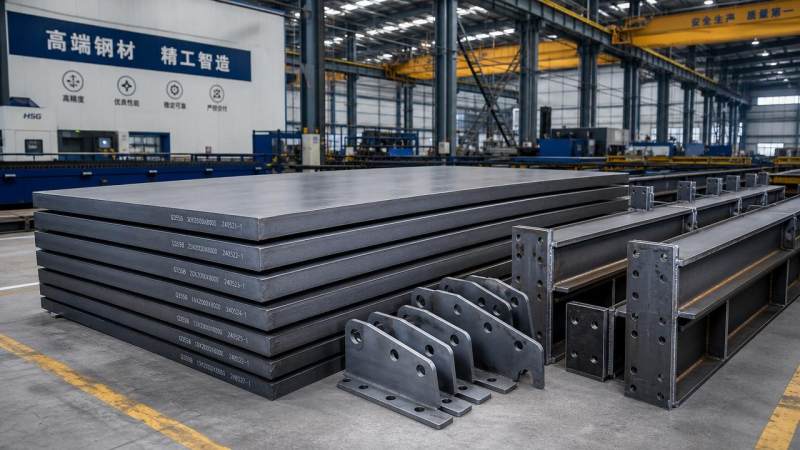
Not every carbon steel sheet performs the same in every workshop or project environment.
A sheet used for bending light enclosures needs different properties than one used for welded structural brackets.
If the application is exposed to impact, vibration, or outdoor weather, material decisions become even more important.
That is why carbon steel sheet should be chosen from a scenario-based view, not only by price or stock availability.
Key checks usually include grade, yield strength, thickness tolerance, flatness, and whether the sheet will be cut, formed, punched, or welded.
Scenario 1: Carbon steel sheet for welded structural parts
For frames, supports, stiffeners, and load-bearing components, weldability should be one of the first decision points.
Low to medium carbon content usually gives better welding performance and reduces cracking risk in heat-affected zones.
In this scenario, carbon steel sheet must also provide stable strength and dimensional consistency after cutting and joining.
If heavy welding is expected, review chemical composition, especially carbon equivalent, before confirming the grade.
Surface scale matters too, because excessive oxide can increase cleaning time and reduce welding efficiency.
Key judgment points for welded applications
- Choose grades with reliable weldability and traceable standards.
- Match thickness to load and joint design.
- Check flatness for easier fit-up and assembly.
- Confirm whether preheating is required for thicker plates.
Scenario 2: Carbon steel sheet for bending and forming work
When the process includes folding, rolling, stamping, or deep forming, ductility becomes more critical than maximum strength.
A carbon steel sheet with poor elongation may crack at bend lines or produce inconsistent angles.
For formed housings, panels, channels, and brackets, surface condition also affects appearance and tooling performance.
Cold rolled carbon steel sheet is often preferred when tighter tolerances and smoother surfaces are needed.
Hot rolled material may still be suitable when appearance is less critical and cost control matters more.
What to review before forming
- Minimum bend radius for the selected carbon steel sheet.
- Thickness consistency across the coil or sheet lot.
- Elongation values and cracking resistance.
- Surface finish for painted or visible parts.
Scenario 3: Carbon steel sheet for outdoor and corrosive service
Carbon steel sheet itself does not provide strong corrosion resistance without added protection.
If the fabricated part will be used outdoors, near moisture, or in industrial air, the surface treatment plan must be included early.
In such cases, it is not enough to choose the right thickness and strength alone.
You should also decide whether painting, galvanizing, or another coating system will be applied after fabrication.
A clean and uniform carbon steel sheet surface improves coating adhesion and final service life.
How related structural products affect sheet selection decisions
Many fabrication projects combine carbon steel sheet with profiles, beams, and welded assemblies.
For example, sheet components may be used as stiffeners, end plates, covers, or connector parts in beam structures.
In these assemblies, material compatibility and fabrication efficiency should be reviewed together.
A project using H Section Beam may require matching sheet grades for welded brackets or reinforcement parts.
Such beam products are widely used in mechanical manufacture, steel structures, shipbuilding, bridging, and automobile chassis work.
Common standards include JIS G3101, EN10025, ASTM A36, ASTM A572, and ASTM A992.
Available specifications can include hot rolled and cold rolled options, with flange thickness from 8 to 64 mm.
When sheet parts connect to larger structural members, strength-to-weight ratio and bending resistance become practical selection factors.
Differences in carbon steel sheet needs across applications
Practical advice for choosing carbon steel sheet step by step
A practical method is to start from the fabrication process, then work backward to the material specification.
- Define the part function, load, and service environment.
- List the required operations, such as laser cutting, bending, punching, or welding.
- Choose the carbon steel sheet grade that fits both strength and processability.
- Confirm thickness range, tolerance, and surface finish.
- Review standards, inspection records, and supply consistency.
This approach reduces rework and helps avoid selecting a carbon steel sheet that looks economical but performs poorly in production.
Common mistakes when selecting carbon steel sheet
One common mistake is choosing only by tensile strength while ignoring forming or welding behavior.
Another is assuming all carbon steel sheet with the same nominal thickness will machine the same way.
In reality, tolerances, residual stress, surface scale, and chemistry can change fabrication results significantly.
Some projects also overlook end-use exposure and apply corrosion protection too late.
Others fail to match the sheet specification with connected structural products, leading to unnecessary welding adjustments.
Points that are often ignored
- Lot-to-lot consistency in repeated production.
- Cut edge quality after laser or plasma processing.
- Coating compatibility after fabrication.
- Compliance with ASTM, EN, JIS, or GB requirements.
Next steps for selecting the right carbon steel sheet
The right carbon steel sheet is the one that fits the real fabrication scenario, not just the drawing thickness.
By comparing welding needs, forming difficulty, surface demands, and service conditions, better material decisions become easier.
For global construction and industrial projects, stable quality and dependable lead time are equally important.
Hongteng Fengda provides structural steel products and customized solutions aligned with international standards and practical fabrication needs.
If a project requires reliable carbon steel sheet selection together with structural profiles and export support, the next step is to confirm drawings, standards, and processing requirements in detail.
Please give us a message


Please enter what you want to find