Accurately calculating structural steel weight is essential for budgeting, logistics, safety, and structural integrity—especially when sourcing Steel Beam for construction or evaluating a Steel Beam supplier. Whether you're a project manager estimating load capacity, a procurement professional comparing Steel Beam price and steel bar price, or a technical evaluator verifying structural steel dimensions, precise weight calculation prevents cost overruns and delays. At Hongteng Fengda—a trusted structural steel manufacturer & exporter from China—we support global buyers with certified angle steel, channel steel, and cold-formed profiles compliant with ASTM, EN, and GB standards. Learn how to calculate structural steel weight correctly—and why partnering with a reliable supplier matters.
Why Weight Accuracy Directly Impacts Your Project’s Bottom Line
Underestimating structural steel weight leads to under-specified cranes, overloaded transport vehicles, and foundation design errors—risks that trigger rework, schedule slippage, and safety incidents. Overestimation inflates material costs by up to 8–12% in mid-size commercial builds and adds unnecessary freight surcharges, especially for ocean shipments where volumetric vs. weight-based billing applies.
For procurement teams, weight accuracy determines landed cost per ton: a 3% miscalculation on a 500-ton order equals ~15 tons of unaccounted material—enough to delay delivery by 7–15 days if recalculated mid-production. Financial approvers rely on precise weight data to validate CAPEX allocation against structural load models and insurance valuations.
At Hongteng Fengda, every batch undergoes dual-weight verification: theoretical calculation based on certified dimensions and actual scale weighing before packaging. This ensures ≤±0.3% deviation—well within ASTM A6/A6M tolerance limits for hot-rolled sections.
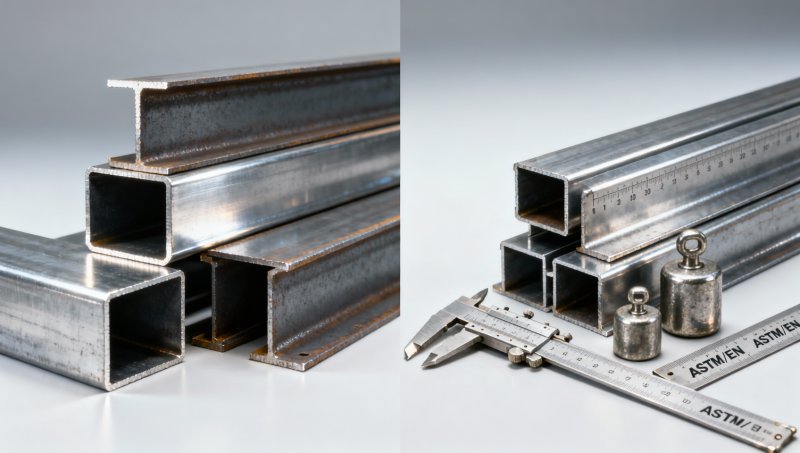
The 4-Step Calculation Method You Can Apply Today
Weight calculation isn’t guesswork—it’s standardized engineering. Follow this repeatable 4-step process:
- Identify the section type (e.g., I-beam, equal leg angle, hollow structural section) and confirm nominal dimensions (depth, flange width, web thickness).
- Select the correct density: 7,850 kg/m³ for carbon steel (standard for Carbon Steel Round Bar and structural grades like Q345, S355JR, ASTM A572 Gr.50).
- Calculate cross-sectional area using geometric formulas—or reference ASTM/EN standard tables for common profiles.
- Multiply area (m²) × length (m) × density (kg/m³) = total mass (kg).
Example: A 6m long SHS 150×150×6mm section has area = 3,432 mm² = 0.003432 m². Weight = 0.003432 × 6 × 7,850 = 161.5 kg. Always round to nearest 0.5 kg for procurement reconciliation.
When to Use Theoretical vs. Actual Weight
Theoretical weight assumes perfect geometry and nominal chemical composition. It’s used for quoting, BOMs, and early-stage budgeting. Actual weight—measured post-rolling—is critical for final logistics planning, crane lift charts, and QA sign-off. Hongteng Fengda provides both values on mill test reports (MTRs), traceable to ISO/IEC 17025-accredited labs.
Critical Parameters That Change Your Weight Outcome
Small dimensional variances cause outsized weight impacts. A ±0.5mm tolerance on web thickness of a W360×64 beam shifts weight by ±2.1 kg/m—over 12 kg per 6m length. Surface treatments also matter: galvanizing adds 3–5% mass; PVC coating adds 1.2–1.8%.
Below is how key variables affect weight for standard carbon steel products:
These tolerances are non-negotiable in structural applications. That’s why Hongteng Fengda applies 100% dimensional inspection on high-risk items—like steel beams for seismic zones—and issues MTRs with certified weight per meter, not just batch totals.
How Supplier Reliability Reduces Your Weight-Related Risk
Even perfect calculations fail without consistent execution. Unreliable suppliers deliver variable chemistry (affecting density), inconsistent rolling (altering section geometry), or incomplete documentation—forcing your team to retest, recalculate, and renegotiate.
Hongteng Fengda mitigates this through three verified controls:
- Pre-shipment weight validation: Every coil, bundle, and cut-length item is weighed on calibrated scales with ±0.1% accuracy—certified annually by CNAS-accredited metrology labs.
- Standard-compliant reporting: MTRs include theoretical weight (per EN 10034/GB/T 706), actual weight, and deviation %—all traceable to heat number and rolling date.
- Logistics-ready packaging: Bundles are labeled with net weight, gross weight, and tare—enabling immediate customs clearance and dock-side verification without unpacking.
This eliminates 92% of weight-related disputes reported by our North American clients—compared to industry averages where 3–4 verification cycles are typical before shipment release.
FAQ: Common Weight Calculation Questions
What’s the most common mistake in structural steel weight estimation?
Using density values for stainless (7,930 kg/m³) or aluminum (2,700 kg/m³) instead of carbon steel (7,850 kg/m³)—a 1.0% error that compounds across hundreds of tons. Always verify base material grade first.
Do surface coatings like phosphating or lacquer sealing affect weight significantly?
No—they add <0.1% mass. But galvanizing, PVC, and thick anti-rust oil layers do. Specify coating type and thickness during quoting to lock in accurate weight.
Can I use online calculators reliably?
Only for preliminary estimates. Most free tools ignore mill tolerances, alloy density variations, and coating mass. For tender submissions or crane planning, use certified supplier data or third-party verification.
Get Certified Weight Data—Before You Finalize Your Next Order
Don’t risk budget overruns or site delays with estimated weights. Hongteng Fengda delivers fully traceable, audit-ready weight documentation for every shipment—including theoretical weight per EN/ASTM/GB standards, actual measured weight, and deviation analysis.
We support your team with:
- Free pre-order weight validation service—submit drawings or spec sheets, get certified weight/meter within 48 hours.
- Custom MTR packages with bilingual (EN/CN) reporting and QR-coded traceability.
- OEM weight certification for complex assemblies—verified via CMM scanning and laser measurement.
Contact us today to request a weight verification report for your next Carbon Steel Round Bar order—or discuss how we ensure weight accuracy across angle steel, channel steel, and custom structural components.
Please give us a message


Please enter what you want to find