How to Avoid Costly Rejection of ASTM Steel Pipe Deliveries: 7 Critical Inspection Points Before Acceptance
Rejection isn’t the end of a steel pipe delivery—it’s the beginning of a cascade: delayed erection, re-ordered materials, idle crews, and contractual penalties. For quality control and safety managers on structural projects, the most expensive rejection isn’t one that happens at the dock—it’s the one that should have happened, but didn’t—because a non-conformance slipped past pre-acceptance inspection.
This isn’t about theoretical compliance. It’s about what actually triggers rejection under ASTM A53 (carbon steel), A106 (high-temperature service), and A312 (stainless seamless/welded) — standards routinely cited in procurement specs, yet frequently misinterpreted at the receiving bay. Drawing on field experience across hundreds of ASTM-compliant pipe shipments—from North American refineries to Middle Eastern infrastructure projects—the following seven inspection points consistently separate accepted deliveries from rejected ones. Each is tied directly to verifiable test criteria, documented evidence, or observable physical condition—not supplier assurances or certificate gloss.
1. Mill Test Report (MTR) Alignment — Not Just Presence, But Precision
A stamped MTR isn’t proof of compliance—it’s the first checkpoint for traceability and specification fidelity. Verify that the report matches the heat number marked on each pipe (not just the bundle tag), and that every mechanical and chemical requirement listed corresponds exactly to the specified ASTM grade and class (e.g., A53 Grade B, Type E). Common failures: MTRs referencing outdated revision years (ASTM A53-18 vs. current A53-22), mismatched tensile/yield values for wall thickness, or carbon content reported outside tolerance bands—especially critical for low-carbon grades like 304L Stainless Steel Pipe, where ≤0.03% carbon is mandatory to prevent intergranular corrosion in welded assemblies.
2. Dimensional Accuracy — Outside Diameter and Wall Thickness Are Non-Negotiable
ASTM tolerances are tight—and they’re not symmetrical. For example, A106 Grade B seamless pipe allows only +1% / –12.5% on wall thickness, but only ±1% on outside diameter for sizes up to 12 inches. Measuring with calipers alone misses ovality; use a micrometer at four quadrants per pipe end, and confirm OD with a ring gauge if nominal size exceeds 6 inches. Reject any pipe where wall thickness falls below minimum allowable—even by 0.1 mm—if it’s below the spec’s lower limit. This isn’t conservatism: it directly impacts pressure rating, structural capacity, and weld joint integrity.
3. Surface Integrity — Beyond Cosmetic Scratches
Surface defects aren’t just aesthetic—they’re potential stress concentrators and initiation points for corrosion or fatigue. ASTM standards explicitly prohibit laminations, seams, scabs, and rolling laps. What often gets overlooked: grinding marks deeper than 5% of nominal wall thickness, or repairs made without full documentation and post-repair testing. For stainless applications—particularly in corrosive or high-purity environments—surface finish matters as much as chemistry. Pickled or bright-polished finishes must be uniform and free of embedded iron particles, which can compromise passive layer formation.
4. End Preparation — Squareness and Bevel Angle Are Functional, Not Formal
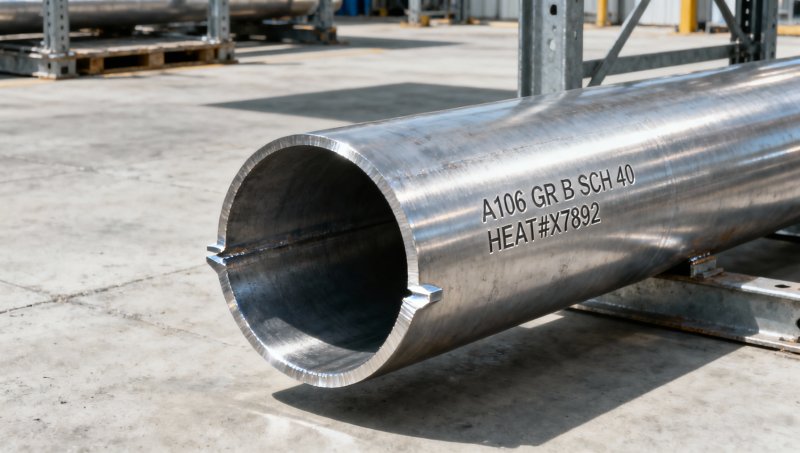
End squareness affects fit-up, welding alignment, and gasket seating. ASTM A53 and A106 require ends to be “reasonably square” — but industry practice (and most project specs) enforce ≤1.6 mm deviation over diameter. More critically: bevel angle and root face on prep pipes must match welding procedure specifications (WPS). A 30° bevel delivered as 37° may pass visual check but will cause burn-through or incomplete fusion during field welding—leading to NDE failure and costly rework. Always verify with a bevel protractor—not estimation.
5. Marking Legibility and Completeness — Traceability Starts Here
ASTM requires permanent marking of grade, size, schedule, manufacturer, and heat number—either stenciled, stamped, or etched. Faded, shallow, or incomplete markings invalidate traceability. If the heat number on the pipe doesn’t match the MTR—or if grade designation (e.g., “A312 TP304L”) is missing or ambiguous—treat it as untraceable material. In safety-critical systems (e.g., ASME B31.1/B31.3), untraceable pipe cannot be released for installation, regardless of test results.
6. Straightness and Bow — Not Just for Alignment, But for Load Path Integrity
ASTM A53 permits up to 1/8 inch per foot of length—but that’s a maximum, not a target. For structural supports or load-bearing conduits, excessive bow introduces eccentric loading, compromises bolted connections, and increases local bending stress. Measure using a straightedge and feeler gauge at mid-length and both ends. Reject pipes where bow exceeds 0.15% of total length—especially for lengths >6 meters, where cumulative deviation becomes operationally significant.
7. Certificate of Conformance (CoC) vs. Actual Compliance — The Paper Trail Must Match Reality
A CoC signed by the manufacturer carries weight—but only if it references actual test data, not generic statements. Insist on CoCs that cite specific test methods (e.g., “Hydrostatic test per ASTM A53 Section 8.2 at 2,250 psi for 5 seconds”), not just “tested per ASTM.” Cross-check CoC claims against MTRs: if the CoC states “hydrostatic test passed” but the MTR shows no test pressure or duration recorded, it’s insufficient. Likewise, for stainless grades, verify that the CoC explicitly confirms solution annealing and pickling per ASTM A312—not just “heat treated.”
These seven points aren’t checklist items—they’re decision gates. Each represents a point where objective evidence either confirms or invalidates acceptance. Skipping one—especially under time pressure—doesn’t save days; it risks weeks of delay when the third-party inspector flags the same issue during pre-installation review.
What separates reliable suppliers isn’t just adherence to ASTM on paper—it’s how rigorously they embed these checks into their final QA process before shipment. At the receiving end, consistency matters more than perfection: inspecting 100% of bundles for marking and MTR alignment, then sampling 10% for dimensional and surface verification, delivers far more value than sporadic, full-inspection efforts driven by last-minute panic.
When rejection does occur, treat it as a system signal—not a supplier failure. Track root causes: Is it recurring dimensional drift? MTR documentation gaps? Heat number mismatches? That data sharpens procurement criteria, refines inspection protocols, and ultimately reduces risk—not just for the next order, but for every pipe that follows.
Please give us a message


Please enter what you want to find