Understanding how stainless steel square pipe price is quoted helps buyers compare offers more accurately and avoid hidden sourcing costs. For project planners, importers, and procurement teams, the final quote often depends on material grade, size, thickness, surface finish, standards, and order quantity. This guide explains the key pricing factors and what global buyers should check before requesting quotations from reliable steel manufacturers.
In the steel trade, two quotes that look similar at first glance can differ significantly once weight calculation, tolerance range, packing method, test requirements, and delivery terms are reviewed. For global buyers sourcing from China or other exporting markets, understanding the quotation structure is often more important than comparing only the unit price.
For stainless steel square pipe, pricing is usually built from raw material cost, processing cost, finishing cost, inspection cost, packaging, and logistics. A reliable supplier should explain these elements clearly so the buyer can judge whether the offer fits the project, the standard, and the expected service life.
Key Factors That Influence Stainless Steel Square Pipe Price
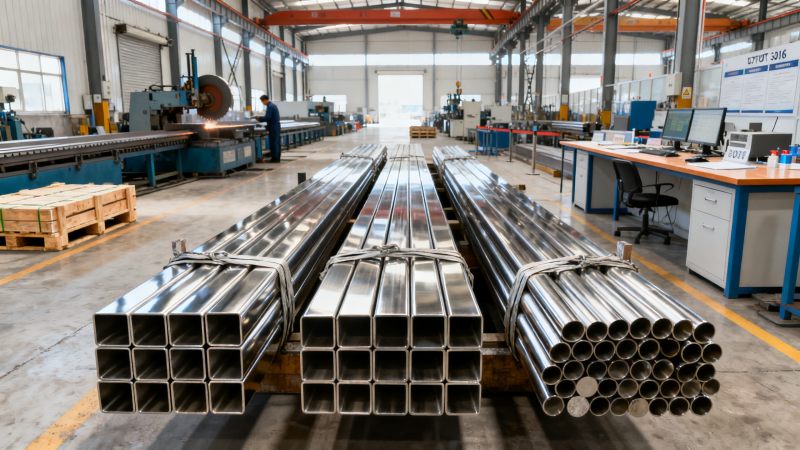
The most direct driver of stainless steel square pipe price is the material grade. Common grades include 201, 304, 304L, 316, and 316L. In many export markets, 304 is used for general structural and fabrication work, while 316 or 316L is selected for marine, chemical, or high-corrosion environments where molybdenum content matters.
A quotation should also state whether the pipe is welded or seamless. For many construction, furniture, enclosure, and light structural applications, welded square pipe is the practical option because it balances cost and performance. Seamless material usually carries a higher price, sometimes by 20% to 50%, depending on size and grade.
Material Grade and Alloy Composition
Grade selection changes the base cost immediately. For example, 201 may be attractive for buyers focused on lower initial cost, but 304 often offers a more stable balance between corrosion resistance and market acceptance. In coastal or chloride-heavy environments, 316 may reduce long-term maintenance risk even if the first purchase price is higher.
Buyers should ask whether the quoted grade follows ASTM, EN, JIS, or GB chemistry ranges. Even if two suppliers offer “304,” differences in nickel content, chromium control, and tolerance policy can affect both price and product consistency.
Size, Wall Thickness, and Weight Calculation
Square pipe is commonly quoted by weight, not just by piece length. Outer dimension, wall thickness, and length determine the theoretical weight per meter. A small change from 1.5 mm to 2.0 mm wall thickness can noticeably increase total tonnage on a 500-meter or 2,000-meter order.
Tolerance matters as well. If a quote is based on theoretical weight but production is controlled with a positive thickness tolerance, the actual shipped weight may be higher. That can increase freight cost and total landed cost. Procurement teams should confirm whether settlement is based on theoretical weight, actual weight, or a fixed piece basis.
Common size-related quotation variables
- Outer size, such as 20×20 mm, 50×50 mm, or 100×100 mm
- Wall thickness, often from 0.8 mm to 6.0 mm for many welded applications
- Standard length, such as 5.8 m, 6.0 m, or custom cut lengths
- Tolerance requirement, including dimensional and straightness control
The table below shows how buyers should read the main pricing variables in a stainless steel square pipe quotation instead of checking only the headline amount.
The main takeaway is that stainless steel square pipe price is rarely a single fixed market number. It is a specification-based quote. The more complete the specification sheet, the easier it is to compare 2 or 3 suppliers on equal terms.
Surface Finish, Standard, and Testing Requirements
Surface finish can add a noticeable premium. Mill finish is usually the most economical. Brushed, satin, mirror-polished, or protective film-coated surfaces require extra labor and inspection. For decorative architecture or visible installations, finish consistency may matter as much as mechanical performance.
Testing and documentation also affect the quote. Standard mill test certificates may be included, but additional PMI, third-party inspection, salt spray-related review for project compliance, or special packing instructions can raise cost and extend lead time by 3 to 7 days.
How Suppliers Build a Practical Quotation
A professional quotation usually combines material cost, production cost, and trade terms. Buyers should expect the supplier to ask at least 6 key questions: grade, size, thickness, length, quantity, and destination port. Without these details, any quoted stainless steel square pipe price is only an estimate.
For export business, Incoterms such as EXW, FOB, CFR, or CIF can change the total comparison result. A lower FOB price is not automatically cheaper than a higher CIF price if shipping, insurance, destination charges, and inland transport are not considered together.
Typical Quotation Structure
- Confirm grade and production standard
- Calculate theoretical or actual weight
- Add welding, forming, cutting, and finishing cost
- Include packaging, marking, and inspection requirements
- Apply quantity-based unit price and delivery term
In many cases, a supplier may provide a valid price window of 3 to 7 days because stainless steel raw material values can move with nickel, chromium, scrap, and mill supply conditions. For large projects, buyers often secure a confirmed price against a specific tonnage and shipment schedule.
Why MOQ and Production Batch Matter
Small trial orders usually cost more per ton than consolidated project orders. This is because machine setup, welding line adjustment, polishing arrangement, and export documentation are spread over fewer pieces. A 500 kg order and a 10-ton order may require similar coordination effort, but the larger batch improves production efficiency.
Lead time also links to price. Standard sizes in common grades may be shipped in 7 to 15 days if stock or semi-finished material is available. Non-standard sizes, strict tolerance requests, or special finishes may require 20 to 35 days depending on mill workload and packaging complexity.
Related Stainless Steel Products in Project Procurement
Many buyers sourcing square pipe also purchase complementary stainless steel products for filtration, protection, screening, or industrial fabrication. One example is 306 Stainless Steel Welded Mesh, which is used in filters, sieves, chemical plants, mining operations, architecture, and residential applications.
This inserted product is available in grades such as SS 201, 304, 304L, 316, 316L, and 430, with wire diameter from 0.0008″ to 0.12″, mesh from 2 to 635 mesh, open area from 25 to 84.6, roll width up to 240″, and roll length up to 2000′. For buyers managing mixed stainless steel sourcing, checking whether one supplier can support both pipe and mesh specifications may reduce communication time and shipment coordination risk.
Its core value lies in resistance to rust, corrosion, acid, alkali, heat, and chemical exposure, along with high strength and durability. When a procurement team combines structural stainless items with process-related stainless mesh in one sourcing cycle, it becomes easier to standardize material documents, inspection expectations, and container loading plans.
How Buyers Should Compare Quotes Without Missing Hidden Costs
The biggest mistake in stainless steel purchasing is comparing offers line by line without normalizing the details. A quote may appear 3% to 8% lower simply because the wall thickness tolerance, film protection, packing type, or test documentation is excluded. A full comparison should review both visible and hidden cost elements.
For importers and project buyers, landed cost can include at least 5 layers: product price, inland transport, port charges, ocean freight, and destination handling. If the stainless steel square pipe price is evaluated only on FOB level while the competing offer is CIF, the result can be misleading.
Quote Comparison Checklist
The following table helps buyers compare quotations from different suppliers using the same commercial and technical logic.
A structured comparison often reveals that the lowest apparent offer is not the lowest project cost. Buyers should use the same destination term, the same thickness standard, and the same inspection scope before ranking suppliers.
Questions to Ask Before Requesting a Quote
Technical questions
- Which grade is required: 201, 304, 304L, 316, or 316L?
- What are the exact outer dimensions and wall thickness?
- Is the pipe for structural, decorative, industrial, or corrosive service?
- Which standard and finish are needed?
Commercial questions
- What is the order quantity in tons, meters, or pieces?
- Is the preferred term EXW, FOB, CFR, or CIF?
- What is the target delivery schedule: 2 weeks, 4 weeks, or staged shipment?
- Are there special packaging or marking requirements for customs or site handling?
Clear answers to these questions usually shorten the quotation cycle from several back-and-forth emails to one efficient proposal. For engineering procurement teams, that can save 2 to 5 working days during supplier screening.
Working With a Reliable Structural Steel Exporter
When evaluating stainless steel square pipe price, supplier capability should be reviewed together with the quote. A manufacturer or exporter serving international markets should understand specification matching, production consistency, document handling, and shipment planning. This becomes especially important when orders include multiple steel products in the same project package.
Hongteng Fengda, as a structural steel manufacturer and exporter from China, supports global buyers in construction, industrial, and manufacturing sectors with standard specifications and OEM-oriented solutions. With experience across North America, Europe, the Middle East, and Southeast Asia, the value lies not only in product supply but also in reducing sourcing risk, stabilizing lead times, and improving communication efficiency.
What buyers should expect from a dependable supplier
- Clear quotation basis with grade, size, weight, and trade term defined
- Production aligned with ASTM, EN, JIS, or GB as required
- Consistent quality control before packing and shipment
- Practical lead time planning for standard and custom orders
- Responsive communication during drawing review and logistics coordination
For buyers in the research stage, the goal is not to rush toward the cheapest number. It is to build an accurate purchasing baseline. Once the technical specification, order quantity, and commercial term are fixed, the stainless steel square pipe price becomes far easier to compare and negotiate.
A good quotation should explain grade selection, dimensions, finish, standards, quantity breaks, and shipping terms with enough detail to support real purchasing decisions. That is the most reliable way to avoid hidden cost, reduce approval delays, and choose material that performs well over the full service cycle. If you are sourcing structural steel or related stainless products for an upcoming project, contact us to get a tailored quotation, discuss specifications, and explore more suitable steel solutions.
Please give us a message


Please enter what you want to find