For quality control and safety teams, choosing a Steel Wire manufacturer is not only about price or capacity, but about product consistency that reduces inspection risks, supports compliance, and protects project performance. A reliable supplier with stable quality systems, traceable production, and dependable standards can make the difference between a smooth supply chain and costly failures.
Understanding product consistency in steel supply
In the steel industry, product consistency means that material delivered today performs the same as material delivered next month, next quarter, or across multiple heat numbers in the same project. For a quality team evaluating a Steel Wire manufacturer, consistency is not a marketing phrase. It is a measurable result reflected in chemical composition range, dimensional tolerance, surface condition, mechanical stability, and document traceability.
This matters because steel wire and related carbon steel products often enter applications where repeated inspection, welding compatibility, forming behavior, and load response must remain predictable. If tensile behavior, coating condition, or diameter control varies beyond acceptable limits, the buyer may face delayed approval, additional sampling, or batch segregation. In many projects, even a 1 batch deviation can interrupt a 2- to 6-week installation schedule.
For safety managers, consistency also connects directly to risk prevention. Stable incoming quality reduces the chance of hidden defects moving into fabrication, reinforcement, fastening, or structural assembly. A capable Steel Wire manufacturer should therefore be judged not only by output volume, but by whether its production system can hold repeatability across standard grades, export specifications, and different shipment lots.
What consistency usually includes
- Chemical control within specified ranges for carbon steel and related grades.
- Dimensional stability across coils, bundles, or cut lengths, often checked at multiple points per lot.
- Reliable mechanical performance such as yield behavior, elongation, and formability.
- Surface quality suitable for downstream drawing, welding, coating, or fabrication.
- Traceable documentation tied to heat number, mill test records, and shipment identity.
When these elements stay aligned over 3, 5, or 10 repeat orders, supplier evaluation becomes more efficient. Inspection plans can be optimized, internal risk ratings become easier to maintain, and corrective action frequency often declines. That is why shortlist decisions for a Steel Wire manufacturer are usually shaped by consistency long before final price comparison begins.
Why the industry pays close attention to consistency
Global steel procurement has become more standard-driven and documentation-sensitive. Buyers serving construction, industrial equipment, transportation, and energy applications rarely evaluate material in isolation. They assess how a supplier supports ASTM, EN, JIS, and GB alignment, whether inspection data is repeatable, and how quickly a nonconforming batch can be isolated. For this reason, a Steel Wire manufacturer is often reviewed as a process partner, not just a material vendor.
A common challenge is that variation may not appear in every shipment. A supplier may deliver acceptable material in 8 out of 10 lots, yet the 2 unstable lots can create costly rework, retesting, or field delay. Quality and safety teams therefore look for signals of process maturity: furnace control, rolling stability, lot segregation, sampling frequency, and response speed to deviations. These indicators are more meaningful than broad claims about annual capacity.
Manufacturers and exporters such as Hongteng Fengda, which support global construction and industrial projects, are increasingly expected to combine stable production with customized solutions. For buyers across North America, Europe, the Middle East, and Southeast Asia, consistency is especially valuable because transportation lead time may range from 3 to 8 weeks. Once cargo is in transit, correction options become limited and the cost of replacement rises quickly.
Industry overview: where consistency has the most impact
The table below shows how quality consistency influences different steel-related operating environments and why the evaluation standard for a Steel Wire manufacturer tends to be stricter in safety-sensitive applications.
The pattern is clear: the more complex the downstream use, the greater the value of repeatability. For many buyers, a Steel Wire manufacturer enters the shortlist only after proving that quality performance can stay stable across multiple lots, not just one sample approval.
How quality and safety teams evaluate a Steel Wire manufacturer
A disciplined evaluation process usually combines technical review, process review, and supply performance review. Technical review checks standards, grades, and key properties. Process review examines whether the mill has the controls to reproduce those properties at scale. Supply review focuses on packaging, documentation, lead time reliability, and issue response. Together, these three layers help quality personnel move from a generic vendor list to a practical Steel Wire manufacturer shortlist.
Inspection teams often start with records from the last 3 to 12 months, especially when repeat sourcing is expected. Useful evidence includes heat-level traceability, internal test frequency, calibration intervals for measuring tools, and nonconformance handling logic. Safety managers may additionally review whether the supplier can separate suspect lots, issue replacement plans quickly, and support urgent root-cause communication within 24 to 72 hours.
Another practical criterion is standard familiarity. Suppliers serving export markets should be comfortable with multiple reference systems, such as ASTM, EN, JIS, and GB, because cross-market projects often require comparison between local and international specifications. A Steel Wire manufacturer that understands these standards can reduce interpretation errors during approval and shipment release.
Core shortlist criteria
Technical repeatability
Repeatability is visible in test records, dimensional checks, and surface inspection consistency. If data scatter is unusually wide from lot to lot, the buyer should ask how process parameters are controlled and how many checkpoints exist between raw material input and finished output.
Traceability and documentation
Good traceability means the supplier can connect each bundle or coil to production data, test records, and shipment documents. This is essential when one mixed lot must be investigated without blocking the entire order.
Delivery reliability
For imported steel products, even a 7-day delay can affect fabrication planning or jobsite readiness. Shortlist decisions therefore often consider whether lead times remain dependable during both routine and peak production periods.
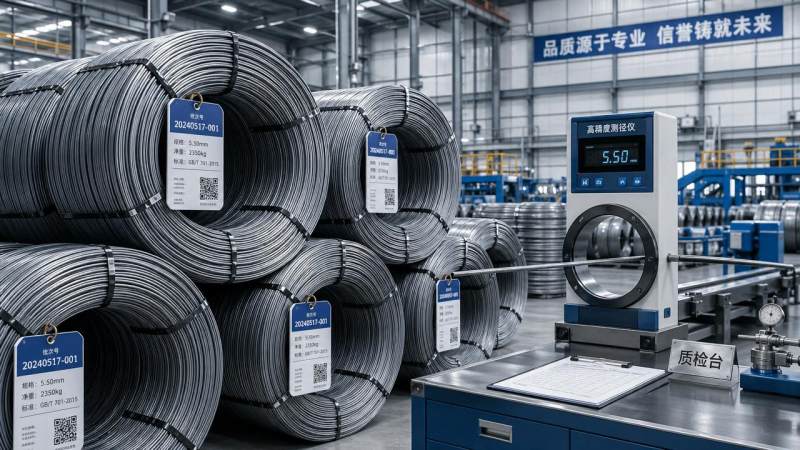
Product integration example: consistency signals in carbon steel rod supply
In practice, quality teams rarely assess a Steel Wire manufacturer only by general claims. They want to see how consistency appears in a real product family. One useful example is Wire Rod, a carbon steel product used in sectors such as auto manufacturing, shipbuilding, aerospace industry, petrochemical plants, auto-power and wind-engine, metallurgical machinery, precision tools, and building material applications.
This product category may be supplied in grades including GB1499.2 HRB400, HRB500, HRB400E, HRB500E, ASTM A615 Grade 60, BS4449 460B, 500B, 500C, and AS/NZS 4671 500N. For evaluation teams, the key point is not simply the number of grades available, but whether the manufacturer can maintain stable control while switching between standards and application requirements. That is a direct test of process discipline.
The same logic applies to fundamental material characteristics. Carbon content in the range of 0.06% to 0.22%, round shape supply, 1-12m length options, and conformity with ASTM, GB, EN, DIN, and JIS create a broad operating window. Yet broad capability only adds value when formability, weldability, and structural suitability remain predictable from batch to batch.
What product data tells a reviewer
The following table shows how product-level information can help quality and safety teams judge supplier consistency more effectively.
For a reviewer, such data becomes useful only when paired with test documentation and stable shipment history. A Steel Wire manufacturer that can explain how product advantages like excellent formability and weldability are protected in actual production will usually stand out more than one that only lists specifications.
Typical risk points and practical control measures
Even in standard-grade carbon steel supply, inconsistency can appear at several points: raw material variation, process temperature drift, rolling deviation, bundle mixing, labeling error, or insufficient final inspection. For quality control teams, these are not theoretical issues. They determine whether incoming inspection remains routine or turns into a time-consuming sorting exercise. A dependable Steel Wire manufacturer should have visible controls at each of these steps.
Safety managers should also consider how nonconforming material is prevented from entering production. If suspect stock cannot be quarantined quickly, the exposure expands from one lot to a larger inventory group. In practical terms, a supplier’s internal segregation speed within the first 24 hours after detection can matter as much as the original defect itself.
Another frequent issue is document inconsistency. Material may be acceptable, but a mismatch between marking, mill test certificate, and packing list can still block release. This is especially important for export projects where customs, third-party inspection, or owner approval may require exact document alignment before installation or resale.
A practical review checklist
- Confirm which standards the supplier regularly produces and whether grade conversion assumptions are avoided.
- Request sample test records from at least 3 recent lots to observe variation range, not just pass/fail status.
- Verify lot identification logic from production to packing, including heat number linkage.
- Check how often measurement tools are calibrated and how deviations are recorded.
- Review the supplier’s response path for claims, including target feedback time and replacement planning.
- Assess packaging, marking, and moisture protection when shipping time may exceed 20 to 40 days.
This kind of review helps buyers compare suppliers on operational reliability rather than on brochure language. In many cases, the most suitable Steel Wire manufacturer is the one that reduces uncertainty at every handoff point, from production release to final receiving inspection.
Why consistent structural steel supply supports long-term project performance
For global buyers, steel sourcing is rarely a one-time event. It often involves repeat orders, rolling forecasts, mixed specifications, and coordination between procurement, quality, engineering, and site teams. A stable supplier relationship therefore delivers value beyond the initial shipment. When product quality remains predictable over 6 to 12 months, internal controls can become more efficient and project planning more accurate.
Hongteng Fengda’s business focus reflects this need. As a structural steel manufacturer and exporter from China, the company supports angle steel, channel steel, steel beams, cold formed steel profiles, and customized structural steel components for global construction, industrial, and manufacturing projects. For many importers and project buyers, this combination of standard products and OEM solutions is most useful when it is backed by modern manufacturing facilities, strict quality control, and reliable lead times.
For quality control and safety personnel, the key advantage of working with a stable steel partner is lower sourcing risk. Consistent production can reduce inspection burden, improve compliance confidence, and limit surprises during fabrication or installation. That is why a Steel Wire manufacturer with repeatable quality systems often earns a place on the shortlist even before final commercial negotiation begins.
Why choose us
If your team is evaluating a Steel Wire manufacturer or related structural steel supplier, we can support practical discussions based on standards, application fit, and supply stability. Our experience in export-oriented structural steel supply helps buyers review material options with attention to compliance, consistency, and delivery planning.
You can contact us to discuss specification confirmation, product selection, grade comparison, delivery cycle planning, OEM or customized solutions, certification requirements, sample support, and quotation details. For projects involving ASTM, EN, JIS, or GB references, we can also help organize communication around documentation and standard matching before order release.
When product consistency is a priority, the right supplier is the one that helps your team prevent problems before they reach the site. If you want to reduce sourcing risk and build a more dependable steel supply chain, contact us with your required parameters, target application, inspection expectations, and shipment timeline.
Please give us a message


Please enter what you want to find