Larger orders reduce the unit cost of 201 stainless steel H-section ODM production when they spread design and setup expenses across more usable material, improve production efficiency, or reduce freight cost per tonne. Those savings stop being attractive when the additional quantity creates storage costs, financing charges, or surplus sections that cannot be used. The useful comparison is the total cost of meeting the project’s demand and delivery schedule, rather than the lowest quoted price per tonne.
There is no universal quantity at which a custom H-section becomes economical. A repeat order using approved drawings behaves differently from a first order requiring section development, trial fabrication, and dimensional approval. Even identical total tonnage can produce different prices when it is divided across several sizes, lengths, or delivery dates.
The quantity that matters is the production batch
A quotation may show a volume discount against total order weight, while the factory’s costs follow individual production batches. Each change in web thickness, flange width, section depth, or fabrication method can require a separate setup. An order containing many customized profiles therefore offers less production continuity than the same tonnage of one repeatable section.
For a welded H-section, cutting plans, assembly fixtures, welding procedures, and straightening requirements influence batch economics. Increasing the quantity of an unchanged design spreads preparation costs and allows repeated operations. Adding a second profile with different proportions can interrupt that efficiency, even if both profiles use grade 201 stainless steel.
A section produced through a rolling route has a different cost structure. Access to a suitable mill, available tooling, and the production campaign required for the geometry determine whether higher volume creates meaningful savings. A general catalog reference to hot-rolled or cold-rolled products does not establish how a particular customized stainless H-section will be manufactured.
Ask for quantity breaks by identical profile and manufacturing route. A discount based only on total purchase weight can conceal separate setup charges or minimum quantities for each size. The quotation should state whether different lengths can share one production batch and whether repeat releases retain the same price.
Separate development costs from repeat production
ODM involves design responsibility as well as manufacturing. The scope can include developing the section geometry, preparing fabrication drawings, assessing manufacturability, and producing an approval sample. Structural calculations and suitability for the intended application need an explicit scope; the term “ODM” alone does not establish that these activities are included.
These expenses should be separated from material and conversion costs wherever possible. If development is embedded in the first order’s unit price, a small opening quantity looks expensive, while a larger quantity appears heavily discounted. That difference may mainly reflect recovery of the same fixed expense.
A useful costing relationship is:
Factory cost per accepted tonne = allocated development and setup cost ÷ accepted tonnage + material cost + conversion cost + inspection and packing cost.
Accepted tonnage matters because trial pieces, rejected sections, and cutting losses do not all become usable deliveries. The quotation should identify whether development samples are included in the ordered quantity and whether the first production batch carries additional approval costs.
For repeat orders, establish who retains the approved drawings and any dedicated fixtures, how long tooling is retained, and what triggers a new development charge. A revision to flange thickness or connection details can invalidate previous preparation. Forecasting repeat demand against an unfinished design overstates the benefit of ordering more.
Material savings depend on dimensions and yield
Higher order volume can improve purchasing terms for stainless plate, strip, or other feedstock. It also creates opportunities to match purchasing quantities to available stock dimensions. However, increased tonnage does not automatically improve material utilization.
In welded production, the web and flanges are cut from parent material. Their widths, thicknesses, and required lengths determine the cutting layout. A slightly different section width can leave a narrow strip that has little reuse value. Repeating that layout across a larger order multiplies the same waste unless the cutting plan changes.
Mixed lengths sometimes improve yield when short components can use remnants from longer cuts. They also introduce identification and handling work. Savings should therefore be supported by a proposed cutting plan and an agreed treatment of remnants, rather than an assumption that a larger order always consumes material more efficiently.
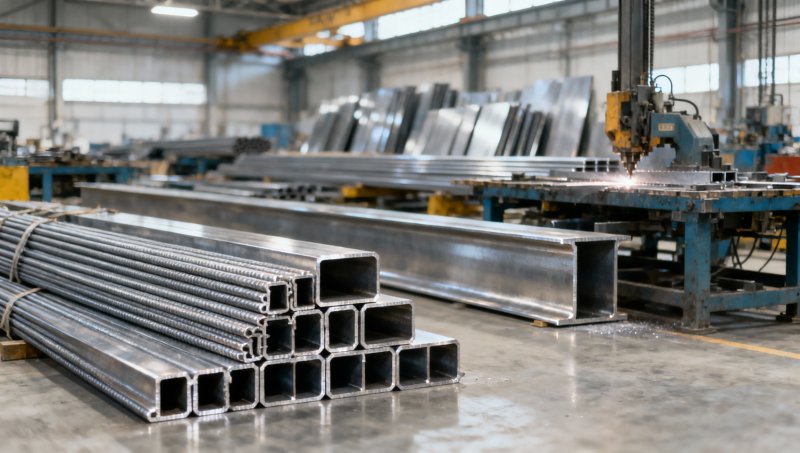
When reviewing a H Section Beam listing with flange thicknesses of 8–64 mm, web thicknesses of 5–36.5 mm, and lengths of 1–12 m or as required, treat those figures as catalog ranges. They do not confirm that every combination is available in grade 201 through the same manufacturing route. The actual geometry needs confirmation before comparing quantity discounts.
The material designation also needs a defined specification and supporting documentation. Grade names alone do not settle mechanical requirements, permitted tolerances, or acceptance criteria. Carbon-steel standards shown beside stainless options in a broad product catalog should not automatically become the contractual basis for the stainless order.
Compare quotations using the same weight basis. Pricing by theoretical weight, actual delivered weight, or purchased feedstock weight produces different totals. A lower price per tonne loses meaning if it applies to a larger billable weight or excludes material losses charged separately.
Where production discounts flatten out
Setup savings diminish as the batch grows because the fixed expense has already been distributed across substantial tonnage. Beyond that point, material, labor, energy, and consumables dominate the unit cost. A larger commitment does not remove those recurring expenses.
Welding illustrates the distinction. More identical sections reduce repeated setup and handling, but every section still requires its specified welds. Flange and web thickness, weld size, joint preparation, welding sequence, and inspection scope continue to affect processing time.
Straightness requirements can also change the economics. Welded sections require control of distortion, and tighter dimensional limits can increase fixture use, straightening, or rejection. Comparing prices without matching these limits creates an apparent volume saving that comes from a different acceptance standard.
Surface condition belongs in the same comparison. Agreed weld cleanup, removal of heat tint, surface treatment, and protection during handling carry costs. A larger batch can make these operations more efficient, but the required finish still has to be applied to every delivered section.
Freight savings follow packing constraints
Order volume affects international freight through both weight and space. H-sections occupy substantial volume, and bundle geometry determines how efficiently they fit within the selected transport equipment. A shipment can reach its practical space limit before its permitted weight limit.
Long sections introduce another constraint. Packaging, loading access, handling equipment, and the transport arrangement must accommodate the ordered length. Changing the length to improve shipment efficiency can create additional joints or fabrication work at the destination, which belongs in the same cost comparison.
Freight discounts therefore need a loading plan. Confirm the bundle dimensions, gross packed weight, protection between sections, and unloading method. An increase in quantity that requires another container or a different transport arrangement can raise the shipment total abruptly, even as the factory unit price falls.
Use consistent delivery terms and the same named destination across quotations. Freight, insurance where applicable, destination handling, duties, and inland transport must be included on a comparable basis. An ex-works price and a delivered price cannot demonstrate the effect of order volume without reconciling their included charges.
Compare the additional purchase with the demand it serves
A larger order ties up cash earlier and extends the period before some sections are consumed. Storage, handling, finance, and damage exposure should be assigned to the additional quantity. Custom profiles also have limited flexibility: surplus material may not match the next project’s dimensions or connection details.
The strongest case for increasing volume exists when approved demand will consume the extra sections within a defined schedule. The weakest case occurs when the discount depends on purchasing speculative quantities of a design that remains subject to revision.
For uncertain demand, compare three commercial arrangements: purchasing the confirmed requirement now, manufacturing a larger batch for staged delivery, and placing a framework commitment with separate production releases. These arrangements have different costs even when their total contracted tonnage is identical.
Staged delivery preserves production efficiency only when the sections are actually manufactured together. If each release starts a new production run, setup costs return. If finished stock remains at the factory, ownership, storage charges, payment dates, and responsibility for damage need clear terms.
Material price adjustment also deserves attention. A commitment to future volume may support a discount without fixing the stainless feedstock price. The quotation should distinguish a firm price for purchased material from a conversion rate applied to material priced at each release.
A quotation comparison that exposes real savings
Request several quantity options against one frozen technical specification. Keep the material requirements, drawing revision, manufacturing route, tolerances, inspection scope, surface condition, and packaging consistent. Otherwise, the comparison measures changing scope as well as changing volume.
The commercial breakdown should show development charges, recurring production price, billable weight basis, shipment costs, and payment timing. For a larger option, calculate the incremental cost of the additional usable quantity rather than relying on the percentage reduction in the headline unit price.
Then compare total expenditure over the same demand period. Include follow-up orders and their repeated setup and freight costs in the smaller-order option. Include carrying costs and the expected cost of unused stock in the larger-order option. Keep uncertain future demand separate from confirmed consumption so that speculative savings remain visible.
Before releasing a large first batch, establish the approval point for drawings, material documentation, and any required trial section. A discount earned by committing early can be erased if an unresolved fit-up or dimensional issue is repeated throughout production. Volume becomes financially useful when the approved design, production batch, and consumption schedule align.
Please give us a message


Please enter what you want to find