A panel can look perfectly adequate while it is still lying on the warehouse floor. The problem often appears later, when it is installed across a wider opening, used as an equipment enclosure, exposed to wind suction, or asked to carry maintenance loads it was never intended to resist. The sheet may visibly sag between supports, oil-can around fasteners, vibrate in service, or develop distorted edges after handling.
Many purchasing decisions begin with a simple question: “Which gauge should we buy?” That is understandable, but it can lead to the wrong selection. The thickness of a galvanized metal plate matters greatly, yet thickness alone does not define panel strength. Span, support layout, steel grade, panel profile, loading direction, connection details, and zinc coating designation all affect whether the finished panel performs as expected.
A more reliable approach is to start with the actual job condition rather than a familiar gauge number. This is especially important when a flat galvanized panel is being substituted for a profiled sheet, when support spacing changes during fabrication, or when a specification gives only a nominal thickness without clarifying whether that value includes the coating.
The first distinction: strength is not the same as stiffness
Thickness improves both strength and stiffness, but not at the same rate. This difference explains why a small thickness change can have a noticeable effect on panel behavior.
For a plate or sheet bending between supports, bending stiffness is strongly related to the cube of the base steel thickness. In practical terms, a modest increase in thickness can substantially reduce deflection. The panel feels firmer, is less likely to sag under its own weight, and generally resists vibration better. Bending strength also increases with thickness, although its relationship is closer to the square of thickness for a comparable panel geometry.
This matters because a panel can remain below its material yield limit and still be unacceptable in service. Excessive deflection may crack sealants, misalign doors, pond water, loosen fasteners, damage finishes, or create an appearance issue on visible cladding. In these cases, selecting only for ultimate load capacity misses the actual performance requirement.
Thin sheet is not automatically unsuitable. It can work well where supports are close together, loads are light, the panel is folded into a stiff profile, or the sheet is used mainly as a protective skin rather than a load-bearing element. The error is treating a thin, flat sheet as if it will perform like a deeper profiled panel or a sheet supported at shorter intervals.
Why the installed span changes the decision
A frequent source of trouble is the gap between what is shown on a material order and what exists on site. A galvanized metal plate may be selected based on an assumed support spacing, then installed across a wider opening because of framing changes, cutouts, or omitted intermediate members. The same sheet can behave very differently over a slightly longer span.
As span increases, deflection rises rapidly. That is why a thickness that is acceptable for a short liner panel may be unsuitable for a longer roof, cover, partition, or equipment guard. The panel orientation also matters. A rectangular sheet is stiffer when it spans in the direction that provides the more favorable effective width and support arrangement. Rotating the same panel by 90 degrees may change its response significantly.
Before comparing thicknesses, establish four job-specific facts:
- The clear distance between effective supports, not merely the overall panel length.
- Whether the panel is supported on two, three, or four sides.
- Whether edges are free, fastened, folded, seated in a frame, or continuously restrained.
- Whether loads act downward, outward, inward, repeatedly, or in more than one direction.
A panel fixed around all edges can act differently from one supported only along two opposite sides. Likewise, a sheet fastened intermittently can develop local deformation between fasteners even if the main span appears adequate on a drawing.
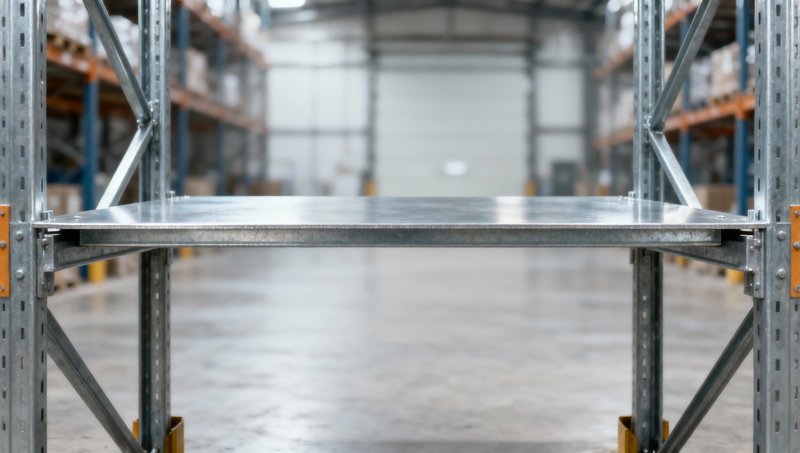
Base metal thickness and coating thickness should not be mixed
Galvanized steel is commonly described using several thickness-related terms, and they are not interchangeable. A purchase specification may refer to base metal thickness, total coated thickness, nominal thickness, minimum thickness, or a gauge designation. If these are not clarified before ordering, suppliers and fabricators may be comparing different values while assuming they mean the same thing.
The zinc coating contributes corrosion protection. It does not provide the same structural contribution as the steel substrate. For panel strength calculations, the base steel thickness is usually the critical value. The coating has mass and occupies physical thickness, but it should not be treated as a substitute for load-carrying steel.
This distinction becomes important with light-gauge material. When the steel substrate is relatively thin, the difference between a coated overall measurement and the underlying base-metal thickness can be meaningful for tolerances, forming, weight estimates, and structural assessment. A clear specification should state the required base steel thickness and the required coating designation separately.
Gauge numbers deserve particular caution. Gauge conventions can vary by product type, market practice, and reference table. A gauge label without a stated millimeter or inch value can create avoidable ambiguity. For engineering review, use an actual thickness value with an agreed tolerance, then confirm whether it refers to the base steel or the finished coated sheet.
Panel geometry can matter more than adding sheet thickness
A flat plate relies mainly on its own thickness to resist bending. A formed panel gains stiffness from geometry. Corrugations, ribs, pans, return flanges, hat sections, folded edges, and closed shapes move material away from the neutral axis, which greatly improves bending performance without requiring a proportionate increase in steel weight.
That is why two panels made from the same galvanized sheet thickness may have very different capacities. A flat closure sheet may be appropriate for a framed opening with closely spaced support. A ribbed or cold-formed profile may be the better choice for longer spans. A shallow folded tray may improve handling stiffness but still need evaluation for concentrated loads or wind pressure.
Do not assume that a deeper-looking profile is automatically stronger. The effective performance depends on rib spacing, profile shape, steel thickness, local buckling behavior, continuity over supports, and the connection pattern. Thin elements in a formed section can buckle locally before the panel reaches the bending capacity suggested by its overall shape.
Where the design permits it, adding an intermediate support or revising the profile can be more efficient than simply moving to a much thicker galvanized metal plate. This is especially true when the primary concern is deflection over a long clear span rather than local damage resistance.
Loads that are easy to overlook
Dead weight is only one part of the evaluation. A panel installed vertically may carry little gravity load but still face wind pressure and suction. A horizontal cover may collect maintenance loads, stored items, debris, water, or accidental impact. Industrial partitions can be pushed by carts or equipment. Shipping and lifting can introduce temporary stresses that exceed normal service loads.
Wind deserves careful attention because suction can pull a panel away from its support system. In that condition, fastener pull-out, pull-over, edge tearing, and local dimpling may govern before the sheet itself reaches a global bending limit. A thicker plate can improve local resistance, but fastening arrangement and supporting member thickness remain essential.
Concentrated loads should not be evaluated as though they were evenly distributed. A person stepping near the middle of a thin cover, a tool placed close to an unsupported edge, or a mounted component bearing on a small area can produce local bending and permanent dents. If concentrated loading is possible, identify the contact area and location rather than relying on a general uniform-load assumption.
A practical comparison process before release
When several thickness options are available, begin by defining the function of the panel. Is it cladding, a weather cover, a machine guard, a liner, a structural diaphragm, a formed component, or a plate intended to transfer load into a frame? The answer determines whether appearance, deflection, local dent resistance, corrosion life, or structural capacity is likely to govern.
Next, document the installed condition. Mark panel dimensions, clear spans, support widths, support spacing, edge restraint, openings, penetrations, and fastener locations. This step often reveals that the real weak point is not the broad center of the sheet but a narrow strip beside an opening, a corner with inadequate fastening, or an unsupported edge created by a field cut.
Then separate the loads by condition. Consider permanent load, temporary maintenance activity, pressure or suction, equipment attachment, handling, and any repeated loading that may cause fatigue or loosening. If the panel is part of an exterior assembly, account for drainage and the possibility that standing water can increase load where deflection creates a low point.
With those inputs, compare candidate thicknesses using the base steel value, not a gauge name alone. Review bending stress, deflection, local buckling, bearing at supports, and connection capacity. For panels with ribs or folds, use properties applicable to the actual profile rather than treating the material as a flat plate. If the panel contributes to the stability of a larger assembly, the analysis should also consider load transfer into the supporting steel members.
Material grade affects the answer, but it does not replace thickness
A higher-strength steel grade can increase the stress level at which yielding begins. This may allow a thinner sheet to meet a strength limit in some applications. However, steel grade does not increase elastic stiffness in the same way. Two common carbon steel grades have broadly similar elastic modulus, so a higher-yield sheet of the same thickness will not automatically deflect less under service load.
This is a useful correction to a common purchasing assumption: higher-strength steel is not a universal substitute for a thicker panel. If the governing requirement is deflection, vibration, oil-canning, or dent resistance, thickness or profile geometry may still need to increase. Higher-strength material can also affect forming behavior, bend radii, edge cracking risk, and fabrication settings.
For formed galvanized components, review the specified grade together with the intended bends, holes, embossments, welded attachments, and tolerances. A panel that looks suitable in a simple strength comparison may create manufacturing difficulties if the chosen combination of grade, thickness, and forming detail is not matched to the part geometry.
Connections often reveal whether the panel selection is realistic
Fasteners do more than hold the panel in place. They determine how loads enter the sheet and how much edge restraint the panel actually receives. Widely spaced fasteners may allow a thin panel edge to lift or flutter. Oversized holes can reduce bearing area. Fasteners placed too close to an edge can cause tear-out. A rigid sheet attached to a flexible frame may still show movement because the support itself deflects.
Pay attention to dissimilar-metal contact and cut edges as well. Galvanizing protects the steel surface, but drilled holes, cut edges, scratches, trapped moisture, and incompatible materials can change corrosion behavior over time. This does not mean every edge requires the same treatment; it means the detailing should match the exposure and expected service life.
Where a sheet must be removed for maintenance, repeated fastening and unfastening can enlarge holes or damage the coating. In that situation, a slightly more robust sheet, reinforced fastening zone, removable frame, or alternative connection detail may be preferable to repeatedly relying on thin material at the same points.
When a thicker plate is the right response—and when it is not
Increasing thickness is usually a sensible response when a flat panel has excessive deflection, poor dent resistance, inadequate local bearing at fasteners, or insufficient strength under a fixed span and load condition. It may also improve handling during transport and installation, reducing the chance that sheets are permanently bent before they are fitted.
However, thickness should not be used to conceal an unresolved design issue. If the panel spans too far, lacks edge support, receives concentrated loads, or uses an unsuitable fastening pattern, simply choosing heavier material may increase cost and weight without addressing the governing failure mode. A revised support layout, a formed profile, stiffening returns, or a better connection arrangement can provide a more direct correction.
The most dependable specification describes the finished need rather than naming only a gauge: base steel thickness, coating requirement, grade where relevant, panel profile, dimensions, support condition, loading assumptions, permissible deflection, connection details, and any fabrication operations. That gives fabricators and project teams a common basis for review.
When the required panel behavior cannot be confirmed from the available drawings, do not rely on visual comparison between samples. Treat the issue as a design verification item. A galvanized metal plate that appears only slightly thinner can perform very differently once span, profile, and restraint are considered. Choosing from the installed condition first is the practical way to obtain a panel that is strong enough, stiff enough, and appropriate for the work it must do.
Please give us a message


Please enter what you want to find