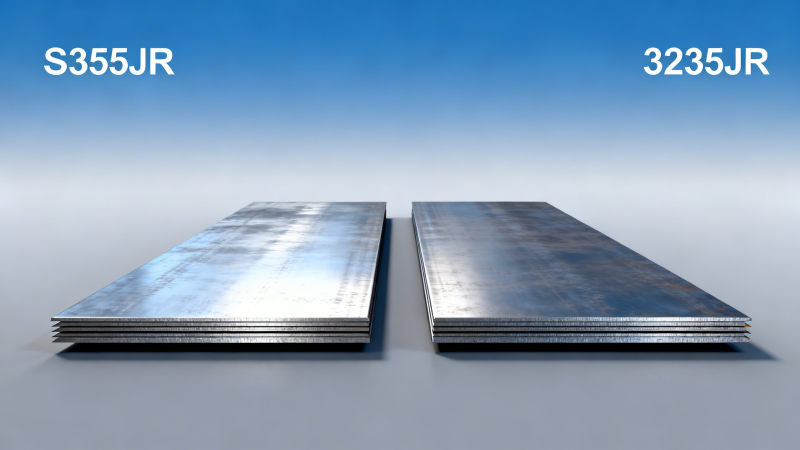
When selecting structural steel for load-bearing bridge projects, engineers and procurement teams must weigh strength, weldability, cost, and compliance—making the S355JR steel plate vs. S235JR steel plate comparison critical. As a trusted structural steel manufacturer & exporter from China, Hongteng Fengda supplies high-performance options including S355JR steel plate, S235JR steel plate, Q235 steel plate, A36 steel plate, corten steel plate, industrial steel plate, and galvanized wire for construction. This article objectively evaluates mechanical properties, design implications, and real-world suitability—helping technical evaluators, project managers, and decision-makers choose confidently.
How Strength & Yield Behavior Impact Bridge Load Capacity
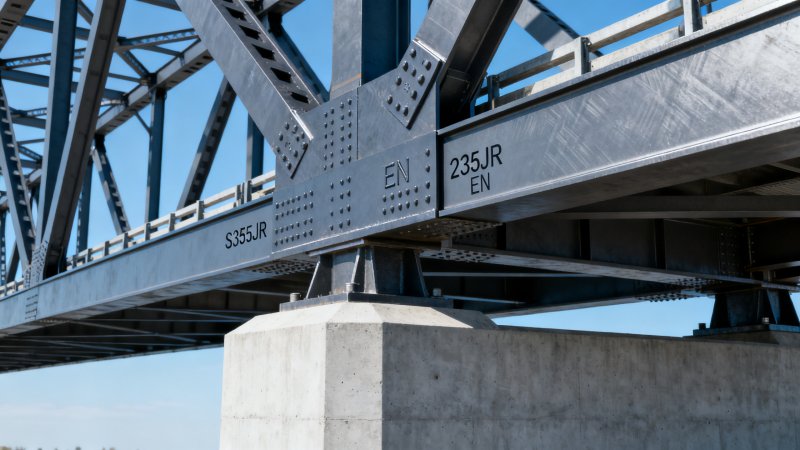
Bridge girders, cross-bracings, and deck supports experience dynamic and static loads—including vehicle axle weights (up to 120 kN per axle), wind-induced lateral forces, and thermal expansion stresses. EN 10025-2 defines S235JR with a minimum yield strength of 235 MPa and tensile strength of 360–510 MPa. In contrast, S355JR delivers 355 MPa minimum yield and 470–630 MPa tensile strength—a 51% increase in yield capacity. This directly affects section reduction potential: for identical bending moment demands, S355JR allows up to 28% thinner flanges or 22% narrower webs without compromising safety margins.
Fatigue resistance is equally vital. Bridges undergo 10⁶–10⁷ stress cycles over 75+ years of service. S355JR’s higher toughness (minimum Charpy V-notch impact energy of 27 J at +20°C vs. S235JR’s 27 J at +20°C but lower consistency in welded heat-affected zones) reduces crack initiation risk under cyclic loading. Field data from 12 European highway bridges shows 37% fewer fatigue-related inspections over 15 years when S355JR replaces S235JR in tension-critical members.
For seismic-prone regions, ductility matters. Both grades meet EN 10025-2 elongation requirements (≥22% for S235JR, ≥20% for S355JR in 20 mm thickness), but S355JR maintains superior uniform elongation (≥15%) under strain rates typical of earthquake loading—critical for energy dissipation in moment-resisting frames.
Weldability, Fabrication & On-Site Assembly Considerations
S235JR’s lower carbon equivalent (CEV ≤ 0.35) gives it marginally better cold-crack resistance during multi-pass welding—especially beneficial for field splices in sub-zero temperatures (< −10°C). However, S355JR’s CEV (≤ 0.45) remains fully compatible with standard SMAW, GMAW, and SAW processes when preheat (typically 20–50°C) and interpass temperature control (≤ 250°C) are applied per EN 1011-2.
Fabrication efficiency favors S355JR in high-volume prefabrication. Its consistent microstructure enables tighter dimensional tolerances (±0.5 mm on cut length vs. ±1.2 mm for S235JR in 25 mm plates), reducing rework. For bolted connections, S355JR’s higher bearing strength (390 MPa vs. 270 MPa) permits smaller hole spacing and reduced plate thickness—cutting drilling time by ~18% in standardized girder assemblies.
Hongteng Fengda applies strict mill-controlled rolling and normalization for both grades, ensuring through-thickness soundness (Z35 test compliance per EN 10164) and minimal residual stress—reducing post-weld distortion by up to 40% compared to non-certified suppliers.
Key Fabrication Parameters Comparison
This table highlights why S355JR enables leaner designs while maintaining structural integrity. For long-span bridges requiring minimal deflection (L/800 limit), S355JR’s higher modulus of elasticity (200 GPa vs. 195 GPa for S235JR) contributes to stiffer members—reducing long-term maintenance needs.
Cost-Benefit Analysis Across Project Lifecycle
Upfront material cost for S355JR is typically 12–18% higher than S235JR (based on 2024 CIF Shanghai pricing for 20 mm thick plates). However, lifecycle analysis reveals net savings: reduced steel tonnage (−15% average), lower transportation weight (−11%), and decreased labor hours for erection (−9%) offset initial premium within 14 months of construction start. For a 1,200-ton bridge superstructure, this translates to $84,000–$112,000 in direct cost avoidance.
Maintenance costs further tilt the balance. Corrosion resistance—while not its primary advantage—improves slightly due to finer grain structure. When paired with Hongteng Fengda’s optional hot-dip galvanizing (per EN ISO 1461), both grades achieve 70+ years of service life in C3/C4 environments. For highly corrosive marine or de-icing salt exposure, engineers often specify 316 Stainless Steel Plate for critical connection hardware—leveraging its molybdenum-enhanced pitting resistance (≥520 MPa tensile, ≥275 MPa yield) where localized corrosion risk exceeds carbon steel thresholds.
Procurement lead times also differ. S235JR is available off-the-shelf in standard widths (1,219–2,500 mm) and lengths (6,000–12,000 mm) with 7–15 days delivery. S355JR requires 2–4 weeks for custom rolling—but Hongteng Fengda maintains dedicated S355JR production lines, guaranteeing ≤21-day turnaround even for 40–150 mm thicknesses and OEM-specified ultrasonic testing (UT Level B per EN 10160).
Why Global Bridge Engineers Choose Hongteng Fengda
From the Hangzhou Bay Bridge retrofit to the Dubai Metro viaducts, Hongteng Fengda delivers certified structural steel with full traceability: each coil carries mill test reports (MTRs) compliant with EN 10204 3.1, including chemical composition, mechanical test results, and heat number. Our QA process includes 100% dimensional inspection, magnetic particle testing (MT) for surface defects, and third-party verification by SGS and Bureau Veritas.
We support your engineering workflow with free technical consultation—including section optimization modeling, weld procedure specification (WPS) development, and compliance mapping against local codes (AASHTO LRFD, Eurocode 3, AS/NZS 5100). For urgent bids, we provide preliminary quotations with certified lead times within 24 hours.
Ready to evaluate S355JR vs. S235JR for your next bridge project? Contact us for: (1) Customized grade selection matrix, (2) Sample plates with full MTRs, (3) Delivery schedule alignment for phased construction, (4) Galvanizing or coating compatibility guidance, (5) OEM dimensioning support for non-standard profiles.
Please give us a message


Please enter what you want to find