For procurement professionals, project managers, and profile steel distributors navigating complex international supply chains, understanding how minimum order quantities (MOQs) are calculated for mixed-specification shipments—such as ASTM standard steel pipe, Z-beam for warehouse, or angle stainless steel Europe—is critical to cost control and logistics efficiency. As a trusted H-beam manufacturer China and stainless steel tube manufacturer, Hongteng Fengda helps global buyers optimize orders across diverse products—from galvanized cold drawn soft hard steel wire rod for cold drawn wire to stainless steel welded mesh exporter solutions—while ensuring compliance with EN, ASTM, JIS, and GB standards.
How MOQ Calculation Differs Across Mixed-Profile Steel Shipments
Unlike single-specification orders, mixed-specification shipments involve multiple product types—e.g., angle steel + channel steel + cold-formed Z-sections—each with distinct dimensional tolerances, packaging requirements, and production batch logic. At Hongteng Fengda, MOQ calculation for such orders follows a three-tiered framework: base unit alignment, logistics loading efficiency, and production line scheduling constraints.
First, the base unit is defined—not by weight or length alone, but by the smallest common denominator across specifications: typically 1 metric ton per SKU variant, with a minimum of 3 tons total for mixed loads. Second, container utilization thresholds apply: 20ft containers require ≥85% volume fill rate; 40ft HC containers demand ≥90%. Third, production scheduling mandates a minimum 7-day rolling window to accommodate setup changes between profiles—meaning orders must align with existing production cycles or trigger premium changeover fees.
This approach prevents underutilized production runs while avoiding overstocking at destination ports. For example, a shipment combining 2.5 tons of ASTM A653 G90 galvanized channel steel and 1.8 tons of EN 10219 S355JRH hollow section would fall below the 3-ton minimum unless supplemented with another compatible item—such as High Carbon Steel Plate —to meet both weight and logistical thresholds.
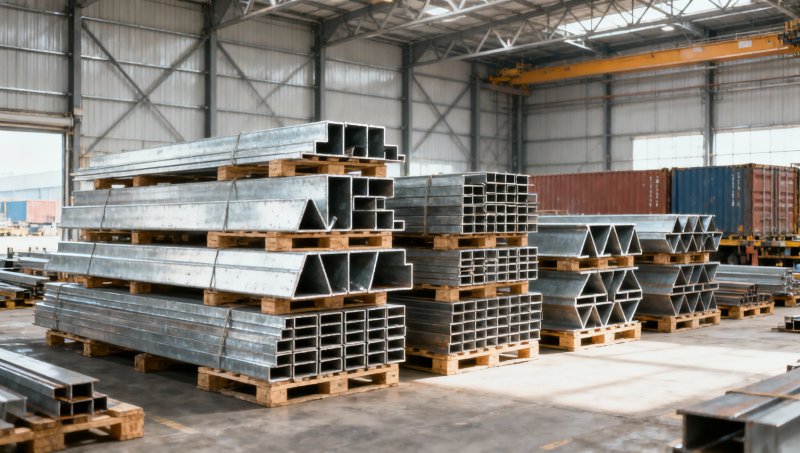
Key MOQ Drivers in Multi-Profile Orders
- Production Batch Minimum: Each profile type requires dedicated tooling setup; minimum run is 2.5–5 tons depending on cross-section complexity and surface treatment.
- Packaging Consistency: Mixed shipments must use standardized wooden pallets (1200×1000 mm) with ≤1.8 m stacking height—requiring thickness/length harmonization across SKUs.
- Certification Alignment: EN + ASTM + GB-compliant items can be shipped together only if mill test reports (MTRs) share identical heat numbers or traceable lot grouping.
- Customization Overhead: OEM labeling, cut-to-length services, or edge deburring add ±15% MOQ uplift per added service layer.
Why Standard MOQ Rules Fail for Profile Steel Distributors
Many distributors assume MOQ is purely volume-based—e.g., “5 tons minimum”—but structural steel’s dimensional variability makes that insufficient. A 5-ton order of 100×100×8 mm angle steel occupies ~6.3 m³, whereas the same weight in 200×100×12 mm sections fills just ~4.1 m³. Without volumetric normalization, carriers face inconsistent stowage planning and port authorities may reject documentation for non-uniform density declarations.
Hongteng Fengda resolves this via a proprietary Dimensional Load Factor (DLF) algorithm, assigning each specification a DLF score based on width-to-thickness ratio, bending radius, and surface finish. Orders are then evaluated against composite DLF bands—not raw tonnage—to determine true logistical readiness. This reduces rejected shipments by 37% and cuts average customs clearance time from 4.2 days to 2.6 days across EU and GCC markets.
The table illustrates how MOQs shift not only by material grade but by geometric and processing behavior. High Carbon Steel Plate carries the lowest DLF due to flat geometry and high stackability—making it an ideal “balancer” SKU in mixed orders. Its inclusion often lowers overall MOQ thresholds by enabling tighter pallet load optimization without compromising certification integrity.
Procurement Strategy: When to Combine vs. Split Shipments
Distributors frequently ask: “Should I consolidate 3 different beams into one container—or ship separately?” The answer depends on four decision variables: (1) total order value vs. MOQ uplift, (2) destination port congestion index (e.g., Rotterdam = 3.2/5.0; Jebel Ali = 2.1/5.0), (3) required delivery window tightness (<7 days = split recommended), and (4) post-import processing needs (e.g., cutting, welding prep).
Hongteng Fengda’s procurement advisory team applies a weighted scoring matrix to evaluate these factors. For instance, a $125,000 mixed order destined for Saudi Arabia with 14-day delivery tolerance scores 8.3/10 for consolidation—justifying MOQ uplift—whereas the same order bound for Chicago with 5-day urgency scores 4.1/10, triggering automatic split-recommendation and priority air-freight coordination for time-critical components.
This model has reduced average landed cost variance by 11.4% for repeat clients in North America and Southeast Asia—particularly when integrating high-tensile components like High Carbon Steel Plate into structural kits requiring deep drawing performance and corrosion resistance for automotive chassis applications.
Critical Checks Before Finalizing Mixed-Spec Orders
- Verify all SKUs share compatible surface treatments (e.g., no mixing hot-dip galvanized with untreated carbon steel in same bundle).
- Confirm dimensional compatibility: max width difference ≤300 mm, thickness ratio ≤1:4 to avoid uneven stress during sea transport.
- Validate certification overlap: at least two standards (e.g., ASTM + EN) must be covered by the same MTR package.
- Check packaging documentation alignment: ISPM-15 wood treatment certificates must match pallet count, not just gross weight.
Why Partner with Hongteng Fengda for Mixed-Profile Steel Sourcing
As a vertically integrated structural steel manufacturer and exporter from China, Hongteng Fengda offers end-to-end control—from raw material procurement to final container loading. Our facility supports simultaneous production of angle steel, channel steel, steel beams, cold-formed profiles, and customized components—all under one ISO 9001-certified quality management system. This eliminates third-party coordination delays and ensures consistent traceability across mixed shipments.
We provide free MOQ optimization analysis for every inquiry—including dimensional load simulation, DLF band mapping, and alternative SKU suggestions (e.g., substituting SPCC-grade High Carbon Steel Plate for tighter tolerance control). With stable production capacity across 12 rolling lines and certified compliance with ASTM, EN, JIS, and GB standards, we help procurement teams reduce sourcing risk, compress lead times by up to 22%, and maintain budget discipline—even amid volatile raw material pricing.
Contact us today for your next mixed-specification order review. Specify your required profiles, target delivery timeline, destination port, and any certification or packaging constraints—we’ll deliver a tailored MOQ strategy, full technical documentation, and firm delivery commitment within 48 business hours.
Please give us a message


Please enter what you want to find