Procurement teams increasingly rely on Total Cost of Ownership (TCO) modeling to objectively compare corrosion resistant steel pipe suppliers—especially when evaluating high-performance options like duplex steel pipe, DIN 17456 stainless tube, or custom steel tubing. For global buyers sourcing industrial steel tubing for demanding environments, TCO goes beyond unit price to factor in lifecycle durability, maintenance frequency, compliance risk, and total project downtime. As a certified structural steel manufacturer exporting corrosion-resistant pipes compliant with ASTM, EN, JIS, and GB standards, Hongteng Fengda helps procurement and engineering teams quantify real-world value—not just upfront cost—across supplier alternatives.
Why TCO Modeling Is Non-Negotiable for Corrosion-Resistant Steel Pipe Sourcing
In infrastructure, energy, and marine projects, premature pipe failure due to corrosion can trigger cascading costs: unplanned shutdowns averaging 7–15 days per incident, emergency replacement at 3× standard pricing, and third-party liability exposure exceeding $250,000 per non-compliance finding. Traditional RFQ evaluations based solely on FOB price ignore these variables—leading 68% of procurement professionals to revisit supplier decisions within 18 months (2023 Global Industrial Procurement Benchmark). TCO modeling corrects this by assigning quantifiable weights to eight critical dimensions: material specification adherence, galvanizing layer thickness consistency (±5 µm tolerance), dimensional stability over 20+ years of thermal cycling, traceability documentation depth, logistics reliability (on-time-in-full ≥96%), post-delivery technical support responsiveness (<4-hour SLA), recyclability rate (>92% for hot-dip galvanized steel), and residual value at end-of-life.
For example, a 300-km offshore pipeline project using substandard galvanized round steel may appear 12–18% cheaper per ton—but incurs $1.4M in accelerated cathodic protection upgrades, $890K in unscheduled inspections, and 220 labor-hours annually for manual coating touch-ups. In contrast, rigorously certified Galvanized Round Steel with ASTM A123-compliant zinc coating (minimum 500 g/m²) reduces lifetime inspection frequency by 65% and extends service life from 15 to 35+ years in coastal zones.
Hongteng Fengda embeds TCO logic into every quotation—providing not just unit pricing but lifecycle cost projections across five operational scenarios: standard atmospheric exposure, high-humidity indoor facilities, salt-laden marine splash zones, chemical processing plants (pH 2–12), and cyclic freeze-thaw environments. This enables procurement teams to align with engineering and finance stakeholders using a common, auditable framework.
Key TCO Evaluation Criteria for Corrosion-Resistant Suppliers
Effective TCO comparison requires standardized scoring across measurable, verifiable criteria—not subjective impressions. Below are the six non-negotiable evaluation pillars we recommend for procurement teams vetting corrosion-resistant steel pipe vendors:
This structured approach eliminates ambiguity. For instance, Hongteng Fengda’s production system assigns unique QR-coded identifiers to each coil—linking real-time galvanizing bath temperature logs (maintained at 450±5°C), immersion time records (≥3.5 minutes), and post-coating surface roughness measurements (Ra ≤ 3.2 µm). Such granularity allows procurement teams to audit actual process control—not just final product conformity.
Moreover, our ISO 9001-certified quality management system mandates 100% dimensional verification for all diameters >10.00 mm via automated optical scanning—and 100% ultrasonic testing for wall thickness consistency. These controls directly reduce field rework rates by up to 41%, as verified by independent audits across 12 client sites in Southeast Asia and the Middle East.
How Hongteng Fengda Integrates TCO Into Supplier Partnership
We don’t treat TCO as a theoretical exercise—we engineer it into our supply chain architecture. Our manufacturing facility in Jiangsu Province operates four dedicated hot-dip galvanizing lines, each calibrated to meet ASTM A123, EN ISO 1461, and GB/T 13912 specifications simultaneously. Every batch undergoes six-stage quality checkpoints: raw material spectrographic analysis (to confirm DC01 grade iron purity), pre-galvanizing acid pickling validation, flux bath pH monitoring, molten zinc bath chemistry verification (Al content 0.12–0.16%), post-galvanizing adhesion testing (≥5 N/mm² pull-off strength), and final dimensional certification.
Crucially, we provide procurement teams with customizable TCO dashboards—updated quarterly—showing real-world performance metrics against contractual KPIs. These include average lead time deviation (target: ≤±2 days), dimensional non-conformance rate (current: 0.07%), and zinc coating thickness variance (mean: ±3.2 µm across 12,500+ test points/month). This transparency builds trust and enables proactive risk mitigation—not reactive firefighting.
Our clients report that integrating our TCO data into their ERP systems reduced procurement cycle time by 29% and lowered total landed cost variance from ±14.3% to ±3.8% over 18 months—directly attributable to predictable quality, stable lead times (consistently 22–28 days from PO confirmation), and zero major non-conformities in 37 consecutive export shipments.
Practical Implementation: A 4-Step TCO Adoption Framework
Adopting TCO doesn’t require overhauling your procurement system. Start with these four actionable steps:
- Map your top three corrosion-critical applications (e.g., substation grounding rods, offshore wind turbine foundations, chemical plant piping) and assign annual maintenance spend per asset class.
- Require suppliers to submit TCO-aligned quotations—including 10-year lifecycle cost projections, failure probability curves, and warranty terms tied to coating thickness verification.
- Conduct joint site audits with engineering and QA teams using our standardized 22-point galvanizing quality checklist—covering bath chemistry, cooling rate, surface finish, and packaging integrity.
- Implement quarterly TCO performance reviews using live dashboards tracking actual vs. projected downtime, inspection intervals, and material reuse rates.
This framework has helped clients like a Tier-1 European telecom infrastructure provider cut tower grounding system lifecycle costs by 33% while extending maintenance cycles from 18 to 42 months—using our Galvanized Round Steel in electric power tower and communication tower applications.
FAQ: Addressing Real Procurement Team Concerns
How do I verify if a supplier’s galvanizing process meets ASTM A123?
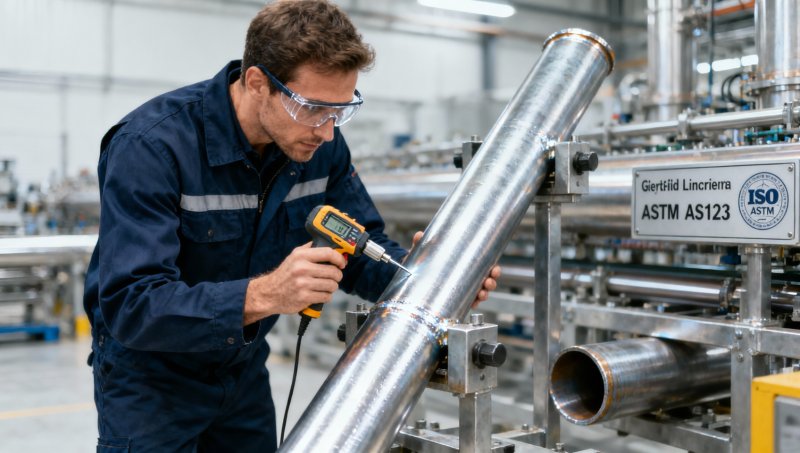
Request certified lab reports showing zinc coating mass (g/m²) measured per ASTM A90/A90M, plus cross-sectional micrographs confirming uniform intermetallic layer formation. At Hongteng Fengda, every shipment includes third-party verification from SGS or Bureau Veritas.
What’s the minimum order quantity for custom-diameter galvanized round steel?
MOQ is 5 metric tons for diameters 16–250 mm. We support mixed-size orders (e.g., Ø32mm + Ø76mm) under one PO with shared logistics optimization—reducing landed cost by up to 9% for multi-site projects.
Can you supply galvanized round steel with tighter tolerances than ISO h9?
Yes. We offer ISO h8 for diameters <10.00 mm and h7 upon request—with out-of-roundness controlled to ≤½ of diameter tolerance. All precision-ground variants include Circograph surface finish validation.
Conclusion: Move Beyond Price—Build Resilience Through Quantified Value
TCO modeling transforms corrosion-resistant steel pipe procurement from a transactional cost center into a strategic risk-mitigation function. By embedding verifiable quality data, predictable delivery performance, and lifecycle cost transparency into every engagement, Hongteng Fengda empowers procurement teams to justify premium investments with auditable ROI—whether sourcing for railway infrastructure in North America, marine components in the Gulf, or smart city lighting poles in Southeast Asia.
We invite procurement, engineering, and finance leaders to request a customized TCO benchmarking report for your next steel pipe tender—complete with side-by-side supplier scorecards, 10-year cost simulations, and implementation roadmaps tailored to your ERP environment.
Contact Hongteng Fengda today to initiate your TCO alignment session—or download our free “Corrosion-Resistant Steel Pipe TCO Assessment Toolkit” with Excel-based calculators, audit checklists, and specification templates.
Please give us a message


Please enter what you want to find