When procuring Industrial Steel Pipes globally, understanding the critical differences between ASTM and EN standards is essential for structural steel pipe selection, compliance, and project success. Whether you're specifying metal wall angle, steel L angle, or metal angle iron with holes for industrial frameworks, mismatched standards can lead to delays, rework, or safety risks. As a trusted structural steel manufacturer & exporter from China, Hongteng Fengda supplies certified Industrial Steel Pipes and customized solutions—including metal angle with holes and L shaped angle steel—that meet both ASTM (e.g., A53, A106) and EN (e.g., EN 10217, EN 10219) requirements. This article breaks down key technical, testing, and dimensional variances to empower procurement teams, engineers, and project managers with actionable insights.
How Do ASTM and EN Standards Differ in Technical Scope & Application?
ASTM standards—developed by ASTM International—are widely adopted across North America, Australia, and many emerging markets. EN standards—published by CEN (European Committee for Standardization)—are mandatory for CE marking and govern structural steel supply across the EU and EFTA countries. While both aim to ensure mechanical integrity and dimensional consistency, their underlying philosophies diverge: ASTM emphasizes performance-based testing under defined conditions, whereas EN integrates harmonized design rules (e.g., Eurocode 3) directly into material specifications.
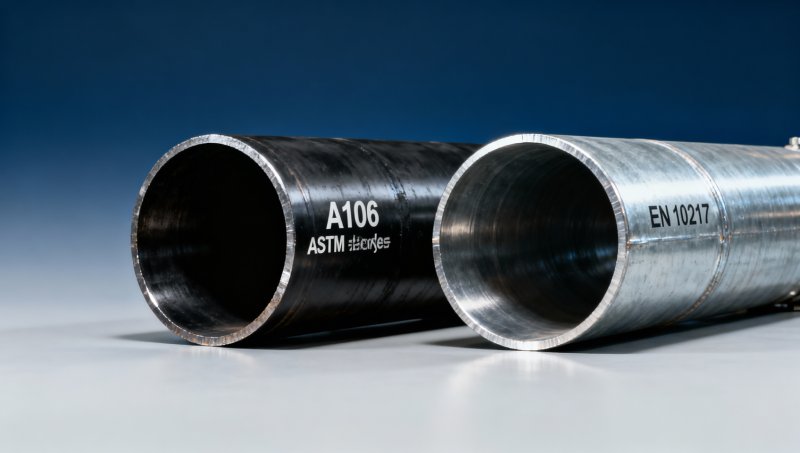
For industrial steel pipes, ASTM A53 covers seamless/welded black and hot-dipped galvanized pipe for pressure and mechanical applications, with yield strength ranging from 240 MPa (Grade A) to 330 MPa (Grade B). In contrast, EN 10217-1 defines welded steel tubes for pressure purposes, requiring minimum yield strength of 235–355 MPa depending on grade (P235GH, P265GH), but also mandates impact testing at −20°C for certain service conditions—a requirement absent in basic ASTM A53.
Dimensional tolerances also vary significantly. For nominal DN100 (4-inch) pipe, ASTM A53 allows ±12.5% wall thickness tolerance, while EN 10217-2 restricts it to ±10% for hot-finished tubes and ±12.5% only for cold-finished variants—making EN more stringent for precision-critical infrastructure projects like offshore platforms or district heating networks.
Key Testing & Certification Requirements Compared
Testing protocols reflect regional risk priorities. ASTM standards typically require hydrostatic testing (1.5× design pressure) and non-destructive examination (NDE) only for specific grades or customer-specified orders. EN standards, however, mandate 100% ultrasonic testing (UT) or eddy current testing (ET) for all welded longitudinal seam pipes per EN 10217-2—ensuring full volumetric inspection before delivery.
Chemical composition limits differ too. ASTM A106 Grade B permits up to 0.30% carbon, while EN 10216-2 P265GH caps carbon at 0.16%—reducing weld hardenability and improving low-temperature toughness. This affects fabrication planning: projects in cold climates or requiring field welding benefit from EN-compliant chemistry, whereas high-temperature steam lines often specify ASTM A106 due to its higher creep resistance.
These differences directly impact procurement timelines: EN-certified pipes typically require 2–4 weeks longer lead time than ASTM equivalents due to mandatory third-party witnessed testing and CE documentation preparation. At Hongteng Fengda, we maintain dual-certified production lines and ISO 17025-accredited in-house labs to compress this gap—delivering ASTM A106 and EN 10217 compliant pipes within 3–5 weeks, including full mill test reports (MTRs) and EN 10204 3.1 certification.
Which Standard Should You Specify for Your Project?
The choice isn’t about “better” or “worse”—it’s about alignment with jurisdictional requirements, design codes, and operational context. For U.S.-funded infrastructure (e.g., DOT, DOE projects), ASTM compliance is non-negotiable. For EU public tenders or projects governed by Eurocodes, EN conformity is legally binding.
Hybrid scenarios are increasingly common. A Middle Eastern refinery may require ASTM A106 for process piping but EN 10219 for structural supports—demanding suppliers capable of managing dual-standard traceability. Hongteng Fengda supports such complexity through batch-level segregation, dual MTR issuance, and real-time QA/QC dashboards accessible to clients’ engineering teams.
Also consider downstream implications: HRB600 Rebar—a high-strength reinforcement solution—delivers 39% higher strength compared to HRB400 grade steel bars, reducing the required reinforcement ratio and decreasing steel consumption. When integrated into reinforced concrete foundations supporting industrial pipe racks, it enables lighter structural framing and faster installation cycles. HRB600 Rebar complies with ASTM A615, GB/T 1499.2, and EN 10080, making it ideal for cross-border infrastructure where both standard sets apply.
Why Global Buyers Choose Hongteng Fengda for Dual-Standard Procurement
Sourcing industrial steel pipes that meet both ASTM and EN standards demands more than catalog availability—it requires synchronized quality systems, certified personnel, and responsive logistics. Hongteng Fengda operates under ISO 9001:2015 and IATF 16949, with dedicated ASTM/EN compliance officers embedded in every production shift.
We offer end-to-end support tailored to your role:
- Procurement &商务 teams: Real-time quotation with dual-standard cost breakdown (e.g., +8–12% premium for EN 10217 vs. ASTM A53 due to enhanced testing)
- Engineering & QA teams: Pre-shipment sample kits with certified MTRs, dimensional reports, and chemical analysis per ASTM E527 / EN ISO 17070
- Project managers: Fixed 4-week delivery window with penalty-backed on-time guarantee, plus container loading supervision and customs documentation support
With facilities certified to produce to ASTM, EN, JIS, and GB standards—and over 70% of our export volume serving regulated markets—we help partners reduce sourcing risks, control costs, and complete projects efficiently. Contact us today to discuss your next industrial pipe specification, request ASTM/EN cross-reference tables, or arrange a factory audit.
Please give us a message


Please enter what you want to find