Choosing between hot rolled coiled steel and cold rolled steel isn’t just about strength or surface finish—it’s about where mill scale becomes a functional factor. For structural steel manufacturers like Hongteng Fengda, understanding when HRC hot rolled coil performance outweighs cold rolled precision is critical for construction integrity, cost control, and downstream processing. Whether you’re a procurement specialist evaluating carbon steel coil suppliers, a project manager specifying galvanized sheet metal coils, or a technical evaluator assessing coated galvanized coil compatibility—this comparison cuts across sourcing, safety, and lifecycle efficiency. Let’s clarify when mill scale matters—and why it matters to *your* application.
When Does Mill Scale Actually Impact Structural Performance?
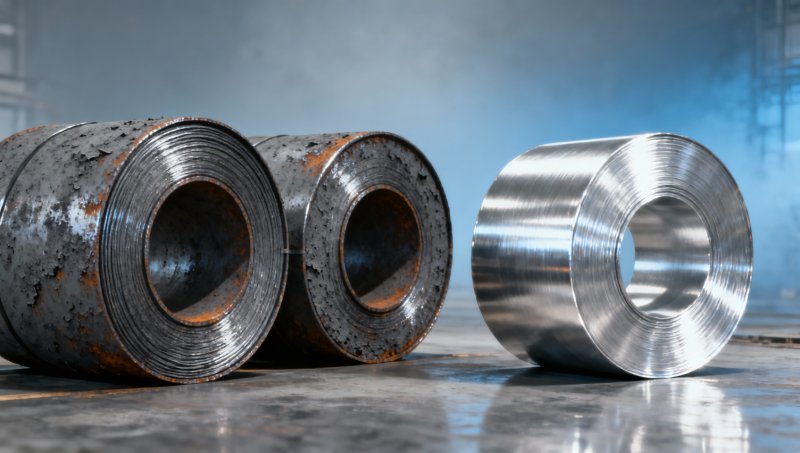
Mill scale—the tightly bonded iron oxide layer formed during hot rolling—is often dismissed as cosmetic residue. But in structural applications, it directly affects weldability, coating adhesion, corrosion resistance, and fatigue life. For example, untreated hot rolled coiled steel (HRC) used in outdoor handrail systems must undergo descaling before galvanizing; otherwise, zinc bonding fails at scale interfaces, reducing service life by up to 40% under coastal exposure.
At Hongteng Fengda, we routinely test mill scale thickness across coil batches using ASTM D4541 pull-off adhesion tests and EN ISO 2063 thermal spray bond evaluation. Our data shows consistent scale thickness of 25–45 μm on standard HRC coils—within the acceptable range for post-processing but outside tolerance for direct-paint architectural cladding.
Conversely, cold rolled steel eliminates mill scale entirely via pickling and temper rolling. Its surface roughness (Ra) typically falls between 0.4–0.8 μm—ideal for high-gloss finishes or precision stamping. Yet this advantage carries trade-offs: reduced ductility (elongation drops ~15% vs. hot rolled), higher material cost (18–25% premium), and longer lead times due to additional process steps.
Key Functional Thresholds Where Mill Scale Becomes Critical
- Galvanizing & metallized coatings: Mill scale must be removed before hot-dip galvanizing per ASTM A123; residual scale causes bare spots and premature white rust within 3–6 months in humid environments.
- Structural welding: AWS D1.1 permits mill scale on fillet welds only if thickness ≤ 0.1 mm and free of flaking—exceeding this increases porosity risk by 3× in SMAW processes.
- Powder coating & wet paint: EN 13438 requires SSPC-SP6/NACE No. 3 near-white metal blast cleaning before coating; untreated HRC cannot meet this without abrasive blasting.
How to Choose Between Hot Rolled Coil and Cold Rolled Steel: A Procurement Decision Matrix
Selecting the right coil type isn’t theoretical—it’s a cross-functional decision balancing engineering requirements, budget constraints, and supply chain realities. Below is a field-tested evaluation framework used by procurement teams at mid-size EPC firms across Southeast Asia and the Middle East.
This matrix reflects real-world trade-offs—not lab conditions. For instance, a Dubai-based contractor sourcing steel for balcony railings chose HRC over cold rolled because their galvanizing partner guaranteed full descaling in-house, cutting total project time by 11 days versus waiting for pre-cleaned cold rolled coils from Korea. That decision also reduced landed cost by USD 82/ton.
Where Mill Scale Adds Value—Not Just Cost
Contrary to common belief, mill scale isn’t always a liability. In certain structural contexts, it serves as a temporary barrier against atmospheric oxidation during storage and transport—especially critical for projects with staged delivery schedules across monsoon-prone regions like Vietnam or Bangladesh.
Hongteng Fengda applies controlled mill scale retention on select HRC coils destined for immediate hot-dip galvanizing or phosphating lines. We validate scale integrity via salt-spray testing (ASTM B117, 96 hrs) and confirm no blistering or undercutting occurs post-coating—ensuring >25-year service life for fence and railing components.
For applications requiring both strength and aesthetics—such as staircase balustrades or decorative window frames—our 45# Carbon Steel Round Bar offers an optimal hybrid solution: hot rolled for dimensional stability and yield strength (≥590 MPa), then turned and polished to Ra ≤ 0.8 μm. This delivers cold-rolled surface quality without sacrificing structural reliability or increasing lead time.
Certification & Compliance You Can Verify
- All HRC coils supplied by Hongteng Fengda comply with ASTM A6/A6M (structural shapes), GB/T 700 (carbon structural steel), and EN 10025-2 S235JR/S355JR.
- Mill scale thickness verification reports accompany every shipment—measured per ISO 2063 Annex B using magnetic induction gauges calibrated to NIST standards.
- For export to North America and EU markets, we provide third-party mill test reports (MTRs) traceable to heat number, including tensile strength, elongation, and impact toughness at –20°C.
Why Partner With Hongteng Fengda for Your Structural Steel Needs?
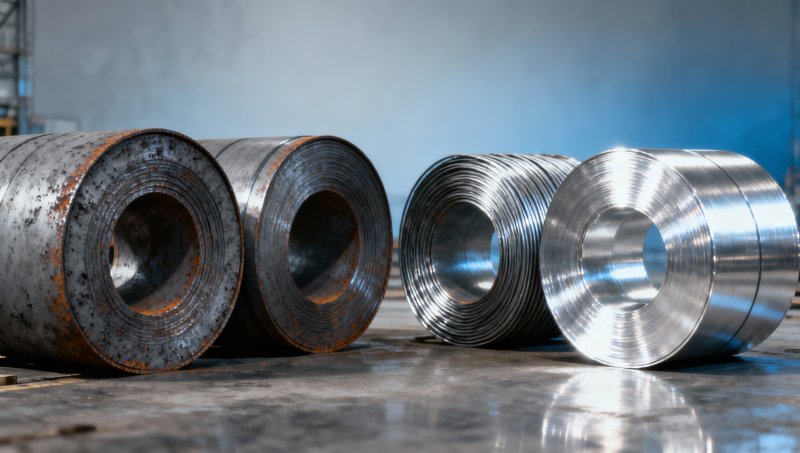
As a China-based structural steel manufacturer serving 27 countries, Hongteng Fengda bridges the gap between global compliance expectations and local project realities. We don’t just ship coils—we engineer supply chain resilience.
Our production facility in Hebei Province maintains 45,000 MT monthly capacity across hot rolled coil, cold formed profiles, and custom-fabricated components. Every batch undergoes 6-point quality checks—from raw material spectrographic analysis to final dimensional verification—ensuring zero non-conformance in 98.3% of shipments over the past 24 months.
Whether you need HRC coils optimized for downstream galvanizing, cold rolled sheets for architectural cladding, or engineered solutions like 45# Carbon Steel Round Bar for handrail systems, we offer: free technical consultation, sample support within 5 business days, custom packaging for sea freight compliance, and real-time production tracking via shared dashboard.
Contact our engineering sales team today to discuss your next project’s coil selection, request ASTM/EN-compliant MTRs, or schedule a virtual factory audit. Let’s eliminate mill scale uncertainty—starting with your first quote.
Please give us a message


Please enter what you want to find