Hot galvanized steel is known for its longer service life and strong corrosion resistance, but is it always the right investment for your project? For business decisions in steel-intensive industries, cost alone is rarely enough. The real question is whether added zinc protection creates measurable value across the project lifecycle, from fabrication and transport to installation, maintenance, and replacement risk.
In structural and industrial applications, hot galvanized steel often performs best where moisture, chemical exposure, or difficult maintenance conditions increase corrosion pressure. In dry indoor use, however, the premium may not always be justified. A practical evaluation should compare environment severity, expected service life, coating alternatives, downtime cost, and supply consistency before choosing the right steel solution.
When hot galvanized steel clearly makes sense
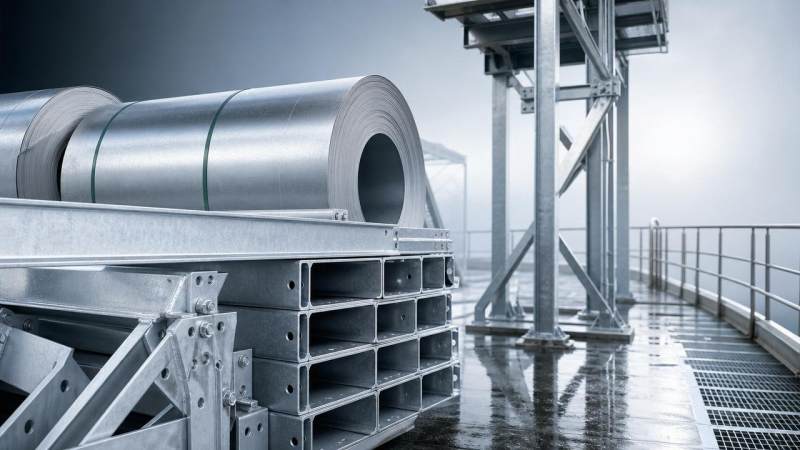
The strongest case for hot galvanized steel appears in outdoor or semi-exposed structures. Rain, humidity, condensation, and polluted air steadily attack unprotected carbon steel. Zinc coating slows this process and extends usable life.
This matters especially when steel is part of a long-term asset. Bridges, platforms, frames, supports, and utility structures often face weather for years. Repainting or replacing these parts later can cost far more than the initial galvanizing premium.
Outdoor construction and infrastructure
Hot galvanized steel is usually worth considering for guardrails, structural frames, stair systems, handrails, roofing support, and transmission-related components. These applications face ongoing exposure and difficult maintenance access.
Where repainting requires shutdowns, lifting equipment, or labor-intensive surface preparation, hot galvanized steel often lowers total ownership cost. The value increases when structures are expected to remain in service for decades.
Coastal, humid, and industrial environments
Salt-laden air, fertilizer dust, chemical fumes, and high humidity accelerate corrosion. In these conditions, hot galvanized steel can outperform untreated steel by a wide margin and reduce the chance of early structural degradation.
Projects near ports, wastewater systems, processing plants, and agricultural facilities should treat corrosion as a design issue, not a finishing detail. Here, hot galvanized steel is often a strategic rather than cosmetic choice.
When the extra cost may not be necessary
Not every project benefits equally from galvanizing. If steel is used indoors, kept dry, and easy to inspect or repaint, the return on additional coating may be limited. In such cases, other protective systems can be sufficient.
Examples include warehouse interiors, temporary frames, sheltered machinery bases, and low-risk fabrication parts. If the expected service life is short or the environment is controlled, untreated or painted steel may offer better cost efficiency.
Temporary or low-exposure installations
Some projects only need steel to last a few years. In these scenarios, paying more for hot galvanized steel may extend life beyond what the application actually requires. That means capital is tied up without practical benefit.
Short-cycle industrial builds, provisional supports, and internal fixtures should be evaluated by real service duration. Matching coating level to actual operating conditions improves both budgeting and material selection.
Applications with easy maintenance access
If components can be cleaned, inspected, and recoated without major disruption, hot galvanized steel may not always be the best choice. Accessibility changes the economics of corrosion control significantly.
A protected indoor frame with scheduled maintenance may perform well using standard carbon steel plus paint. The decision should compare maintenance intervals against galvanizing cost, not rely on coating preference alone.
How application details change the value equation
The worth of hot galvanized steel depends on more than location. Fabrication method, part geometry, welding requirements, working temperature, and downstream processing can all influence the right choice.
For many fabrication programs, material selection starts before coating. Base steel quality affects forming, welding, and performance. In boiler-related and industrial processing uses, substrate consistency is especially important.
A practical example is Rolled Coil used in carbon steel applications such as boiler plate supply chains. Available grades include Q235, Q235B, Q345, Q345B, Q195, St37, St42, St37-2, St35.4, St52.4, and St35.
This material offers carbon content from 0.12% to 0.20%, manganese from 0.30% to 0.70%, silicon not exceeding 0.30%, and phosphorus and sulfur each not exceeding 0.045%. It also supports standards such as GB/T 700-2006, AiSi, ASTM, DIN, and JIS.
Its value in fabrication comes from excellent weldability, good cold working properties, and suitability for elevated temperatures during hot working. Bending, stamping, forging, and hot rolling are all supported without special post-weld heat treatment in many cases.
When evaluating hot galvanized steel, this matters because coating should support the actual manufacturing route. A well-selected base material improves processing efficiency first, then galvanizing can be added where corrosion exposure truly requires it.
Different scenarios require different corrosion strategies
The same steel product may face very different operating conditions. A clear comparison helps determine where hot galvanized steel offers the strongest return.
A practical checklist before choosing hot galvanized steel
To decide whether hot galvanized steel is worth the premium, assess the project through a use-based checklist rather than a generic specification habit.
- Will the steel face rain, condensation, humidity, salt, or chemical exposure?
- Is the target service life long enough to justify higher upfront cost?
- Would future repainting require shutdowns, lifting, or specialized labor?
- Can the fabrication route handle coating requirements efficiently?
- Will corrosion failure create safety, compliance, or downtime risks?
- Are supply lead times and quality consistency reliable for galvanized products?
If several answers point to long exposure and costly maintenance, hot galvanized steel is often the better long-term decision. If most answers point the other way, simpler protection may be enough.
Common mistakes that distort the decision
One common mistake is comparing only purchase price. Hot galvanized steel frequently costs more at the start, but corrosion-related repairs, recoating, and replacement can multiply total project expense later.
Another mistake is over-specifying protection for low-risk indoor conditions. This reduces cost competitiveness without improving project performance in a meaningful way.
A third issue is ignoring fabrication compatibility and standards. Coating choice should align with design life, steel grade, welding method, and project specifications rather than being added at the final stage.
Choosing the right steel partner for application-based decisions
A good steel decision depends not only on material type, but also on supply reliability, standards compliance, and processing support. Consistent quality helps reduce sourcing risk and protects project schedules.
Hongteng Fengda is a professional structural steel manufacturer and exporter from China, supplying angle steel, channel steel, steel beams, cold formed steel profiles, and customized structural steel components for global projects.
With modern facilities and strict quality control, products are supplied to major international standards including ASTM, EN, JIS, and GB. This supports better alignment between corrosion protection strategy and actual application needs.
If your project is evaluating hot galvanized steel, the best next step is to compare environment, lifespan, maintenance difficulty, and fabrication requirements together. A scenario-based review leads to a more accurate and cost-effective choice.
In short, hot galvanized steel lasts longer, but it is worth it mainly where corrosion risk and maintenance cost are real. Where exposure is limited and access is easy, other steel protection options may deliver better value.
Please give us a message


Please enter what you want to find