Hot Dipped Galvanized Wire for Tying Rebar: What Really Matters in Corrosion-Resistant Selection
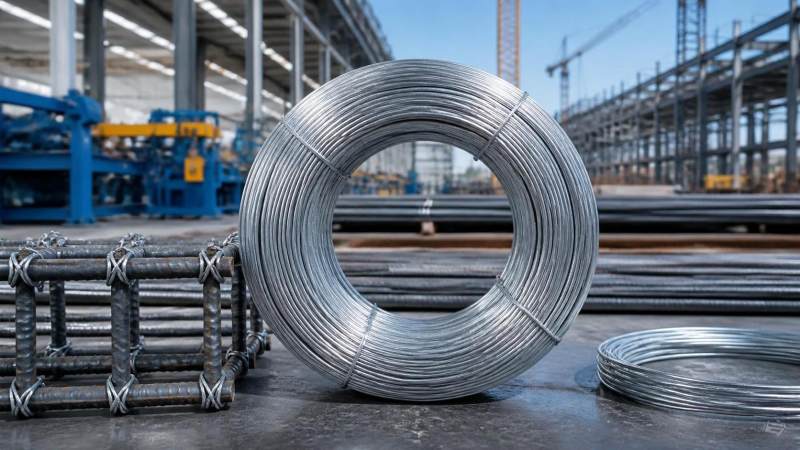
Hot dipped galvanized wire for tying rebar is often treated as a small accessory in reinforced concrete work, but on exposed, humid, or coastal jobs, small accessories are exactly where avoidable durability problems begin. Rebar tie wire does not carry the same structural role as the bar itself, yet it still sits inside the concrete environment, and its corrosion behavior affects construction quality, placement stability, and in some cases the long-term condition of the reinforcement cage during storage, transport, and pouring.
For sourcing teams, the challenge is rarely just “galvanized or not.” The real question is which specification gives enough corrosion resistance without creating unnecessary cost or supply risk. That means looking past the product name and checking coating method, wire diameter, tensile behavior, surface condition, coil consistency, and the standards actually required by the project documents.
In practice, hot-dip galvanized tying wire is usually chosen when black annealed wire may rust too quickly during storage or before concrete placement, or when the project environment includes high humidity, marine air, frequent rain exposure, or longer on-site holding periods. It is a practical procurement decision, but only if the wire is matched to the work conditions.
Why hot-dip galvanizing changes the buying decision
The key difference is the zinc coating formed through immersion in molten zinc, which generally provides better corrosion protection than a very light electro-galvanized layer. For rebar tying, that matters less in a dry, fast-moving slab pour and much more in foundations, retaining structures, precast yards, coastal infrastructure, water-related works, and any project where tied cages may sit outside for days or weeks before final placement.
A common mistake is assuming all galvanized wire performs the same because the surface looks bright. It does not. Some buyers focus on appearance and unit price, but field crews usually notice different issues first: coating flaking during twisting, wire snapping too easily, inconsistent softness from coil to coil, or corrosion spots appearing after short outdoor exposure. Those problems usually come back to process control rather than the word “galvanized” itself.
For suppliers serving international construction markets, this is where manufacturing discipline matters. Companies with stable steel processing experience and quality control under ASTM, EN, JIS, and GB frameworks are usually better positioned to keep wire properties consistent across batches. That is also why many overseas buyers prefer working with steel exporters that already support structural sections, fabricated components, and OEM requirements, because they tend to understand project documentation, traceability, and shipment reliability instead of treating wire as a low-value commodity only.
The specs worth checking before you compare prices
If you are evaluating hot dipped galvanized wire for tying rebar, five points deserve attention before price negotiations start.
1. Zinc coating thickness or coating mass
This is the first corrosion-resistance checkpoint. Project documents may specify coating mass by grams per square meter, or they may refer to a relevant national or international standard. If no value is stated, it is worth asking the supplier how coating is verified and what test method is used. Without that, “hot dipped” can remain too vague for a real purchasing decision.
Heavier zinc coating generally improves corrosion resistance, but there is a trade-off. Very thick coating on small-diameter wire can reduce flexibility or lead to coating damage during aggressive twisting if the base wire and process are not balanced well.
2. Wire diameter tolerance
Tie wire must be easy to handle while still providing enough holding force. Too thin, and it may break or require double tying. Too thick, and crews lose speed, especially in dense reinforcement. The best diameter is not universal; it depends on bar size, tying method, and whether the site uses manual tying or tying tools. What matters for procurement is not only nominal diameter, but consistency. Large diameter variation across coils creates frustration on site and can slow placement more than buyers expect.
3. Tensile strength and elongation
People often ask for “stronger wire,” but tying wire that is too hard is usually the wrong answer. It needs enough strength to hold the cage in position, yet enough ductility to twist cleanly without springback or breakage. This is especially important for workers making repeated hand ties all day. A brittle wire can look acceptable in inspection reports and still perform poorly on site.
4. Surface quality after galvanizing
A usable galvanized tie wire should have a reasonably uniform coating without heavy ash deposits, bare spots, sharp zinc build-up, or peeling during normal twisting. Not every visual irregularity is critical, but obvious coating defects are a warning sign. If the project has long exposure before embedment, surface quality becomes even more relevant.
5. Coil weight, packaging, and traceability
This sounds mundane, but it affects site productivity and claims handling. Buyers should confirm coil weight range, inner diameter, bundling method, moisture protection, and labeling. If wire arrives with mixed heat numbers or unclear packing marks, it becomes harder to track performance issues later. On export shipments, packaging is not a cosmetic point; it directly affects corrosion risk during transit and storage.
When galvanized tying wire is worth the extra cost
Not every project needs it. In dry indoor work with fast installation and immediate concrete cover, black annealed tie wire may still be commercially reasonable if allowed by specification. But once the reinforcement cages are prefabricated outdoors, transported between yards, or left exposed in humid air, hot dipped galvanized wire starts to make more sense.
The same logic applies to projects near the sea, wastewater structures, bridge substructures, ports, or tropical climates. The wire itself may represent a small fraction of total steel cost, but replacing corroded bundles, re-tying loosened intersections, or dealing with avoidable site delays costs more than the unit price difference in many cases.
Questions buyers should ask suppliers before placing an order
A short inquiry list can save a lot of trouble later. Ask what galvanizing standard or internal control standard is applied. Ask for coating verification method. Ask whether the wire is soft annealed before galvanizing or processed to a specific tying performance. Ask how diameter tolerance is controlled. And ask how the material is packed for ocean shipment or long storage.
If a supplier mainly sells on price and cannot answer those points clearly, the risk is not theoretical. Tie wire problems usually show up late enough to disrupt work but early enough that everyone argues over responsibility.
This is also where a broader steel supply background helps. Exporters with experience in structural sections, formed profiles, and customized steel components tend to understand that procurement is not only about tonnage. Hongteng Fengda, for example, operates in that wider structural steel space, supplying angle steel, channels, steel beams, cold formed profiles, and OEM steel components to overseas markets. That kind of portfolio does not automatically make a wire better, but it usually means the supplier is already used to standard matching, quality documentation, and lead-time discipline across project-based orders.
On some jobs, buyers are sourcing multiple steel items together rather than treating each line item separately. In those cases, it is common to combine reinforcement accessories with other practical construction steel products such as A36 Patterned steel plate for walkways, equipment-floor areas, transportation platforms, or anti-skid surfaces around machinery. That product is typically available in grades such as A36, Q235B, 235JR, S235, or SS400, with thickness from 2 mm to 8 mm, widths from 600 mm to 1800 mm, and lengths from 2 m to 12 m or customized. It is a different application entirely, but from a procurement standpoint, consistent export packaging, standards familiarity, and schedule control often matter across all these steel categories.
A few specification traps that are easy to miss
One is substituting electro-galvanized wire when the quote only says “GI wire.” Another is ignoring storage conditions between arrival and use. Even a good hot dipped galvanized wire can suffer if coils are stored wet under damaged wrapping with no ventilation. A third is buying only by sample feel. The sample may twist nicely, but unless batch consistency is controlled, production material can behave differently.
There is also the issue of compatibility with local practice. Some crews prefer softer wire because they tie by hand. Others use tying tools and want a different balance of stiffness and diameter. If procurement does not check with the site team early, the selected wire may be technically compliant but unpopular in actual use, which often leads to informal substitution on site.
A practical way to make the final decision
Start with the environment and storage duration, not the price sheet. Then confirm the required standard, coating expectation, wire diameter, and handling method. If the project is routine and exposure is limited, you may not need to over-specify. If the project sits in a corrosive environment or has long logistics cycles, it is usually worth paying closer attention to coating quality and packaging integrity.
For hot dipped galvanized wire for tying rebar, the smartest purchases are usually not the cheapest and not the most overbuilt. They are the ones where coating, ductility, diameter consistency, and shipping protection are aligned with the real job conditions. If those points are clear before order confirmation, the wire tends to disappear into the workflow the way it should. And for a construction material this small, that is usually a sign the specification was chosen correctly.
Please give us a message


Please enter what you want to find