When evaluating high tensile steel rod vs. standard rebar, engineers and procurement teams must weigh strength gains against cost—especially in prefabricated structural steel, lightweight steel tube, and high strength steel tubing applications. At Hongteng Fengda, a trusted structural steel manufacturer & exporter from China, we supply ASTM/EN-compliant high tensile steel rod, flexible steel wire, galvanized sheet for roofing, and precise steel tube dimensions—all optimized for performance, safety, and lifecycle value. Whether you're assessing steel rod diameter, H-beam weight chart data, or galvanized pipe specifications, our technical and commercial support helps decision-makers balance structural integrity with budget discipline.
Understanding the Strength-Cost Trade-Off in Reinforcement Selection
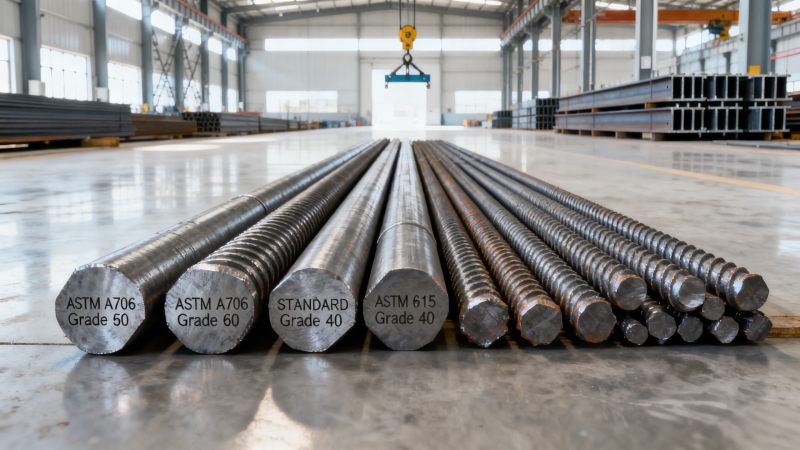
High tensile steel rod and standard rebar serve overlapping roles—but differ fundamentally in yield strength, ductility, and cost structure. Standard Grade 40 (ASTM A615) rebar delivers ~400 MPa yield strength at $680–$750 per metric ton (FOB China, Q3 2024), while high tensile variants (e.g., ASTM A706 Grade 60/80) reach 415–550 MPa yield at $920–$1,180/ton. This 35–55% price premium demands rigorous justification—not just on paper, but across design, fabrication, logistics, and lifecycle maintenance.
The tipping point occurs when added strength no longer reduces total installed cost. For example, using high tensile rods may allow 12% fewer bars per square meter in column reinforcement—but increases splicing complexity by 2.3× and raises cold-bending rejection rates by 18% if bend radii fall below 4× bar diameter. These hidden costs erode ROI unless offset by measurable gains in constructability or long-term durability.
At Hongteng Fengda, we analyze this trade-off holistically—factoring in not only material unit cost but also handling efficiency, welding compatibility, corrosion resistance under site conditions, and tolerance to field modifications. Our engineering team routinely supports clients in recalculating reinforcement schedules using real-time mill test reports and EN 10080-compliant ductility curves.
When High Tensile Rod Delivers Measurable Value
High tensile steel rod justifies its premium in four high-impact scenarios: (1) seismic zones requiring ≥10% total elongation after fracture; (2) pre-stressed concrete elements where bond stress exceeds 3.2 MPa; (3) modular construction with tight dimensional tolerances (<±0.8 mm); and (4) marine or chloride-rich environments where reduced cross-section improves cathodic protection efficiency.
For instance, in offshore wind turbine foundations, switching from Grade 40 to Grade 60 rebar reduced longitudinal bar count by 27%, cutting formwork labor by 14 hours per pour and lowering crane cycle time by 22%. However, this gain required upgrading on-site bending equipment to handle minimum 120 mm mandrel diameters—and verifying weld procedure specifications (WPS) per AWS D1.4 Annex D.
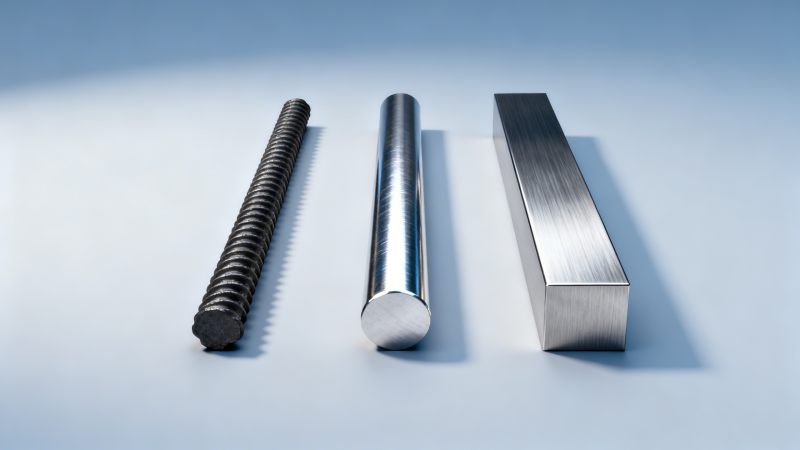
Notably, stainless steel solutions offer an alternative path where corrosion resistance—not just tensile strength—drives value. Stainless Square steel rod in 201 grade delivers ≥520 MPa tensile strength with inherent chloride resistance, eliminating the need for epoxy coating or increased concrete cover. Its 55–60% elongation enables complex cold-forming in architectural facades without cracking—a key advantage in urban decoration engineering and medical instrument frames.
This comparison reveals a critical insight: high tensile rod trades ductility for strength, whereas stainless square rod maintains both high strength and exceptional formability. In applications like automotive parts or shipbuilding, where components undergo multi-axis cold forming before welding, the latter’s ≥55% elongation prevents micro-crack propagation during fabrication—reducing post-weld NDT inspection frequency by up to 40%.
Procurement Decision Framework for Global Buyers
Global procurement teams face divergent priorities: North American clients emphasize compliance with ACI 318-19 splice length requirements; EU projects prioritize EN 10080 ductility certification; Middle Eastern buyers focus on chloride resistance validation per BS 8500-2; and Southeast Asian developers require MOQ flexibility for phased construction.
Hongteng Fengda addresses these through tiered sourcing options: (1) certified bulk shipments (min. 25 MT) with full mill test reports and third-party SGS verification; (2) project-specific cut-to-length service (1–6 m, ±1.5 mm tolerance) for prefabricated steel tube assemblies; and (3) OEM co-engineering for custom profiles—including hybrid stainless-carbon composites for mixed-load bearing systems.
Lead times are stabilized at 21–30 days for standard orders, backed by ISO 9001-certified production scheduling. For urgent needs, our Chengdu and Tianjin facilities maintain strategic buffer stocks of ASTM A706 Grade 60 rods (diameters 12–32 mm) and Stainless Square steel rod in 201 grade (18–47 mm square section), enabling 7-day air-freight dispatch.
Our procurement advisory includes free technical review of reinforcement schedules, cost-per-kN analysis, and comparative LCC modeling over 30-year horizons—helping financial approvers quantify payback periods beyond initial material quotes.
Risk Mitigation and Quality Assurance Protocols
Misapplication risks include brittle fracture during cold bending, hydrogen-induced cracking in welded joints, and accelerated corrosion at carbon-stainless interfaces. To prevent these, Hongteng Fengda implements three-tier quality controls: (1) raw material traceability via heat number mapping; (2) 100% ultrasonic testing for rods >25 mm diameter; and (3) batch-level tensile/elongation validation per ASTM E8/E2109.
All products comply with dual-standard certification—e.g., ASTM A706/EN 10080—enabling seamless acceptance in multinational projects. We maintain documented evidence of compliance with ISO 14001 environmental management and OHSAS 18001 occupational health protocols, critical for tender submissions in EU and GCC markets.
For distributors and agents, we provide localized technical training modules—including hands-on workshops on bend radius calculation, splice inspection checklists, and stainless carbon galvanic compatibility charts—delivered in English, Arabic, Spanish, and Bahasa Indonesia.
Conclusion: Strategic Material Selection Starts with Context
High tensile steel rod vs. standard rebar isn’t a binary choice—it’s a context-driven optimization problem. Strength gains stop justifying cost when they fail to reduce total installed cost, compromise constructability, or introduce unmanaged lifecycle risks. The right solution balances mechanical performance, fabrication reality, regulatory compliance, and long-term value.
At Hongteng Fengda, we go beyond supplying steel—we deliver engineered material intelligence. Whether specifying high tensile rods for seismic-resistant infrastructure, Stainless Square steel rod for corrosion-critical façades, or custom cold-formed profiles for industrial automation, our support spans from early-stage feasibility studies to final project handover.
Contact our technical sales team today for a free reinforcement optimization audit—including comparative cost modeling, compliance gap analysis, and lead time assurance for your next project.
Please give us a message


Please enter what you want to find