For most modular building frames, the best starting point is a structural grade that meets the design loads and can be fabricated consistently in the required section sizes. A higher yield strength can reduce member weight where strength governs, but it may offer little benefit where deflection, local buckling, connections or minimum practical thickness control the design.
Grade selection should therefore begin with the module’s load path and manufacturing process, not a search for the highest available strength. For technical teams evaluating high-strength steel, or acero de alta resistencia para la construcción de estructuras modulares, the useful comparison is between complete design and fabrication options: grade, product form, thickness, connection details and the standard under which the material will be supplied.
Start with the members that can benefit from higher strength
A modular building does not necessarily need one steel grade throughout. Floor beams, columns, corner posts, lifting points and connection plates can be governed by different actions. A grade that makes sense for a heavily loaded column may add cost without reducing the size of a floor beam controlled by vibration or deflection.
Map the critical load cases before comparing grades. In addition to the completed building, assess the module during lifting, transport, temporary storage and installation. The support conditions and load paths can change at each stage. A corner post designed mainly for compression in service, for example, may also transfer concentrated forces from lifting or stacking details. The grade and section must work with those details, not just with the final gravity-load calculation.
Higher-strength steel is most useful when a member’s resistance is the controlling constraint and a smaller or thinner section remains practical. It is less attractive when the design is controlled by stiffness: increasing yield strength alone does not proportionately increase elastic stiffness. If floor deflection or vibration governs, a deeper section, a different layout or additional bracing may be more effective than a stronger grade.
Weight savings should also be checked against member stability. Reducing thickness can make a plate element more susceptible to local buckling, and a lighter compression member still needs adequate resistance to overall buckling. Depending on the design code and cross-section, the full yield strength may not be available in the resistance calculation.
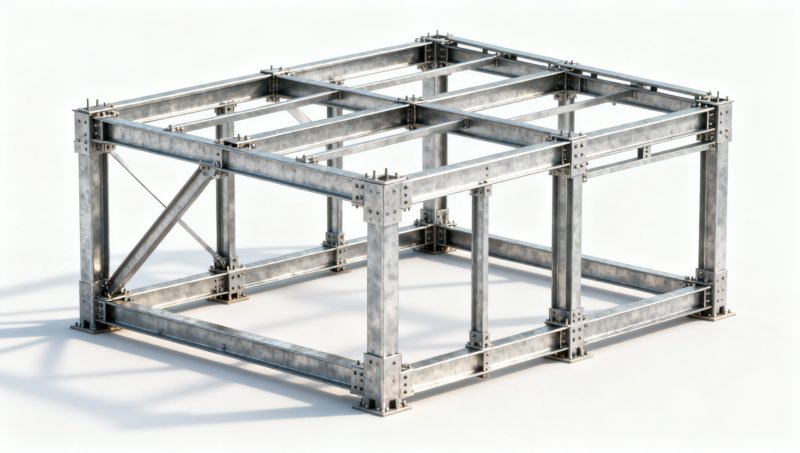
Compare grades as specified products, not strength labels
Grade names are a starting point, not a complete material specification. A structural grade must be read together with its product standard, delivery condition, thickness range and any supplementary requirements. The specified minimum yield strength can vary with thickness, and properties established for plate should not automatically be assumed for a beam, tube or cold-formed profile carrying a similar grade designation.
For an initial comparison, ask the steel supplier for the relevant standard designation and the properties applicable to the exact product form and thickness. Then evaluate the candidates against the project’s governing structural code. Common selection paths include:
- Conventional structural grades: Often a practical baseline for frames where stiffness, connection detailing or readily available section sizes govern. They provide a useful cost and weight reference for any higher-strength alternative.
- Higher-strength structural grades: Candidates for heavily loaded members or weight-sensitive modules when strength governs and suitable sections, welding procedures and toughness properties are available.
- Cold-formed structural grades: Relevant to light-gauge framing and selected secondary members. Check the applicable profile standard, coating, forming effects and local buckling rules; a sheet grade alone does not establish the capacity of the finished profile.
Specifications from ASTM, EN, JIS and GB systems should not be treated as interchangeable solely because nominal yield strengths look similar. Chemical composition limits, impact requirements, dimensional tolerances, testing provisions and product forms can differ. Substitution requires a documented engineering review against the project specification and governing code, including any approval required by the designer or authority.
For example, a buyer comparing two nominally similar-strength grades should check whether both are available as the required hollow section, whether the specified yield applies at the proposed wall thickness, and whether each meets the project’s toughness and weldability requirements. A comparison based only on a mill’s headline strength value leaves those questions unanswered.
Welding, toughness and connections can decide the grade
Modular frames often contain repeated welded joints, attachment plates and connections made in confined areas. Higher strength does not automatically make a material difficult to weld, but grade selection must account for the specified chemistry, section thickness, restraint and fabrication conditions. Review carbon-equivalent requirements where applicable, along with the proposed welding procedure, consumables, preheat and inspection plan.
Early coordination matters because a grade that appears economical by weight can introduce additional welding controls or production constraints. Thick connection plates, for instance, may need a different assessment from the thinner members they join. The welding procedure must address the actual combination of materials and thicknesses, including any dissimilar-grade joints.
Toughness is a separate selection issue. Where the applicable code or project specification calls for impact testing, establish the required test temperature, energy and product condition before ordering. Service temperature is relevant, but so are thickness, restraint and the consequences of fracture. A general claim that a steel is “suitable for cold weather” is not a substitute for a specified toughness requirement.
Connections can also absorb or eliminate the expected weight saving. A stronger column may require thicker end plates, local stiffeners or revised welds to transfer the force into the next module. Bolt bearing, weld resistance, plate bending and local deformation all deserve attention. Select the member and its interfaces together, particularly at module corners, where stacking, diaphragm and lateral-load paths may converge.
Keep concrete reinforcement in its own specification
Some modular projects combine a steel frame with concrete foundations, cores or slabs. Reinforcing bar should be selected under the applicable reinforcement standard and concrete design rules, rather than treated as an alternative to structural sections. For example, HPB300 Rebar can be considered where the design calls for that reinforcement grade; its stated minimum yield strength is 300 MPa. The required bar form, diameter, bend detailing, anchorage and suitability under the project standard still need to be established. A structural frame grade with a similar yield value does not make the two products interchangeable.
Check what can be manufactured and delivered
Once a shortlist meets the engineering requirements, compare actual sections and fabrication routes. A grade may be available as plate but not in the beam, channel or hollow section dimensions needed for the frame. Substituting a built-up section can solve the availability problem, but it adds welds, inspection and potential distortion. Equally, reducing the wall thickness of a cold-formed member may create forming, handling or fastening limitations that offset the material saving.
Dimensional tolerances deserve particular attention in modular work because errors can accumulate across prefabricated interfaces. Specify the tolerances that matter to assembly, including member straightness and the location of critical connection features, alongside the applicable product tolerances. Material compliance alone does not guarantee that a completed module will align with its neighbors.
Corrosion protection should be considered at the same stage. The exposure environment, intended service life, accessibility for maintenance and protection system affect detailing as well as material choice. Thin sections may be especially sensitive to section loss, while closed sections need appropriate detailing for the selected coating process. A higher yield strength should not be assumed to compensate for inadequate corrosion protection.
For each candidate, request documentation tied to the ordered material: the product and grade designation, applicable standard, dimensions, heat identification and inspection or test certificates required by the contract. Match the certificate to the delivered product and check the reported properties against the specified thickness and requirements. For imported material, establish the required documentation and acceptance route before placing the order, especially where the project specification restricts substitutions.
Make the final comparison at module level
A useful decision is to compare at least a baseline frame with a higher-strength alternative using the same loads, serviceability criteria and module geometry. Record which checks govern each critical member, then include connection plates, stiffeners, welding and corrosion protection in the comparison. A lighter beam by itself is not necessarily a lighter or cheaper completed module.
Where higher strength reduces section size without creating a stiffness, stability or fabrication penalty, it can be a sound choice. Where it does not change the controlling design check, retain the grade that best meets the documented requirements and the available fabrication route. The final specification should identify the exact product standard and grade for each member group, together with the thickness-dependent properties and supplementary requirements on which the design relies.
Please give us a message


Please enter what you want to find