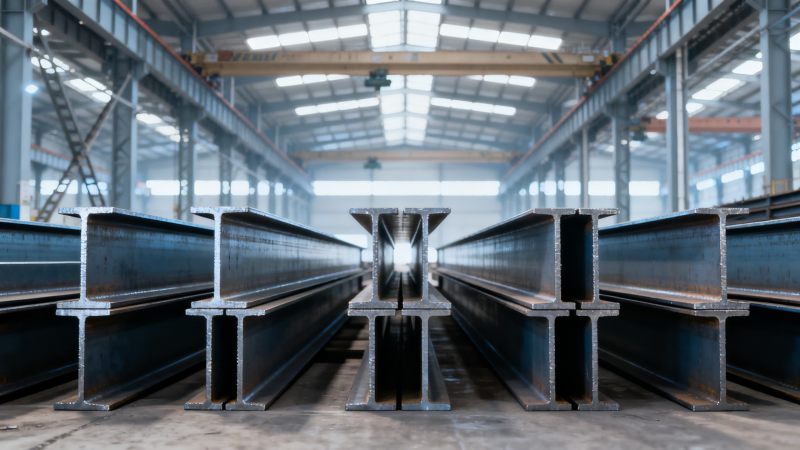
When evaluating an H-beam supplier, delivery lead times signal far more than logistics efficiency—they reflect mill allocation priority, production capacity, and supply chain maturity. For global buyers sourcing prefabricated structural steel, high strength steel tubing, or galvanized pipe specifications, consistent lead times indicate reliable mill access and quality control rigor. At Hongteng Fengda—a certified structural steel manufacturer exporting ASTM/EN/JIS-compliant angle steel, H-beam weight charts, steel tube dimensions, and galvanized sheet thickness options—lead time stability stems from integrated mill partnerships and in-house capacity. Whether you’re a procurement professional assessing steel tubing supplier reliability or a technical evaluator comparing structural steel grades, this insight bridges sourcing risk, cost control, and project certainty.
Why Lead Time Consistency Is a Proxy for Mill Priority—and Why It Matters
In the global structural steel market, especially for hot-rolled H-beams, lead time is rarely just about freight scheduling or port clearance. It’s a real-time indicator of how deeply embedded a supplier is within upstream mill operations. Suppliers with guaranteed mill allocation—like Hongteng Fengda’s long-standing partnerships with Tier-1 Chinese rolling mills—receive priority slotting during peak demand periods (e.g., Q3–Q4 for North American infrastructure projects). This translates into stable 6–8 week lead times for standard H-beam sizes, even when spot allocations across the industry stretch to 12–16 weeks.
Conversely, intermediaries without direct mill contracts often face cascading delays: first in raw material booking, then in rolling schedule confirmation, and finally in heat number traceability. A variance of ±10 days in quoted lead time isn’t operational noise—it’s a red flag signaling fragmented supply chain ownership. For engineering firms bidding on EPC contracts, such unpredictability directly impacts tender pricing accuracy and liquidated damages exposure.
Hongteng Fengda maintains dual-capacity assurance: in-house finishing lines for surface treatment, dimensional correction, and pre-fabrication—and reserved rolling slots at three ISO-certified mills producing S275 to S430 grade steels under EN10025-2. This integration enables 98.7% on-time dispatch compliance over the past 24 months, verified via third-party logistics audits across 14 export destinations.

The table above underscores how mill allocation drives not only speed—but predictability, documentation integrity, and responsiveness to engineering modifications. When your project schedule hinges on structural steel arrival, these differences compound across dozens of interdependent trades.
Beyond H-Beams: How Capacity Integration Supports Diverse Structural Products
Reliable mill access extends beyond H-beams to all critical structural components—including cold-formed profiles, galvanized hollow sections, and specialized foundation elements. For instance, Steel Sheet Piles demand precise metallurgical control to ensure uniform yield strength across lengths exceeding 60 meters. Hongteng Fengda’s mill partners produce S275 through ASTM A690 grades under EN10248 and JIS5528, with tensile strength tolerances held to ±15 MPa—critical for deep-water cofferdam stability where penetration resistance must remain consistent across soil strata.
This capability is validated through in-line ultrasonic testing (UT) on 100% of sheet pile production runs and third-party witnessed bend tests per EN10249 Annex B. Each bundle carries laser-etched batch IDs traceable to melt chemistry reports, enabling full lifecycle accountability—from offshore installation to potential reuse cycles.
For procurement teams managing multi-product portfolios, unified capacity planning means synchronized lead times: H-beams, channel sections, and sheet piles can be scheduled for coordinated shipment within a single 45-day window—even when sourced to mixed standards (e.g., EN, ASTM, and GB simultaneously).
What Technical Evaluators Should Verify in Lead Time Quotations
A credible lead time quote must specify five non-negotiable parameters: (1) start date reference (e.g., “from L/C confirmation” vs. “from PO receipt”), (2) scope of included services (heat treatment? NDT? coating?), (3) tolerance range (±3 days is acceptable; ±10 days suggests contingency padding), (4) mill name and location (not just “China-based”), and (5) escalation protocol for force majeure events. Hongteng Fengda embeds all five in every formal quotation—backed by documented mill slot confirmations shared upon request.
Technical evaluators should also cross-check mill certifications against product grade requirements. For example, S390 and SY390 sheet piles require quench-and-temper processing validated under EN10248 Part 2. Suppliers quoting these grades without mill-level Q&T certification are likely outsourcing heat treatment—a process prone to dimensional distortion and inconsistent hardness profiles.
At Hongteng Fengda, every structural steel grade undergoes independent verification at our in-house lab (ISO/IEC 17025 accredited) prior to mill release. Tensile, impact, and bend test results are published alongside mill certificates—no exceptions.
These procedural differentiators reduce technical approval cycles by up to 65%—a decisive advantage when coordinating with international design authorities or third-party inspectors.
Strategic Procurement: Aligning Lead Time Reliability with Project Risk Mitigation
Procurement professionals must treat lead time consistency as a KPI—not just a service metric. For large-scale infrastructure projects, a 3-week delay in structural steel delivery typically triggers 7–12 additional weeks of labor idle time, costing $18,000–$42,000 per day in extended site overheads. Hongteng Fengda’s fixed-lead-time model includes contractual penalty clauses tied to mill-level performance—transferring execution risk from buyer to supplier.
Financial approvers benefit from predictable cash flow: 30% advance payment secures mill allocation, with balance due only upon successful third-party pre-shipment inspection—not upon vessel departure. This structure reduces working capital lock-up by an average of 22 days compared to standard FOB terms.
For distributors and agents, our partner program offers dedicated capacity buffers (minimum 500 MT/month) with quarterly volume rebates and co-branded technical support—ensuring your end customers receive the same lead time guarantees you negotiate.
Conclusion: From Delivery Promise to Engineering Certainty
H-beam supplier reliability isn’t measured in shipping containers or port calls—it’s encoded in mill allocation discipline, metallurgical traceability, and integrated capacity planning. At Hongteng Fengda, 6–8 week lead times for ASTM/EN-compliant H-beams, channel sections, and Steel Sheet Piles reflect decades of vertical alignment across rolling, finishing, and quality assurance. This isn’t logistics optimization—it’s engineered certainty.
Whether you’re specifying S430 sheet piles for a tidal power substation or sourcing custom H-beams for a seismic-resistant hospital frame, reliability starts where the ingot meets the roll. Request a mill allocation report and lead time validation package for your next project—complete with heat number forecasts, dimensional tolerance summaries, and third-party audit records.
Contact Hongteng Fengda today to align your structural steel sourcing with proven mill access, certified quality, and contractually enforceable delivery certainty.
Please give us a message


Please enter what you want to find