When evaluating h metal beam and I beam options for heavy-load structures, project managers need more than basic shape comparisons—they need reliable performance, cost efficiency, and supply consistency. This guide explains the key differences, load-bearing advantages, and application scenarios to help you choose the right steel beam for safer, more efficient project execution.
Why does the h metal beam vs I beam choice matter in heavy-load projects?
For project managers, beam selection affects far more than structural drawings. It influences steel tonnage, fabrication complexity, installation speed, code compliance, transport planning, and long-term structural reliability.
In warehouses, industrial workshops, bridges, substations, equipment platforms, and multi-bay steel buildings, the wrong beam profile can create avoidable cost pressure or unnecessary safety margins.
That is why the comparison between h metal beam and I beam should be based on flange geometry, section efficiency, connection behavior, and supply practicality rather than shape alone.
- Heavy loads require better resistance to bending, shear, and deflection across long spans.
- Tight construction schedules demand standard sizes, stable lead times, and predictable fabrication quality.
- Global procurement often requires compliance with ASTM, EN, JIS, or GB specifications for easier approval and inspection.
What is the real structural difference between h metal beam and I beam?
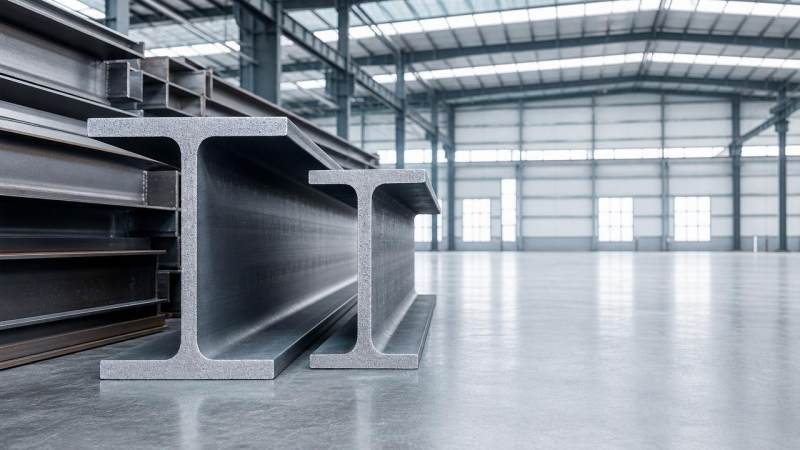
Both sections are widely used in structural steel systems, but their geometry creates different performance characteristics. In practical engineering language, an H beam typically has wider flanges and a thicker web-to-flange proportion, while an I beam usually has narrower flanges and a more tapered appearance in some standards.
For many heavy-load applications, h metal beam profiles are preferred because the section distributes material more efficiently across the width of the flange, improving bending resistance and supporting stronger connection design.
The table below gives project teams a quick comparison framework before moving into detailed calculations.
This does not mean every I beam is weak or unsuitable. It means the h metal beam often offers a more favorable section profile when the design objective is higher load capacity with practical fabrication and stable structural behavior.
How section geometry affects project outcomes
Wider flanges help resist bending moments more effectively. They also improve local stability in many design situations. For project managers, this can reduce design revisions caused by excessive deflection or connection redesign.
A more robust section can also simplify coordination between structural engineers, fabricators, and site teams. Fewer late-stage changes usually mean fewer delays.
Which beam performs better under heavy loads?
In many heavy-duty steel structures, the h metal beam performs better because of its stronger cross-sectional efficiency. It is commonly selected for primary framing where high bending stress, concentrated loads, and long unsupported spans are present.
However, performance should always be judged by actual section size, steel grade, span length, connection type, and load combination. A larger I beam can outperform a smaller H beam, so section designation alone is never enough.
Key performance factors for heavy-load selection
- Moment capacity: Important for roof girders, crane beams, and transfer members.
- Shear resistance: Critical near supports and under concentrated equipment loads.
- Deflection control: Essential for serviceability, cladding alignment, and vibration-sensitive installations.
- Connection detailing: Wider flanges may reduce connection congestion in bolted or welded nodes.
The next table helps compare common project-side decision points rather than only theoretical structural differences.
For heavy industrial buildings, logistics centers, and infrastructure support frames, engineers often move toward h metal beam solutions because the overall design process becomes easier to control from calculation to fabrication.
Which application scenarios are better for H beams and which for I beams?
The best beam is the one that matches actual structural demand, not the one with the most familiar name. In steel procurement, application clarity prevents overspecification and underperformance.
Typical scenarios where h metal beam is a stronger choice
- Industrial workshops with overhead equipment loads and long-span bays.
- High-load warehouse frames that require low deflection for rack alignment and operational safety.
- Bridge approach structures, transfer platforms, and substation support systems.
- Columns and composite members where balanced strength and connection area matter.
Typical scenarios where I beams may still be practical
- Secondary beams in lighter industrial or commercial steel framing.
- Shorter spans with moderate loads and standard connection details.
- Projects with strict budget limits where structural demand allows a lighter section approach.
In practice, many projects use both. A primary frame may rely on h metal beam sections, while secondary framing uses I beams or channels to optimize cost and weight.
What should project managers check before procurement?
Procurement failure often starts with incomplete technical confirmation. Even when the structural engineer names an h metal beam, the purchasing team still needs to verify size range, steel grade, tolerances, standard equivalency, coating needs, and fabrication scope.
- Confirm the governing design standard, such as ASTM, EN, JIS, or GB, before requesting quotations.
- Check whether the beam is a stock size or requires custom rolling, cutting, drilling, or welding.
- Review dimensional tolerances, straightness, and surface condition requirements for downstream fabrication.
- Clarify whether anti-corrosion treatment is needed before shipment or after fabrication.
- Verify delivery batch consistency to avoid section mismatch across different project phases.
In many steel packages, beam procurement is not isolated. Ancillary steel products are often needed for bracing, connectors, substation accessories, tower parts, or fabricated assemblies. For corrosion-sensitive applications, some buyers also source Galvanized Round Steel together with structural sections.
This product is available in iron material with DC01 model options, tensile strength of 570 -820 MPa, diameter range of 16-250mm or customized lengths, and a galvanized glossy surface. It is commonly used in electric power towers, communication towers, railway systems, highway protection, street light poles, marine components, building steel structure components, and substation ancillary facilities.
For project managers, that matters because mixed steel packages often need coordinated corrosion performance. When support rods, fastener-related components, or fabricated accessories must match the beam system environment, galvanized round steel can reduce maintenance risk and improve package consistency.
How do cost, fabrication, and delivery affect the final decision?
Initial unit price is only one part of beam selection. The better question is total installed cost. A lower-priced I beam may not remain economical if it increases tonnage, connection complexity, stiffener demand, or site adjustment work.
By contrast, an h metal beam may carry a higher section price in some cases, but reduce fabrication time and support a cleaner structural solution. This is especially relevant when deadlines are tight and crane time on site is expensive.
The table below helps convert beam selection into a practical cost review for project execution.
The most cost-effective option is usually the section that minimizes total project friction: fewer revisions, manageable tonnage, simpler connections, and dependable delivery.
Why do standards, tolerances, and supply capability matter as much as beam type?
A technically correct section can still create project risk if supply is unstable. Heavy-load structures depend on dimensional consistency, accurate marking, traceable material batches, and conformity with the required standard family.
Key compliance points to review
- Section designation and dimensional tolerance according to the specified market standard.
- Mechanical property alignment with design requirements and welding procedures.
- Surface condition, cutting accuracy, and straightness for shop fabrication compatibility.
- Packaging, marking, and shipment planning for export handling and site identification.
Hongteng Fengda supports global buyers with structural steel products and customized solutions for construction, industrial, and manufacturing projects. For project teams, this matters because beam sourcing is rarely only about one item. It often involves coordinated supply of angle steel, channel steel, steel beams, cold formed profiles, and custom structural components under controlled production and quality systems.
With manufacturing capability aligned to common international standards such as ASTM, EN, JIS, and GB, buyers can simplify cross-border procurement reviews and reduce the risk of mismatch between design documents and delivered materials.
Common mistakes when comparing h metal beam and I beam
Mistake 1: Judging only by shape name
A beam name is not a full engineering specification. Always compare actual dimensions, steel grade, weight per meter, and section properties.
Mistake 2: Focusing only on purchase price
If a lower-priced section drives up fabrication labor or causes site modifications, total project cost rises. Cost review should include manufacturing, logistics, erection, and maintenance considerations.
Mistake 3: Ignoring delivery consistency
In phased construction, inconsistent beam supply can delay assembly and force resequencing. Stable production capacity is often as important as section efficiency.
Mistake 4: Overlooking connection design
A beam that works on paper may still complicate bolting, welding access, or plate arrangement. Connection detailing should be reviewed early, especially for heavy-load nodes.
FAQ: what do project managers usually ask before ordering?
Is h metal beam always better than I beam for heavy loads?
Not always, but often. The h metal beam is commonly more efficient for heavy structural duty because of its flange width and section balance. Still, the final answer depends on section size, span, support condition, load type, and code-based design checks.
What documents should I confirm before placing an order?
You should confirm section designation, standard requirement, steel grade, length schedule, tolerance expectation, fabrication scope, surface treatment, marking method, and shipping batch details. For export orders, clear technical documentation reduces approval delays.
Can one supplier handle beams and related structural products together?
Yes, and this is often a strong advantage. A supplier that can provide steel beams, angle steel, channel steel, cold formed profiles, and customized structural components helps reduce coordination workload, especially for infrastructure and industrial projects.
How important is anti-corrosion treatment in beam procurement?
It is critical in coastal, marine, power, transportation, and outdoor infrastructure environments. The correct coating strategy depends on the service environment, fabrication sequence, and maintenance plan. Related accessories may also require galvanized materials for consistent durability.
Why choose us for structural steel project support?
For project managers comparing h metal beam and I beam solutions, the real need is not only product supply. You need a partner that can support section selection, standards matching, fabrication coordination, and dependable export delivery.
Hongteng Fengda provides structural steel manufacturing and export support for global construction, industrial, and manufacturing projects. Our scope covers steel beams, angle steel, channel steel, cold formed profiles, and customized structural steel components, allowing buyers to manage multi-item procurement more efficiently.
- Parameter confirmation for beam type, section size, standard, and steel grade.
- Product selection support for heavy-load frames, industrial buildings, substations, towers, and custom steel structures.
- Lead time communication based on production schedule and shipment planning.
- Customized solutions for OEM structural parts and mixed steel package sourcing.
- Standard and certification alignment for ASTM, EN, JIS, and GB-oriented supply requirements.
- Quotation discussions with clear technical scope to reduce rework and sourcing risk.
If you are evaluating the right h metal beam solution for a heavy-load project, you can move faster by sharing your drawings, loading conditions, target standard, required delivery schedule, and any coating or fabrication requirements. That makes it easier to confirm the right beam option, related accessories, and a practical supply plan.
Please give us a message


Please enter what you want to find