When comparing h beam and i beam for column applications, technical evaluators must weigh load capacity, stability, connection performance, and cost efficiency.
Although both sections appear similar, their structural behavior can differ under real project conditions.
This matters more today because steel projects increasingly demand faster fabrication, higher safety margins, and tighter cost control.
In that context, understanding h beam and i beam is no longer a basic comparison.
It has become a practical decision affecting column performance, project efficiency, and long-term reliability.
Why the h beam and i beam choice is receiving closer attention
Across construction and industrial steelwork, column selection standards are becoming more performance-driven.
Design teams now focus less on section familiarity and more on measurable structural efficiency.
That shift has pushed h beam and i beam comparisons into earlier design discussions.
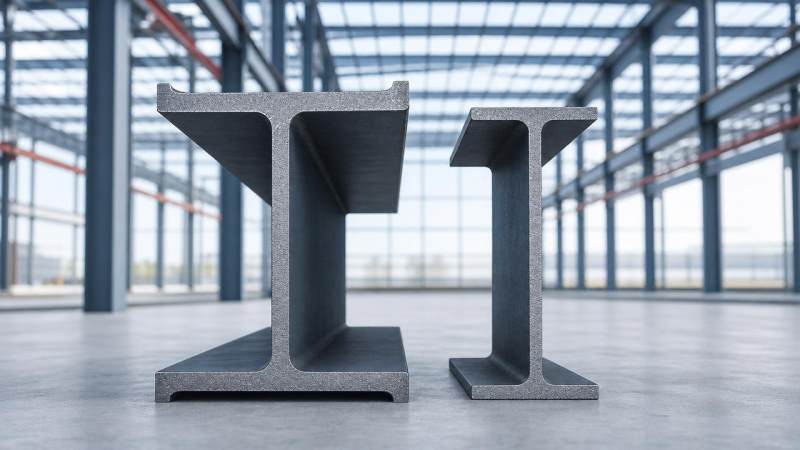
H sections usually offer wider flanges and a more balanced profile.
I sections often have narrower flanges and a more tapered geometry, depending on the standard.
For beams, both can be effective.
For columns, however, the differences in flange width, section symmetry, and buckling resistance become much more important.
As projects move toward taller frames, modular systems, and prefabricated steel connections, these differences directly affect selection quality.
The current trend favors performance-based column selection
A clear market signal is emerging in structural steel design.
Column sections are increasingly selected through performance metrics rather than legacy habit.
This trend affects how engineers compare h beam and i beam in practical applications.
Projects now demand better axial load behavior, easier baseplate connections, and improved lateral stability.
Because of this, H-beam columns are often preferred in heavy-duty frames, industrial plants, and multi-story steel buildings.
I-beam columns still remain useful in lighter structures, controlled spans, and designs where weight reduction matters.
The key change is not that one section replaces the other everywhere.
The change is that selection now depends more strictly on actual loading and connection conditions.
How h beam and i beam differ in column behavior
What is driving the shift in h beam and i beam evaluation
Several forces are reshaping how h beam and i beam are judged for columns.
- Higher live and equipment loads in industrial buildings
- Greater use of prefabricated steel connection systems
- Stricter code compliance under ASTM, EN, JIS, and GB frameworks
- More attention to seismic behavior and buckling control
- Pressure to reduce fabrication time and site welding complexity
- Rising demand for optimized steel tonnage without sacrificing safety
These drivers explain why H sections often gain preference in column-intensive structures.
Their shape supports stronger connection detailing and more stable compression performance.
Still, I sections remain relevant where architectural limits, stock availability, or lighter load paths support their use.
How the choice affects fabrication, installation, and lifecycle value
The h beam and i beam decision influences more than structural calculation.
It also affects workshop processing, field assembly, and maintenance planning.
H beams often simplify gusset, stiffener, and end-plate integration.
That can reduce fabrication adjustments and improve fit-up consistency.
In repetitive column grids, that efficiency becomes especially valuable.
I beams can still work effectively, but connection detailing may need stricter control.
This is particularly true when the column supports combined axial and bending loads.
Supporting components also matter in complete steel packages.
For example, anchor systems, braces, pins, and connection parts may require reliable steel stock.
In such cases, A36 Carbon Steel Round Bar can complement broader structural applications.
It offers excellent strength, wear resistance, multiple diameters, and compliance with common international standards.
Business impact across project stages
- Design stage: more accurate member sizing and lower redesign risk
- Procurement stage: better alignment with available section standards
- Fabrication stage: fewer connection conflicts and smoother processing
- Installation stage: improved assembly speed and field tolerance control
- Lifecycle stage: stronger durability under sustained structural demand
What deserves the closest attention before selecting h beam and i beam
A practical decision should not rely only on section appearance.
It should be based on several evaluation points.
- Check axial compression demand and slenderness ratio first
- Review strong-axis and weak-axis stability requirements
- Assess baseplate, cap plate, and bracing connection complexity
- Compare local availability under ASTM, EN, JIS, or GB standards
- Estimate total fabrication cost, not just raw steel price
- Consider transport, erection, and inspection efficiency
In many medium and heavy column applications, H sections provide a safer margin for practical execution.
In lighter or more constrained designs, I sections may still offer acceptable value.
The better option depends on the full project system, not a single dimension.
A workable method for making the final comparison
The most reliable way to compare h beam and i beam is through a structured review.
This method turns the h beam and i beam discussion into a measurable engineering choice.
It also helps avoid oversimplified assumptions based only on section names.
The practical conclusion for column applications
For most column-heavy steel structures, H beams usually work better than I beams.
Their wider flanges and balanced geometry support stronger stability and easier connections.
That makes them a frequent choice in demanding structural frames.
However, I beams should not be dismissed.
They can still perform well where loads are moderate and detailing is carefully controlled.
The best h beam and i beam decision comes from aligning section behavior with real design conditions.
A reliable structural steel supply partner also strengthens that decision.
Hongteng Fengda supports global projects with steel beams, angle steel, channel steel, cold formed profiles, and customized structural components.
With stable production, strict quality control, and international standard compliance, more accurate steel selection becomes easier to achieve.
If your project is comparing h beam and i beam for columns, the next step is simple.
Review load conditions, connection details, and section availability together before finalizing the specification.
Please give us a message


Please enter what you want to find