Understanding h beam i beam differences is essential for procurement teams managing structural steel budgets, specifications, and delivery risks. Although these beam types may appear similar, their profiles, load performance, production standards, and pricing can directly affect project cost and sourcing decisions. This article explains the key distinctions buyers should evaluate before selecting the right steel beam for construction or industrial applications.
For buyers in construction, fabrication, and industrial supply, beam selection is not only a design issue. It also affects tonnage planning, supplier qualification, machining cost, weldability, transport efficiency, and installation speed. A small specification mismatch can create rework, delays of 7–21 days, or unnecessary steel consumption across an entire project package.
As a structural steel manufacturer and exporter from China, Hongteng Fengda supplies steel beams, angle steel, channel steel, cold formed profiles, and customized structural components to buyers across North America, Europe, the Middle East, and Southeast Asia. For procurement teams comparing h beam i beam options, the goal is usually practical: meet the drawing, comply with ASTM, EN, JIS, or GB standards, and control total delivered cost.
What Buyers Need to Know About H Beam and I Beam Profiles
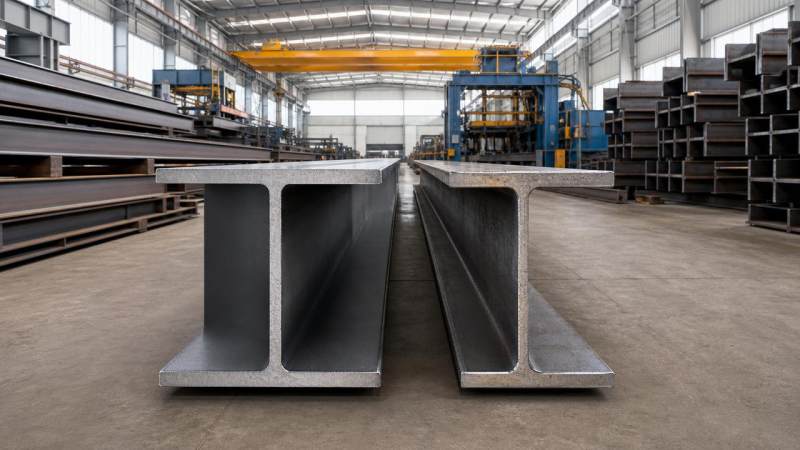
The most visible h beam i beam difference is the cross-sectional shape. Both are structural beams, but the flange and web geometry are not the same. That geometric variation changes how the beam handles load, how it is fabricated, and how efficiently steel is used in different spans and support conditions.
Profile geometry and section characteristics
An H beam typically has wider flanges and a web that forms a shape closer to a true rectangle in section. Flange thickness is usually more uniform, which helps distribute load and often improves performance in columns, heavy platforms, and long-span frames.
An I beam generally has narrower flanges, and its flange surfaces may taper depending on the standard and production method. That shape can be efficient in certain bending applications, especially where vertical load dominates and the design does not require the broader flange footprint of an H beam.
Why this matters in procurement
- Section shape influences weight per meter and therefore raw material cost.
- Flange width affects connection design, bolt layout, and welding access.
- Different standards may allow different dimensional tolerances, often within ±1.5 mm to ±3.0 mm depending on size.
- Incorrect substitution can trigger engineering review and delay shop drawing approval by 3–10 working days.
The comparison below helps procurement personnel separate appearance from purchasing impact. While project engineers focus on structural calculations, buyers need a clear view of what those differences mean for cost, stock availability, and downstream processing.
The key takeaway is that h beam i beam selection should not be based on visual similarity alone. Procurement teams should verify section designation, flange dimensions, web thickness, and applicable standard before asking for quotations, because one changed dimension can alter both the unit price and fabrication route.
Common standards and sourcing implications
International buyers often purchase according to ASTM, EN, JIS, or GB standards. Equivalent beam names do not always mean identical dimensions. A section accepted under one system may differ in flange width, root radius, or mass per meter from a similar designation under another system.
For example, when a project moves between 2 or 3 regional supply chains, the buyer should request a full section sheet, not just a beam label. This reduces substitution risk, especially in projects that combine imported steel, local fabrication, and third-party inspection.
How H Beam and I Beam Differences Affect Total Project Cost
The direct beam price is only one part of the equation. In real purchasing decisions, h beam i beam differences influence at least 5 cost layers: steel weight, processing hours, connection materials, transport utilization, and erection efficiency. Buyers who compare only ex-works ton price often miss the more important total installed cost.
1. Material weight and steel consumption
In some load cases, an H beam may carry the required load with fewer reinforcement measures or fewer fabricated attachments. In others, an I beam may offer a lower mass per meter and reduce raw material expenditure. The correct answer depends on span, support condition, load path, and connection details.
For procurement teams handling quantities of 200–1,500 tons, even a 3% to 5% difference in section weight can materially affect budget. That is why section optimization should happen before final RFQ release, not after purchase order issuance.
2. Fabrication and welding cost
Wider flanges may simplify some plate connections, reduce awkward weld positions, and shorten fit-up time per joint. If a project contains 500 or more repeated connections, a labor saving of even 8–12 minutes per joint becomes commercially meaningful.
At the same time, if the chosen H beam is heavier than necessary, machining, drilling, and surface treatment costs can increase. This is why buyers should compare not just the beam section but also the complete fabrication drawing package.
3. Freight, packing, and loading efficiency
Beam shape and section size affect bundle configuration and container or truck loading efficiency. Longer or heavier beams may require breakbulk shipment, special trailers, or extra lifting arrangements. These logistics factors can shift delivered cost by 2%–8% depending on route and volume.
For mixed cargo procurement, some buyers also source plates, coils, and secondary steel products from the same supplier to simplify shipment planning. In projects requiring corrosion-resistant sheet materials for enclosures or auxiliary fabrication, products such as Steel Coil Galvanized may be combined with beam orders to reduce coordination effort across multiple vendors.
4. Installation speed and site risk
If the selected section improves bolt access, alignment, or base connection stability, the site team can install faster and with less rework. On large industrial structures, reducing crane occupancy by even 1 day can offset a higher unit beam price.
By contrast, substitution without engineering review may create field modification work, which is often the most expensive correction path. Site cutting, additional stiffeners, and altered splice plates can easily cost more than the original section difference.
The table below shows how buyers should compare beam options across cost categories instead of focusing on price per ton alone.
This comparison makes one point clear: the best h beam i beam choice is the one that lowers total project friction. That includes fewer revisions, cleaner fabrication, and more predictable site performance, not merely the lowest quotation line item.
How Procurement Teams Should Evaluate Suppliers and Specifications
A strong purchasing decision depends on more than section type. Reliable sourcing also requires documentation control, production capability, standard compliance, and communication speed. For international projects, buyers should evaluate at least 4 areas before confirming h beam i beam orders.
Specification review checklist
- Confirm standard system: ASTM, EN, JIS, or GB.
- Verify section dimensions, theoretical weight, and tolerance range.
- Check steel grade, such as yield strength and required test documents.
- Review length range, cutting tolerance, and end preparation needs.
- Confirm coating, blasting, primer, or galvanized requirements if applicable.
- Align inspection scope, such as MTC, dimensional check, and third-party witness points.
For many projects, lead time is as important as price. Standard beam sections may be ready faster, while special lengths, nonstandard grades, or fabricated assemblies can extend production by 2–4 weeks. Procurement teams should ask whether the supplier is quoting mill stock, rolling schedule production, or fabricated conversion supply.
Questions that reduce sourcing risk
Before RFQ
- Is substitution between H beam and I beam permitted by the engineer?
- Are connection details already fixed, or can section optimization still happen?
- Will the project require mixed standards across multiple countries?
Before PO confirmation
- Can the supplier provide section drawings and material test certificates?
- What is the normal production window: 10–20 days, 20–35 days, or longer?
- How are packing, marking, and shipment lots controlled for traceability?
Hongteng Fengda supports global buyers with structural steel products including steel beams, angle steel, channel steel, cold formed sections, and customized components. With modern manufacturing facilities and strict quality control, the company supplies standard and OEM solutions aligned with major international requirements. For purchasing teams, that combination of production stability and documentation consistency is often more valuable than a small short-term price advantage.
Typical Application Scenarios and Practical Buying Advice
Different projects create different priorities. A warehouse, a multi-story steel building, and a machinery support platform may all use beams, but they do not create the same demand on section geometry, fabrication detail, and delivery schedule. Matching the beam type to the actual use case is the most practical way to manage project cost.
Where H beams are often preferred
H beams are commonly selected for columns, transfer structures, heavy workshop frames, and projects where stronger flange support benefits the connection layout. In long-span or high-load applications, the wider profile can help improve structural efficiency and reduce the need for additional reinforcement details.
Where I beams may remain competitive
I beams may be suitable for lighter structural members, conventional floor support systems, and designs where bending demand is clear and connection complexity is limited. If the engineering basis is straightforward and local supply is strong, they can be a cost-effective option.
Practical advice for RFQ preparation
When requesting quotations, include 6 core details: standard, grade, section size, length, quantity, and surface requirement. If any fabricated work is included, add hole positions, end plates, splice plates, weld scope, and inspection expectations. This reduces quotation gaps and prevents suppliers from pricing different assumptions.
If your project also includes corrosion-protected sheet steel for cladding supports, duct covers, or light fabricated parts, it can be efficient to discuss related supply items such as Steel Coil Galvanized during the same sourcing cycle, especially when shipment consolidation matters.
Common mistakes buyers should avoid
- Using beam names without standard references.
- Approving section substitution before engineering confirmation.
- Comparing only ton price without fabrication and logistics cost.
- Ignoring length restrictions that affect container loading or cutting waste.
- Skipping tolerance review on projects with high bolt-hole accuracy requirements.
For many procurement teams, the most efficient strategy is to work with a supplier that can support both standard products and customized processing. That shortens communication loops, reduces the number of quality handover points, and improves delivery predictability across multi-item structural steel packages.
Final Decision Framework for Buyers
When evaluating h beam i beam options, buyers should make the decision through 3 filters: engineering suitability, total delivered cost, and supplier execution reliability. If one option appears cheaper but creates longer lead times, more difficult connections, or greater field risk, it may not be the better commercial choice.
A good sourcing outcome means the beam matches the drawing, the standard is clear, the tolerances are acceptable, and the supplier can deliver documentation and production on time. That is especially important for cross-border procurement, where revisions can quickly add 1–3 weeks to project schedules.
Hongteng Fengda helps global buyers source structural steel with stable manufacturing support, consistent quality control, and flexible supply solutions for standard and OEM requirements. If you are comparing H beam and I beam options for a current project, contact us now to get a tailored recommendation, review your specifications, and obtain a reliable quotation for your steel package.
Please give us a message


Please enter what you want to find